In today’s edition … You sent some beautiful reflections on 9/11 … The AI debate is really heating up … but first …
The rarity of political candidates who are working-class Americans
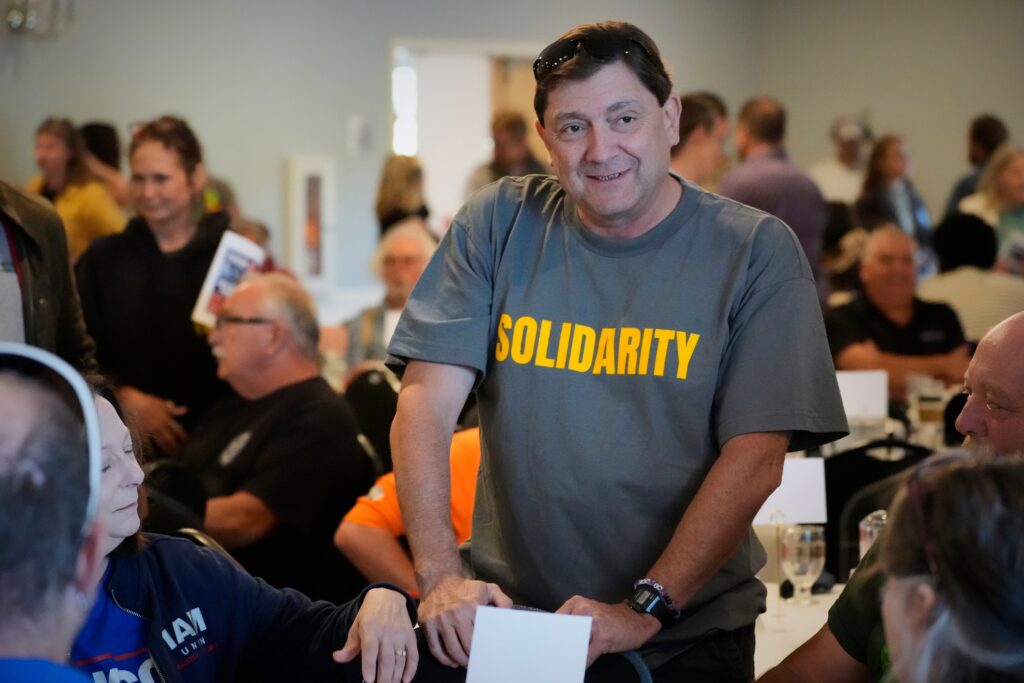
In American politics, candidates often hype their connections to the middle class. Maybe they highlight their upbringing, the job their parents had growing up. Maybe it’s the work they did earlier in their lives.
But what researchers Nicholas Carnes and Noam Lupu found in a recently published paper is that it is notably rare in American politics for any of these candidates to actually be part of the working class.
And that is having a direct impact on the kind of public policy coming out of the nation’s legislative bodies.
“Politicians are people, too,” said Carnes, a political scientist at the Sanford School of Public Policy at Duke University. “And a politician who comes from a working-class job really thinks differently than a politician who was a business owner.”
Carnes said that when a legislative body is mostly white-collar professionals, their priorities “tilt … away from the concerns of working people,” from business regulation to the social safety net.
I’ve seen this in my years covering politics. I often talk to candidates who cast themselves as middle class, despite having careers that have vaulted them well above that economic status. Many of our presidential candidates have cast themselves as fighters for the working class, too, despite having tenuous ties to the group.
Take President Donald Trump. Dating back to his entry into the 2016 campaign, the two-term president has cast himself as a champion for the “the forgotten men and women,” despite being born into immense wealth and privilege. While Joe Biden grew up in a middle class family as the son of a car salesman, he made an over 50-year career out of politics after going to law school.
“Although working-class jobs are essential to our way of life, people from working-class jobs almost never go on to hold elected political office,” Carnes and Lupu write in their paper.
The numbers are stark. The duo found that while 52 percent of United States citizens hold working-class jobs, only 2 percent of state legislators in 2023 and 2 percent of members of Congress in 2019 “held working-class jobs prior to holding public office.” No president in the post-war era has held a working-class job before seeking elected office.
So why is that the case? Lupu said the main barriers are that working-class people often can’t raise money as effectively as white corporate workers and cannot take time off work to mount an unpaid campaign.
“Running for office means that you’re not doing something else that you could be spending your time doing, and often that means not spending your time working at a job that you need to be working to support your family,” said Lupu, a professor of political science at Vanderbilt University.
That’s not the only barrier.
“Working-class people don’t get recruited as a result of all of these things,” Lupu added, partly because those “gatekeepers” who help recruit candidates are not connected to the working class.
I recently covered the race between Republican David Valadao and Democrat Randy Villegas in California’s Central Valley. The Democrat’s working-class roots — he co-owns an auto repair shop and is a political science professor at a local community college — have been central to the race. But Villegas also told me he was by Democratic operatives that this was a barrier when he started running.
“I had lots of people tell me, ‘If you don’t have a hundred people that you can call on Election Day for a thousand dollars, you shouldn’t even run for office,’” he recalled. “And I was like, I definitely do not have that kind of network.”
He also said someone in Washington, D.C., asked him when he was going to quit his job to focus fully on his campaign. “As if that was just easy for people to do,” he said, noting he had bills to pay and couldn’t afford to not work.
“This is why Congress is so out of touch,” he said. “And why their priorities are all out of whack with what people are actually experiencing on the ground. … You have people who are out of touch with those realities and experiences in our district.”
Maine’s Democratic nominee for Senate, Troy Jackson, is another example of a working-class candidate that the researchers wrote about. Jackson was a logger before joining the Maine House of Representatives.
“Examples like these are rare, and because they are so unusual, they often receive outsized attention in our political process, which can make working-class politicians seem more common than they really are,” the researchers wrote.
So how could this issue be fixed?
Lupu said public campaign financing would help, and so would organizations that encourage working-class people to run, much like EMILY’s List backs pro-choice women to seek office. The lengths of our campaigns are also an issue, he said, noting that “Japan has two-week election campaigns and a lot more working-class people.”
But the issue clearly exists, said Carnes, because so many candidates without working-class credentials try to cloak themselves in the working class.
“Especially this cycle, it tells you working-class Americans are really hurting,” he said. “Politicians are picking up on something real. They’re trying to exaggerate their connection to the working class. That’s not an accident. It’s them picking up all the economic anxieties and the precarity the working-class people are experiencing right now.”
Want this in your inbox?
Start your day with The Washington Post’s flagship political newsletter. Sign up here.
Our picks
- Kennedy Center could close as early as Tuesday, warns of bankruptcy, documents show, from Jonathan Edwards and Travis M. Andrews.
- An unusual flurry of court cases creates confusion ahead of midterms, from Julian Mark, Mark Berman and Justin Jouvenal.
- How lasers from space could help solve the world’s energy shortage, from Evan Halper and Layli Nazarova.
- Kansas workers push back against Trump’s call to ban Canadian jet maker, from Ben Binday.
- Trump, Vance open midterm campaign tour as GOP troubles deepen, from Natalie Allison and Isaac Arnsdorf.
- The new threat election officials fear: Trump’s federal government, from Patrick Marley and Laura Meckler.
- Bye, America: Trump’s rhetoric pushes some Canadians to shun the U.S., from Joanna Slater.
What we’re watching
Dario Amodei has sparked a conversation.
The head of Anthropic, one of the nation’s leading artificial intelligence companies, argued in an essay on Saturday that the nation “must slow the pace at which we improve the capabilities of AI models” because of a deep unease about the potential dangers the industry poses.
Other AI leaders, including OpenAI chief executive Sam Altman and SpaceX AI founder Elon Musk, supported Amodei’s warnings, a significant step given the trio are widely seen as bitter rivals.
“Dario is right,” wrote Musk.
Concerns about the rise of artificial intelligence have been at the heart of the midterm elections, from the industry’s vast campaign spending to bipartisan concerns about the proliferation of data centers to how the technology is used to help the federal government and law enforcement.
And these warnings will only heighten those fears. But the politics of this moment could grow even more stark given the president’s hard-line defense of the industry, even as people like Amodei and Musk call for pumping the brakes.
Trump, on the sidelines of the Irish Open golf tournament at his golf course in Ireland, “appeared to dismiss calls from top artificial intelligence leaders to slow the development of AI models,” according to my colleagues Cat Zakrzewski and Violet Jira.
“We’re leading China in AI, we’re the most sophisticated country in the world, and frankly I want to keep it that way,” Trump said. “Whoever wins AI wins.”
This has been Trump’s position for months, despite polls showing widespread concern about the industry. But the divide is even more stark now — and Democrats have jumped on it.
“It’s long past time for our federal government to step up, take this seriously, and put up some guardrails — both here at home and on the global stage,” Pennsylvania Gov. Josh Shapiro (D) wrote on X.
It’s not just Democrats, either. Before Abdul El-Sayed — the progressive Democratic Senate candidate in Michigan — endorsed a proposal from Sen. Bernie Sanders (I-Vermont) to pause AI development, his Republican opponents, former congressman Mike Rogers, backed Amodei’s call.
“Following Dario Amodei’s warning, I believe we must slow down development of AI in order to allow the government and its partners to catch up and put stricter protocols and guardrails in place to protect us from the rapid advancements we’ve seen,” he wrote. “In the Senate, I will make it a top priority to pass the national security framework we need on AI.”
It will be telling to see whether other Republican candidates follow his lead.
In your local paper
Houston Chronicle: Texas Sen. Ted Cruz was ruthlessly booed during an appearance on ESPN’s “College GameDay” on Saturday. He appeared on the show to promote his college sports legislation. But the booing was the news.
Kansas Reflector: It was a big weekend for booing. Kansas Sen. Roger Marshall (R) also got relentlessly booed this weekend during a debate with Rev. Adam Hamilton, his Democratic challenger. These moments went viral and hint at a closer-than-expected race in a state that last elected a Democratic senator in 1932.
Arkansas Advocate: Drone use is still rare on America’s farms. But the practice has been picked up by some of the nation’s largest farming operations, and tariffs on imported drones “could reshape the market for a tool farmers use to inspect, map, and spray crops,” the outlet writes.
From you
I want to thank you all for your reflections on Sept. 11. I received some incredibly personal and touching emails about where you were and how you experienced that dark day.
Stephanie Asalone recalled how she couldn’t reach her father all day but was finally “able to talk with him around 10:00 that night.”
“We cried together, also a major rarity,” she wrote. “I was just grateful I was able to hear his voice, knowing there were other young people who had lost that ability that day with their dads.”
Kay Oshel was working at the Department of Labor at the foot of Capitol Hill.
“When we were sent home that morning, I walked to the Metro scanning the sky for suspicious planes and feeling like I was in a European city during World War II,” wrote Oshel. “It was only when I heard of the downing of the plane in Shanksville, Pennsylvania, that I realized how close we’d come to living that scenario.”
Cate Sullivan was on a 13-day motor coach tour of Canada and remarked on how she was “deeply touched by the kindness and compassion of the Canadians who approached us to offer support and share our grief. The Canadian Government flew their flags at half-mast from day one.”
Antonio J. Ramos was working at a NATO agency based in Luxembourg at the time and recalled how “even today I still have some difficulties understanding what happened and why.”
“Based on the political and social polarization our Nation faces today, I wish we could come back together as a Nation like we did 25 years ago. If anything comes out of the commemoration of the 25th anniversary of 9-1-1, I hope is a sense of unity we have not seen or felt for a long time. A person can always dream,” Ramos wrote.
Scott Leventhal recalled being in New York City and sitting in his office at 26th Street and Park Avenue South when a colleague told him “that a plane had hit one of the towers.”
“We rushed to the street below, watching the burning building downtown. Then, the unspeakable occurred, and I witnessed something I’ll never forget. A second plane hit the South Tower, which erupted in a ball of fire,” he wrote. “It’s indelibly etched in my mind, something I’ll never be able to erase.”
Send a reply
I have asked before about your fears about AI. So I am not going to do that again. But I do want to ask how you use AI in your everyday life. Is there a particular use that you find helpful? Does that use overcome your concerns? Let me and your fellow Early Brief readers know at [email protected].
Thanks for reading. You can follow me on X at @merica.
The post Working-class Americans aren’t running for office. It’s changing our politics. appeared first on Washington Post.