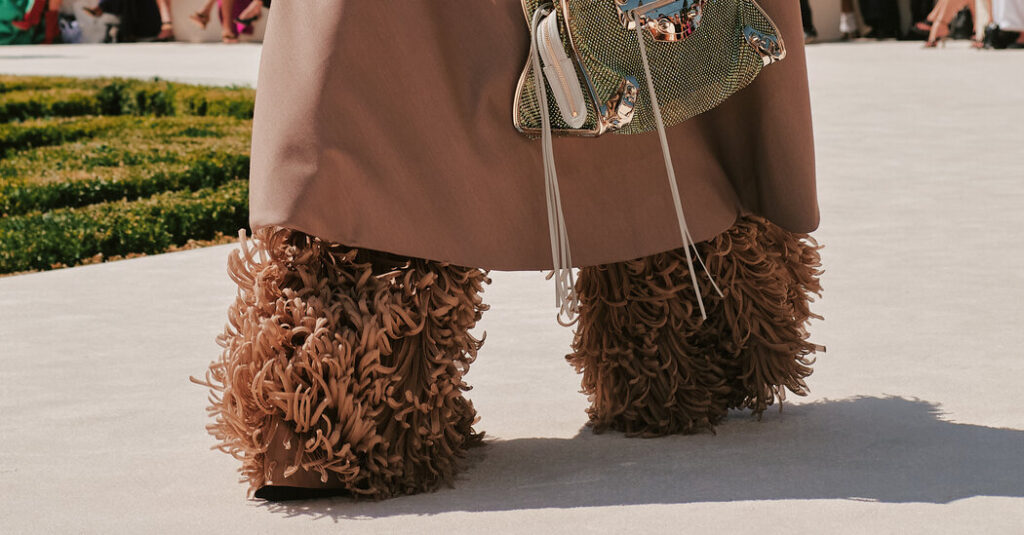
I love a big jacket as much as the next woman, but lately almost everything except workout wear (and even some of that, too) seems oversize. It is almost impossible to find a shirt, sweater or jacket that is not wide enough for several people. What is going on, and how do I manage it? — Diane, New York City
Oversize clothing has been a fashion trope, rather than a trend, since at least the 1920s, when the flappers first loosed their stays and dropped their waists. (Everything is relative, after all, in clothes, as in life.) Since then, oversize fashion has waxed and waned in popularity, and it is currently, as you have observed, having something of a renaissance.
According to Lyst, a fashion search engine, demand for oversize silhouettes was up 12 percent between 2025 and 2026. Fortune Business Insights reports that the oversize apparel market is projected to be worth $136.74 billion in 2026. And even if oversize has reached a peak and may be about to deflate, it’s not going away entirely. (To wit: Fortune projects that the market will grow to $221.22 billion by 2034.)
As to why … well, all that fabric is full of history and associations. It was an assertion of cultural identity and arrival for the pioneers of hip-hop and rap, of subversive rebellion for the acolytes of grunge, and of challenging old style shibboleths and gender stereotypes for high fashion’s deconstructionists like Comme des Garçons and Martin Margiela.
It was a uniform for Tupac Shakur, 50 Cent and David Byrne — and made red carpet history in 1990 when Julia Roberts showed up at the Golden Globes in a slouchy Armani men’s suit. It can be challenging, insistent and protective. It allows you to both occupy space and disappear.
Not to mention it’s also pretty comfortable.
The current revival of oversize has something to do with the coronavirus pandemic, which got everyone accustomed to clothing that didn’t pinch, bind or otherwise constrict; something to do with the revival of all things 1990s and a nostalgia for a time before social media and artificial intelligence; and something to do with a general sense of being besieged by current events. (Oversize can be the wearable equivalent of disappearing under a blanket.)
And it has been driven by the success of brands like Balenciaga, which played a big role in restarting the whole phenomenon during the Demna period; the Row; and Phoebe Philo.
Philo, one of fashion’s lodestars and a woman of ineffable cool, has long been the poster girl for oversize clothing, favoring mega-pants and enveloping shirts and sweaters in her life and her collection. Her namesake brand, which debuted in 2023, has yet to appear on a runway, but its trickle-down effect is impossible to deny.
As Harper’s Bazaar pointed out this year, “These silhouettes she’s cultivated — the oversize funnel-neck jackets, the perfectly slouched trousers — are now everywhere.”
All that said, going big is not as simple as throwing on a giant suit and walking out the door. Proportion matters when it comes to oversize and can make the difference between looking like a girl who raids her mother’s closet and looking like someone out to effectively navigate the world.
Fernando Garcia and Laura Kim, the co-founders of Monse, who designed the (yes) gigantic palazzo sweatpants that Naomi Osaka wore to her third-round match at the U.S. Open this year, said that balance was crucial to making oversize seem modern.
“If you have very wide pants, opt for a narrower top,” Kim said. Or try tailored trousers that puddle at the ankle with a voluminous top, rather than leggings or skinny jeans, which have an overly retro vibe.
It’s not just about big and small, however. It’s also about navigating clichés of masculinity and femininity. The designer Joseph Altuzarra likes the contrast between “an oversize blazer that looks like your husband or boyfriend’s thing and a little slip dress or skirt,” he said.
Finally, Stuart Vevers of Coach, who included lots of oversize suiting in his recent New York Fashion Week show (inspired by his memories of the city in the ’90s) said that updating an oversize look could be as simple as paying attention to accessories.
“You need some sharpness,” he said, even if it’s merely in the form of well-polished leather shoes and a streamlined bag. He also pointed out that fabric matters. The bigger the garment, he said, the lighter the material should be. (Think jersey and washed silk.)
That way, even if it seems substantive, it won’t weigh you down.
Your Style Questions, Answered
Every week Vanessa will answer a reader’s fashion-related question, which you can send to her anytime via email or X. Questions are edited and condensed.
The post Why Is Everything So Oversize? appeared first on New York Times.