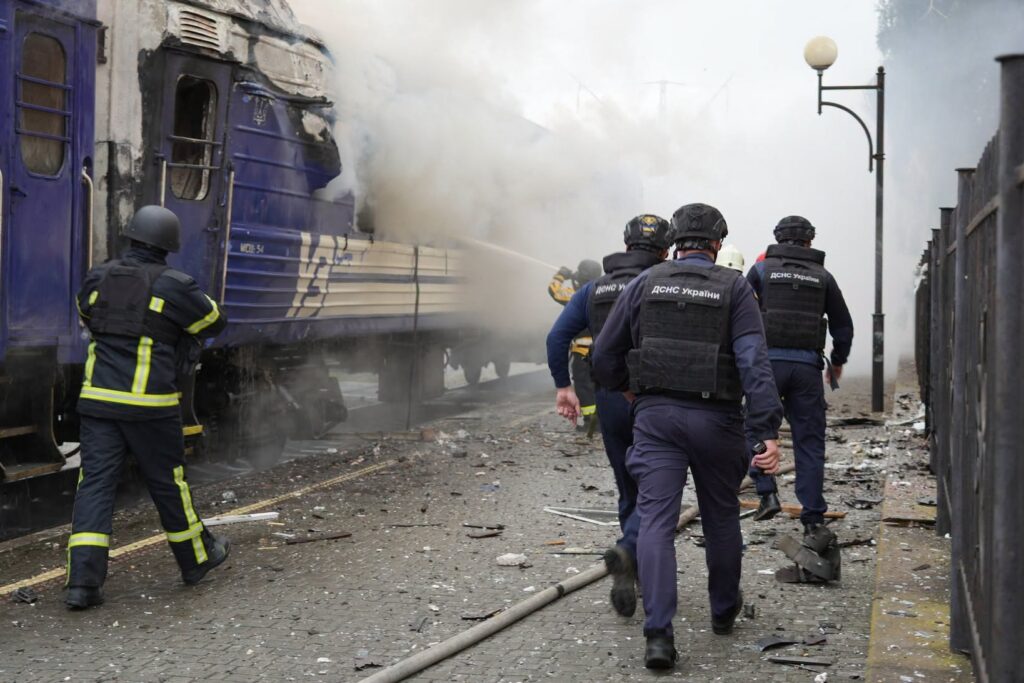
YAHODYN, Ukraine — We thought the danger had largely passed.
As our train traveled west from Kyiv to the Polish border, we’d already been evacuated twice. Word had spread among the passengers that the explosion we’d heard two hours earlier had hit a nearby gas station. The pattern had become familiar among Ukrainians living under escalating Russian bombardment: They attacked infrastructure but not the train itself.
We were wrong. We dismounted for the third time around 6 a.m. Saturday. Antiaircraft fire drew passengers’ gaze skyward, and some began to cry out the Ukrainian word for missile: “Raketa!”
It was, in fact, a drone: Long, sleek and white, with four fins and a rear-mounted engine, whistling in low like a small jet. It hit sufficiently close that the flash and the sound and the ear-pounding concussion arrived simultaneously.
Passengers scrambled for the tree line as smoke rose over the small train station. One small child ran out the front door of a nearby house, only to be scooped up by his mother, who ran back inside and slammed the door. Train staff urged passengers to keep moving away from the tracks toward a lake nearby, where they said it would be safer.
Two nights earlier, the dignitaries at one table at the InterContinental Kyiv hotel bar, visiting the Ukrainian capital for the annual Yalta European Strategy (YES) conference, discussed how they planned to leave the country. I had attended the conference with David Petraeus, a former general and CIA director.
After a day punctuated by air raid alarms and explosions, one suggested that the Kyiv-Warsaw rail link might become a target of Russian President Vladimir Putin’s escalating aerial terror campaign.
“I think that would be deeply counterproductive to Russia’s aims,” former British prime minister Boris Johnson said.
The following evening, Glenn Corn and I sat in the back seat of a police car leading Petraeus’s motorcade to Kyiv’s central railway station. Corn, a former CIA station chief who speaks Russian, had just received a message from Ukrainian intelligence. “It’s going to be a loud night in Kyiv.”
Eight hours later we arrived at Yahodyn station, the border control point for trains departing Ukraine. At 3:30 a.m., with Ukrainian customs still in possession of our documents, a train attendant hurried through our carriage announcing something in Ukrainian. “Evacuate,” Corn translated.
In an open field, Ukrainian women and children gestured at a set of liquefied natural gas tank cars. Some laughed nervously.
We were invited to reboard, but the train remained stationary. Word spread that Poland had closed the border with Ukraine.
I texted a person in Ukrainian intelligence for an update. “There are drones in the air all over western Ukraine,” he replied.
An hour later we were ordered into the field again. As we dismounted, an explosion from somewhere ahead of us spurred commuters into a hurried run. It was the gas station, hit by a drone less than a mile from Polish territory.
A railway employee confirmed the LNG tankers were, indeed, fully loaded. Fifteen minutes later we returned to our berths, but the train still didn’t move.
It was daybreak by the time the third order came. Ralph Goff, a former chief of European operations for the CIA traveling with Petraeus, identified the incoming weapon as a Russian Geran-5, a new jet-powered drone that Ukrainian air defense cannot intercept without American Patriot missiles. It scored a direct hit on the locomotive of the passenger train alongside Petraeus’s carriage.
Petraeus said the attack was intended to prevent Ukraine from securing diplomatic support for the war.
“This is definitely an escalation,” he said. “The timing after the YES conference is clearly intended to discourage foreign officials from traveling to Kyiv in the future.
“I think next time we will take cars.”
The post When drones targeted our train journey out of Ukraine appeared first on Washington Post.