At some of Texas’ biggest public universities, students could once take courses in women’s studies or climate change to check off graduation requirements. Classes about ethnic studies and literature’s monsters were in the mix, too.
Not anymore.
The range of courses that college students can take to meet general education requirements is narrowing in states that lean rightward, reshaped by ideological warfare over what higher education’s values should be and what students actually need to know.
Core classes are meant to nudge students beyond the bubbles of their chosen majors and leave them more well-rounded. But the question of which courses qualify as core has prompted fierce jockeying among politicians, college presidents and professors, especially in Republican-controlled states where many conservatives are suspicious of academia.
How the clashes over which courses to count are resolved will shape undergraduate experiences for years to come.
Texas is seeing hundreds of courses stripped of their designations as classes that fulfill general education requirements. And in Florida, public universities are no longer allowing introductory sociology courses to satisfy core requirements.
Courses that are not included in core curriculums are often less appealing to students, and professors fret that plunging demand could cause their disciplines to shrivel and imperil their jobs. Sometimes, they say, the process seems more about politics than pedagogy.
“Whatever they say about it, it’s clear that this is indoctrination,” said Andrew Dessler, a Texas A&M University atmospheric sciences professor who has taught a climate change course that regents recently voted to remove from the core curriculum. “That’s the key word. There are things that they don’t want people to learn, and they’re doing whatever they can to stop people from learning them.”
Some supporters of core changes counter that they are editing out classes with left-leaning concepts they see as their own brand of indoctrination. They argue that core curriculums have become too broad and should be tailored to meet the needs of specific places and eras, preparing students for the work force and making their degrees more valuable.
James E. Davis, the president of the University of Texas at Austin, recounted to regents what he had told a committee reviewing the core on his campus: “We are going to produce 100,000 citizens over the next 10 years. What do you want them to know?”
An old idea meets modern conflict
The debates of societies and their scholars over the essence of education are ancient: Plato, after all, articulated his ideas for curriculum.
But the modern era of general education took root at Columbia University, which debuted a core with one course — “Contemporary Civilization” — in 1919. The idea took off at other schools. By the early 1960s, according to a contemporary article in the Journal of General Education, there were endemic disagreements about “quantity, quality, formulation and administration.”
Those clashes generally played out inside academia. Now political wrangling is commonplace.
In 2020, Democrats wrote a law that led the California State University system to include an ethnic studies course as a graduation requirement, arguing that it would prepare students to live in a multicultural society.
Since then, Republicans have been driving change. In 2023, a Florida law to overhaul the core described the types of topics that should be included, like the “historical background and philosophical foundation of Western civilization,” and which ones should not, such as “theories that systemic racism, sexism, oppression and privilege are inherent in the institutions of the United States.”
In some states, politicians have sought to add specific subjects to core curriculums. Ohio officials approved a law last year banning universities from granting bachelor’s degrees to people who have not finished a course on “American civic literacy,” with mandatory readings of the Constitution, the works of Adam Smith and the Rev. Dr. Martin Luther King Jr.’s 1963 open letter from a jail in Birmingham, Ala.
‘Back to basics’ in Texas
Today, Texas is the biggest battleground.
A law passed last year says that core courses should, among other conditions, be “foundational and fundamental to a sound postsecondary education.” One goal, it said, was to equip students for the work force.
A Republican state senator pushed the measure and soon after became the chancellor of the Texas Tech University System, where administrators have used artificial intelligence to scrub the curriculum.
The law is now the backdrop for scrambling statewide.
At the University of Texas at Austin, a task force recently proposed a core curriculum of 36 credit hours, down from 42, that would require students to take classes covering matters like “Great Questions of Human Life,” Western civilization and “Great Ideas in Science.”
Although campus officials are still ironing out details, Kevin P. Eltife, a Republican former state senator who chairs the university system’s board, declared that the blueprint was “what this board has been asking for for quite a long time: to get back to basics.”
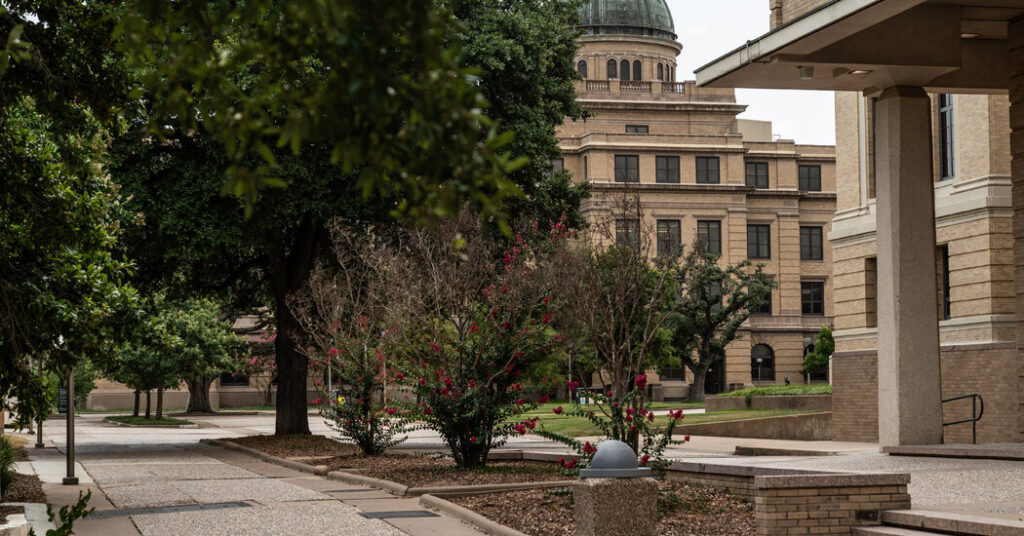
Texas A&M system regents recently decertified 350 course entries as core compliant, including ones about Black people in the United States, Texas literature, crime and gender studies.
“Not every worthwhile course has to be a core course,” Robert L. Albritton, the system board’s chairman, said in a statement. “The core is the foundation every undergraduate carries into a degree. It should be focused, rigorous and worth the time and tuition students invest.”
Dr. Dessler, the climate change expert, said that students should understand how a warming planet stood to affect so many aspects of modern life.
“It’s a big deal in the world, and that’s exactly what college should be teaching people about,” he said.
The University of Houston has also been whittling its core. Before recent changes, some tied to low enrollments and other factors unrelated to the new state law, 280 courses at Houston’s main campus could be used to fulfill a core requirement.
Now that number will be 147.
Although classes on subjects like women’s or L.G.B.T. studies are no longer considered general education offerings, the core still includes topics many conservatives consider anathema, like sociology and histories of certain races and ethnicities.
But María C. González, an English professor who sat on the committee that reviewed Houston’s core behind closed doors, said in an interview that political considerations had lurked during deliberations.
People would make references like “the current atmosphere we’re dealing with,” she said, and they worried about how courses could “call attention to us being a woke university.”
Appearing before regents in August, Dr. González said her committee was being “used to whitewash” an overhaul she thought would leave academic power concentrated with administrators who would carry out elected officials’ wishes.
“Our leadership bends to the whims of politics,” said Dr. González, who has accused Houston of backtracking on its pledge for a meaningful appeals process.
In a statement, a spokesman for Houston, DJ Sprenger, did not directly address Dr. González’s account. But he said this year’s review had “centered on academic purpose, focusing on what is truly foundational to delivering the knowledge, intellectual skills and critical thinking expected of every graduate.”
Dr. González acknowledged that different universities may want to prioritize different topics. The core she navigated as an undergraduate at a Catholic university was loaded with theology, language, philosophy and history — not always subjects deemed essential at public institutions.
“All of us are probably going to disagree about what should be foundational knowledge,” she said. “But we should come together, have a discussion and figure it out together.”
In a memo in August, Houston’s provost, Diane Z. Chase, said that any courses removed from the core curriculum would still be offered. And she noted a state board’s recommendations could lead to more debate.
“If approved by the Legislature,” Dr. Chase wrote, “all universities will undergo another revision of their core curriculum next summer.”
The post What Should Be Essential Learning at College? It’s Getting More Political. appeared first on New York Times.