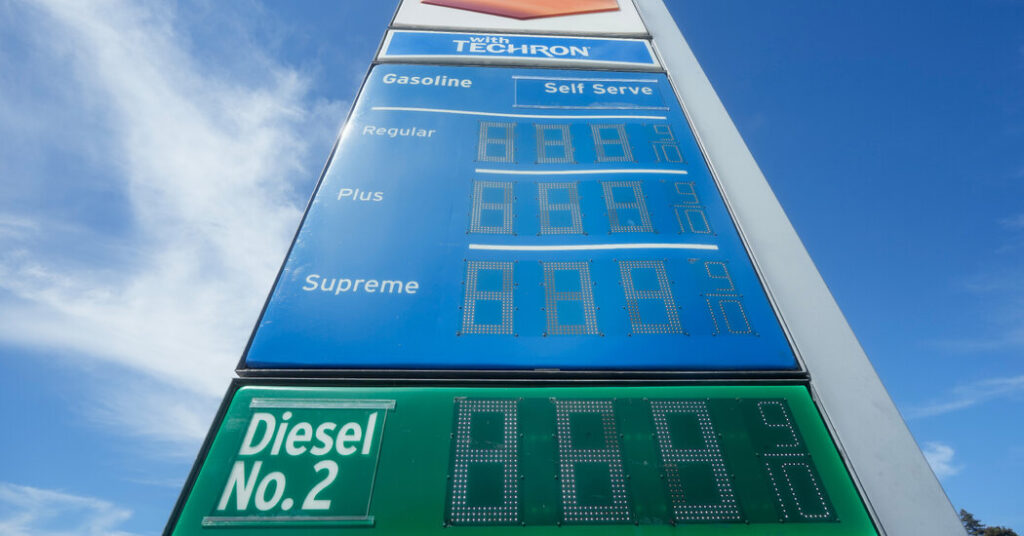
President Trump recently blamed surging diesel prices on Ukrainian attacks on Russian refineries. But energy experts say that while he is partly right, the war in Iran has been a more important driver of energy prices.
The average price of a gallon of diesel in the United States has been setting records in recent days, topping $6 a gallon on Friday and climbing to $6.23 by Monday morning, up about 65 percent since the United States and Israel attacked Iran on Feb. 28.
The national average price for a gallon of regular gasoline, $4.31 on Monday, has also risen sharply since the start of the Iran war, by about 45 percent. And the global price of oil, the raw material for diesel, gasoline and other fuels, is up roughly 50 percent.
“We have basically two wars involving two of the world’s largest energy producers,” said Helima Croft, an energy analyst at RBC Capital Markets. “The Middle East is the most prolific energy production zone, and then you add Russia into this,” she said.
Mr. Trump and his aides have recently sought to focus attention on Ukraine’s strikes on refineries in Russia, and away from the war in Iran. And, indeed, the Ukrainian strikes, which are meant to deprive Russia of revenue it needs to finance its war, have had some impact by forcing the Kremlin to suspend exports of diesel and other fuels to the rest of the world.
“The World’s Diesel price rise is mostly caused by the Russia/Ukraine War, not Iran,” the president wrote on his social media site on Monday.
But even Russian officials have recently acknowledged that those refinery attacks are not the central driver of higher fuel prices.
A Kremlin spokesman, Dmitri S. Peskov, said in a conference call with reporters on Monday that Russia’s oil markets were “deteriorating rapidly, mainly due to instability and further rounds of escalation in the Persian Gulf region.”
In the same call, Mr. Peskov welcomed Mr. Trump’s Sunday statement and called on Ukraine to end its refinery strikes.
Later on Monday, Mr. Trump said that Russia and Ukraine had agreed to suspend strikes on each other’s energy infrastructure. However, there was no confirmation from Ukraine that such an agreement had been reached. In a statement, President Volodymyr Zelensky of Ukraine put the ball in Russia’s court.
“If our partners are ready to ensure that Russia genuinely refrains from striking our electricity system, other energy facilities, critical infrastructure and food supply routes, then, of course, we are ready to ensure a corresponding halt to our strikes,” he said.
Diesel supply from Russia and the Middle East has effectively collapsed, analysts say. Russian exports of the fuel have fallen by around 90 percent compared with the beginning of the year and Middle Eastern diesel exports are down around 75 percent, according to Pickering Energy Partners, a Houston-based investment firm.
On Friday, Saudi Arabia announced that it had shutdown a critical pipeline that it had been using to move oil from the Persian Gulf to the Red Sea as a precaution against attacks on the country by the Houthi militia. Saudi Arabia had to rely on the pipeline because Iran has effectively closed the Strait of Hormuz, a narrow passage way linking the Persian Gulf to the Indian Ocean.
Daniel Evans, the global head of fuels and refining research at S&P Global Energy, said the Iran and Russia-Ukraine conflicts and China’s suspension of oil and diesel exports left no slack in the global refinery system. It is not clear when conditions would improve, he added.
“One of the unknowns is how badly damaged some of these refineries are in Russia,” he said. “If the attacks stop today, it’s still not clear how quickly the supply can come back online.”
The jump in diesel prices could have a significant economic impact because the fuel is widely used by tucks, buses and agricultural equipment. Farmers are expected to be hit hard by the sharp rise in prices because many of them use a lot of diesel in the late summer and fall for harvesting, processing and transportation.
Milana Mazaeva and Cassandra Vinograd contributed reporting.
The post What Is Driving Diesel Prices Up? Energy Chaos Caused by Two Wars. appeared first on New York Times.