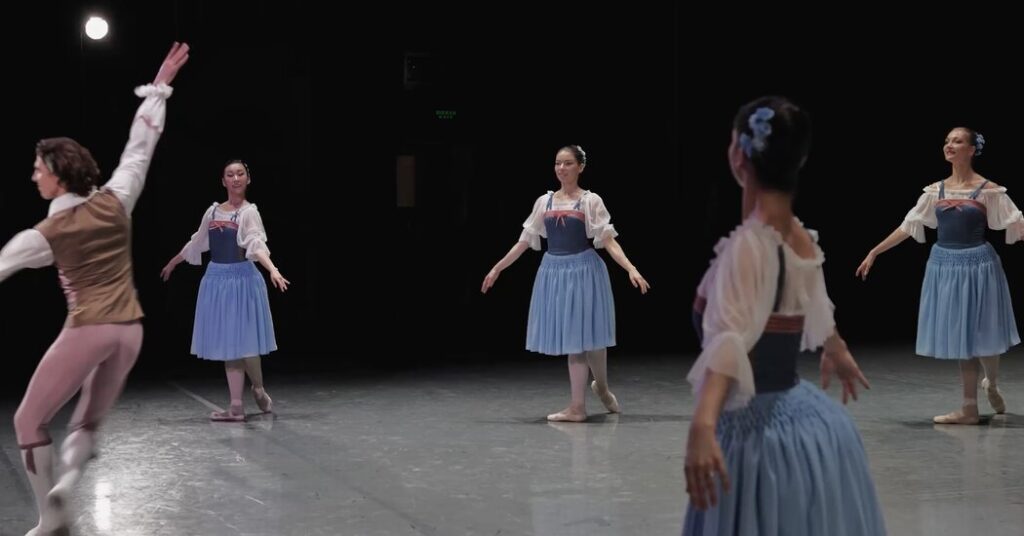
The eminent ballet choreographer Alexei Ratmansky has been a vocal supporter of the Ukrainian cause since the Russian invasion in 2022. He has made two dances that deal directly with the horrors of war, “Wartime Elegies” and “Solitude.”
Both he and his wife, Tatiana, spent the early years of their careers in Kyiv, dancing for the national ballet company at the Kyiv Opera House, and both have family in and around the city. But until this August, neither had been back since the war began.
Ratmansky, who is artist in residence at New York City Ballet, and who was the director of the Bolshoi Ballet in Moscow for five years, has often wanted to go to Kyiv, he said in a recent video interview from their hotel in central Kyiv. It never felt like the right time. But their desire to work with the dancers of the national ballet company won out over fear.
The Ratmanskys’ arrival coincided with one of the worst periods of the war, a time of constant attacks on the capital that sent them and others scurrying to bomb shelters multiple times a day. “It is difficult in every sense,” Tatiana said, “mental, physical.”
“People say it has never been this bad,” Alexei said.
The immediate reason for their return was to stage a work by the great 20th-century choreographer George Balanchine, whose ballets are in the repertory of top companies around the world. Now the National Ballet of Ukraine, too, will have a Balanchine ballet, “Donizetti Variations,” a lighthearted work packed with witty steps danced at high velocity.
“It’s exhausting and really difficult,” the dancer Mykyta Sukhorukov said in an interview, “but he understands that the theater needs this kind of repertory.”
Conditions at the company, as in the rest of the city, are hard. The troupe is down to 95 dancers from 176 before the war. Many have left to dance abroad. Twice-yearly the male dancers must sign papers exempting them from military service. These days performances are often interrupted by alarms warning of incoming fire.
On those occasions the performers, crew and audience — kept to no more than 600 in a theater with capacity for 1,300 — head to a shelter underground. But during the day dancers often stay put during alarms. “Otherwise,” Sukhorukov said, “we’d have to live in the shelter.”
A few days before the Sept. 10 premiere of “Donizetti,” the Ratmanskys sat down for a WhatsApp interview from their hotel. The interview was interrupted twice by sirens. Distant explosions were audible. What follows are edited excerpts from that conversation.
How did you get to Kyiv?
Alexei There is a train from Vienna to Kyiv. Actually, it’s just two cars attached to another train. But in Vienna, the train never arrived, so we took a different train to Budapest and then got on the car going to Kyiv. There was this big group of Ukrainians running from one track to the other, up and down the stairs with their suitcases.
What did it feel like to realize you were finally in Ukraine again?
Alexei You feel at home — there’s an ease to it, you understand it. But then you realize: this is not a fairy tale. It’s real. People are dying every day. We hear explosions around us.
How often do the alerts come?
Tatiana One night we tried to go to the shelter each time we received an alert. You get up, dress, go to the shelter, come back, undress, go to bed, and then do it all over again, many times a night. So we stopped doing it.
But when it’s quiet for too long, it’s also scary, because you feel like the Russians must be preparing something. It’s like the myth of the Minotaur. Every night, it has to take someone. Except it’s real. In the morning you hear the news: 2 people killed, 17 people killed, 38. It’s like that every night and every day.——
What is the feeling like in the city? How does it look?
Alexei Beautiful, I have to say. There are people in the streets. The cafes, restaurants, and stores are open. The arts are flourishing. Everyone is so caring, so alive, so warm. People are taking care of each other.
What is the atmosphere at the theater?
Alexei Everyone does their job. There is a feeling of normalcy. For example: In addition to setting Balanchine’s “Donizetti Variations,” I’ve been teaching morning ballet class every day. After that first sleepless night, when we kept going back and forth to the shelter — I don’t think anyone in Kyiv slept that night — I had a class to teach at 10 a.m. I came in, not sure what I would find. Would anyone be there? But when I got there the whole class was there, waiting. They greeted us, smiling. That made me cry.
Some of them live across the river; the metro doesn’t run, or they close the bridges. One of the pianists told me she has to travel two hours to get to the theater on time. And there she is, every day, on time. No matter what happened the night before, the next morning people go and do their job, quietly.
[A phone alert sounded, followed by an air raid siren and an announcement on the hotel’s P.A. system. The conversation resumed after a few minutes.]
What sorts of conversations have you had with people at the theater?
Tatiana Mostly we talk about the war — how they hide, how they survive, how they feel about it. Not so much about art. And about how many dancers have left.
What have the rehearsals been like?
Alexei We had some very intense days of rehearsal and then everyone was exhausted. Tatiana said “Why should we make them work this hard? They don’t need that right now.” I mentioned that to a couple of people at the theater, and they pushed back, saying “you can’t imagine how much we need this. To have a project, a production, a premiere to look forward to.” That was very inspiring to hear. They all come and do their jobs, not just at the theater but everywhere.
How is the company functioning? Is it still touring?
Alexei They tour quite a lot. They just got back from Japan, and soon they’ll be going to Dubai. And they still have regular performances. They’ve been performing “Wartime Elegies.”
In the last week, one of the performances was interrupted for 15 minutes while everyone went to the shelter. A performance of “Giselle” had to be canceled.
[Another siren, then the distant sound of an explosion.]
Why did you decide on “Donizetti Variations”?
Alexei I felt that they should have a Balanchine ballet in their repertory. When I went to the Balanchine Trust, I asked for a ballet that didn’t have a huge cast, not too long. And it had to be uplifting. And of course, no Russian music.
The company is trained in a more classical style. How have they adapted to the speed and spikiness of Balanchine?
Alexei I teach class every day, so I can explain things. I want to use every second while I’m here. It’s such a different way of dancing — it takes time. This intensity within each choreographic phrase is new to them. But their stamina is improving.
How do people in the theater react when there are sirens?
Tatiana Most of them don’t run to the shelter. One ballet mistress, a former star of the company, said during an alarm, “I’ll stay. I don’t have much left to live anyway.” And a coach told us that at home, when he hears an alarm, he turns the music up louder so he doesn’t hear it.
I went to have my hair dyed, and right in the middle of it the siren went off, and I said, “What should I do?” And the hairdresser said, “Nothing, it’s nothing special.” I kept falling asleep in the chair, and I could see he was exhausted too. He said he had spent the night cleaning his apartment because the alarm kept going off. And then he washed the staircase of his building, just to keep busy.
Do you think you’ll return?
Alexei I would. The city, the country, keeps functioning, because of this amazing strength people have. They pull themselves together and just do things. It’s the people, the national character. I think it’s a miracle.
The post Staging a Ballet in Kyiv, Between Trips to the Bomb Shelter appeared first on New York Times.