When Taryn Simon got the call that the baby was coming, she loaded two large-format cameras and strobe lights into her car and sped the five hours from her home in Manhattan to a hospital in Exeter, N.H. To get the photo she envisioned, she had called around to the obstetricians affiliated with the hospital until she found one who put her in touch with her pregnant patients. Eventually, Simon spoke to a couple willing to have a photographer present at their baby’s birth. She arrived just as the head was crowning and had only a few minutes to set up her equipment and position herself inches away from the laboring woman’s open legs.
The journey that led her to this hospital room was complicated. For years, Simon, a photographer whose practice stands at the intersection of journalism and conceptual art, had been working on a project about the life of a single retired F.B.I. agent. She encountered his name by happenstance in 2017, and since then had been in an ongoing conversation with him, trying to understand everything she could about his career.
As it turned out, his work had touched many catastrophes of American life — the 1996 crash of TWA Flight 800, for example, which the agent helped to inspect, or the attack on the Pentagon on 9/11, when the agent was in charge of sifting debris in the immediate aftermath — and also lesser-known events, historical footnotes that were nonetheless telling. What interested Simon were not just the events themselves, but also their reverberations, far beyond any immediate blast radius. What happened, for instance, to the physical ruins from the TWA crash? What became of the woman who tried to take a photograph of the smoldering Pentagon, whose film the F.B.I. agent had confiscated? Or to the Iraqi diplomat who ran the country’s U.S. embassy during the Persian Gulf war, whom the agent had monitored? Or to the child of a couple accused of being Russian spies, whose house the agent had raided?
She hoped to make an artwork out of the pursuit of these questions, and like many of the projects Simon had done in her career, this would require applying her imagination to a hyper-rigorous investigative process. She followed dozens of story lines connected to the agent’s work and found people who had been affected by shootings, spying, political back-stabbing and surveillance — directly or indirectly, suffering or benefiting. She would then research the details of their lives, and it was often one of those details that led her to the photographs she would eventually make: in kitchens, in weapons depots, on mountains, in forests, in summer camps, in med spas, in people’s homes; in Kenya, Russia, Israel, Greece and all over the United States.
The project became huge and fractal: biography as butterfly effect. On one level it was the story of one man’s life; on another it was a wild alternative history of the American security state, and the thousands of people, institutions, animals and objects caught in its net.
The images she spent years chasing down have culminated in a monumental, highly unusual show called “Father Country I Do Love You,” which opens at the Guggenheim Museum in New York on Sept. 18. The exhibition “sets several records,” Nat Trotman, a curator at the museum, told me. It’s the first time that any artist has had the “ambition or opportunity” to fill the entire rotunda with new works. It’s also the first time that the museum has given that space over to a photographer. The sheer volume of the work — more than 1,000 photographs, along with video, sculpture and text pieces — and the intricacy of its detail are hard to fathom.
When Simon began to conceptualize how to present the project to a viewer, she decided she would start at the very beginning, with the F.B.I. agent’s birth, which she needed to find a way to capture visually. Her philosophical commitment to authenticity borders on the obsessive, and she felt that whatever picture she made had to be taken in circumstances that were as close to the agent’s own birth as possible. This is what brought her to the hospital in Exeter: It was where he was born, nearly 70 years ago.
“It was so stressful,” she told me, recalling that day. She had only so much time to get it right. We were standing in a Brooklyn warehouse, weeks away from the show’s opening, looking at the photograph that resulted from her efforts. The image is big, about 5 feet by 6 feet, and weirdly alluring — a shocking photograph of something perfectly natural. The frame is mostly filled with a woman’s inner thighs, the soft black mass of the baby’s head slicked with blood and tissue emerging from between them, enclosed in the perfect circle of her open vagina. In the top third of the frame, a hand holds a Doppler wand over the woman’s belly, its nails painted a jaunty orange. Implicit in the image is Simon’s determination, her skill at persuasion and the precision of her eye, which can trap so much glinting detail in one shot.
That day, the photograph was being readied for shipping to the Guggenheim, where it was to be installed at the top of the first ramp in the building’s spiraling rotunda — a provocative welcome sign for an exhibition that is itself a semi-miraculous act of labor: one continuous narrative made up of 42 chapters encompassing Simon’s telling of the agent’s career and the many lives it touched.
Soon, Simon would transform nearly every surface of the Guggenheim building — covering some of its curving walls with latticed teak, painting others in brilliant colors, relighting every alcove, hanging swaths of felt curtains and building what she calls “protrusions” to bring the artworks closer to viewers instead of recessed in the building’s curved bays.
What it all amounted to was still coalescing for Simon. But the show’s uncontainableness arises from her earnest attempt to give visual form to the branching, contradictory, often unbelievable facts of American life. Simon began the project as Donald Trump first took office, and it has spanned the years when the country’s unifying ideals have devolved into paranoid conspiracy. It’s as if she is trying to grab onto a fracturing shared reality, rearranging its pieces into some new shape in which we might again recognize ourselves. What she discovered is both familiar and utterly strange. It’s a Great American Novel in visual form — and yet it’s true.
One morning in June, I met Simon in Washington Square Park, where she walks every day, sometimes for up to eight hours straight, to sort out her thoughts and have phone meetings. She greeted me warmly and pointed out a tree she loves, a huge, bountiful oak with a knob in its trunk. “It looks pregnant,” she said. We started circling the park, passing Simon’s friend Marty, a chess teacher and “philosopher of the highest order” who is stationed at the park’s stone game tables each day. She pointed out the corner where the police had recently massed, raiding the park to kick out loiterers in what she considered an absurd show of force.
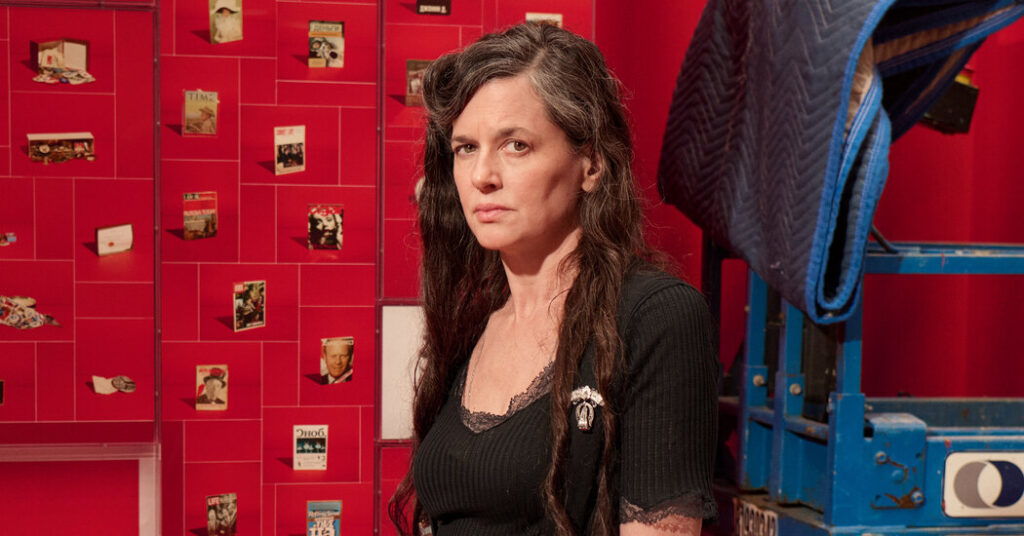
At 51, Simon is a petite, elegant, engaging person whose tenacious will and dissecting eye quickly reveal themselves. We stopped to inspect the carcasses of rats whose trampled bodies nearly blended into the pavement. She’d been photographing these remnants for years, vanquishing her fear in order to get up close to them. She took out her phone to show me some examples, in a folder called simply “Rats.” There were fresher, plumper ones with their guts spilling out, others that looked like shadows edged with fur. “I feel bad for them,” she said, “because they’re thought of as disgusting.” Some of these images would find their way into the museum.
As we kept circling, Simon told me the origin story of “Father Country I Do Love You.” It was 2017, and she was looking at files related to a major federal case from the ’90s, searching for details that might be seeds of a project. She found the F.B.I. agent’s name on an evidence receipt from the investigation.
At that time, Simon had been thinking about the idea of middlemen. People who “have power, according to the badge, the agency, the position. But you’re still only getting a fraction of the total picture.” There was something fascinating to her about a person who participates in events — sometimes violent, world-altering ones — but is incidental to them, and therefore has only a partial view. When she found the agent’s name, she had some vague intuition that he might be one of these figures who is “invisible, disposable, but essential,” a person through whom the currents of history run.
She approached him the way she has hundreds of other potential subjects throughout her career, with a call from a project producer explaining that Simon is an artist who would like to interview them. Most people are intrigued, she has found, or at least willing to have an initial conversation. At first, she and the agent texted. Then they began meeting — at restaurants along the side of a highway, in church parking lots. He was feeling her out, she assumed, trying to see if he could trust her.
As she got to know him better, she found him unassuming, frank, patriotic, largely without ego. His career, it turned out, was fascinating. He told her he had a minor role in the sting operation that resulted in the arrest of Marion Barry, the mayor of Washington. He was sent to Nairobi after the bombing of the American Embassy there. He was part of the manhunt for the Washington snipers — a 17-year-old under the influence of a guru father figure — who were convicted of murdering 10 people. He went to Saudi Arabia to investigate the beheading of an American citizen. The list went on and on. This was quite typical, she learned. Many F.B.I. agents touch this much horror.
For a few years, she and the agent met and texted, and he told her more of his stories, perhaps trying to make sense of them himself. Eventually, he agreed to show her his files. It was a huge, tantalizing pile. “I like to think of these files as having so many voices,” Simon told me. “So many histories. And it’s all boxed up in these things! These things have so much in them, if you ever bother to look.”
Simon’s whole career has been about bothering to look. She’s driven by a forensic curiosity, attempting to render the large, complex, often unseen systems that govern world affairs in a way that’s intelligible to an average viewer. She has a singular ability to persuade institutions that are off limits to the public to allow her inside to catalog their contents, revealing, as the Whitney Museum curator Elisabeth Sussman and the art historian Tina Kukielski wrote, “the divide between the privileged access of the few and the limited access of the public.”
In “American Index of the Hidden and Unfamiliar,” which she completed in 2007 and was another yearslong project, Simon made pictures of secret places around the country — a nuclear-waste storage facility operated by the U.S. Department of Energy, or a cage within a cage on death row where a man was imprisoned, or the headquarters of the gun manufacturer Smith & Wesson — with bright, reverent clarity, pairing them with captions that were data-rich and dry. The effect was mesmerizing: an encyclopedia of wonders that also hinted at the underground forces shaping the distribution of power and danger across our society.
For another project, “Contraband” (2010), she embedded with U.S. Customs and Border Protection at Kennedy Airport for five straight days photographing more than a thousand confiscated items, including alcohol, a goatskin drum, counterfeit Louis Vuitton handbags and “unidentified meat.” She presented these objects in an alphabetical index, revealing the government’s attempt to regulate the folk beliefs, greed, perversion and just plain strangeness that human beings bring with them wherever they travel. But the objects are also simply themselves: gross or beautiful, banal or precious. Flecks of human striving, pulled from the bureaucratic conveyor belt, given their due.
For other projects, Simon started with individual people rather than with institutions and showed the ways in which their lives collided with forces over which they had little control. For “The Innocents” (2000-3), she photographed people who had been convicted of rape or murder but were eventually exonerated by DNA evidence, often going with them to the scene of the crime; for “A Living Man Declared Dead” (2008-11), she made 922 portraits of every descendant she could find of 18 families, all over the world, whose ancestors were often victims or perpetrators of violent events. In gridded rows of portraits she tried to trace the generational traumas that stirred behind people’s faces and inside their bodies — an impossible thing to visualize, but a feat she nonetheless attempted, with a patience and almost compulsive rigor .
She spends months, sometimes years, persuading subjects to participate and interviewing them extensively. The portraits she takes are straight on, with a frank, neutral gaze. And yet, as Simon once told me, the way they appear should be “intimacy that doesn’t look like intimacy.” Her access, all that banging on doors to be let inside, results in what she calls “another distance” — a solemn respect for all that the camera can’t reveal.
Her work, according to Sussman and Kukielski, draws on the social realist tradition of late-19th-century photographers like Jacob Riis and Lewis Hines who took pictures of impoverished people on the margins, but also on the questing spirit of other American artists determined to map “uncharted territories”: landscape painters like Thomas Eakins and, much later, the slant documentarians Diane Arbus and Walker Evans. In her acts of endurance and even machismo, I sense a debt to feminist artists of the ’70s and ’80s like Yayoi Kusama and Marina Abramovic and Carolee Schneemann, though Simon, when I asked her who her artistic influences were, said, “No one.”
To this new project with the F.B.I. agent, Simon brought her usual impulse to bore into individual life stories until she could find how they are embedded in a larger set of systems. At first, she hoped that it could be smaller and more personal than her previous works, built around just one character. With her husband, the filmmaker Jake Paltrow, she was raising two young children, and she was trying to make work that kept her closer to home in New York. But then the pandemic confined Simon to her house, exacerbating her tendency to lose herself in her research.
She and her studio assistant began to pick the agent’s files apart, item by item, and she undertook her own reporting into the people mentioned in them. One day she’d be trying to get in touch with the brother of a man the agent had tracked who attacked abortion clinics and gay clubs in the ’90s as part of a far-right religious movement called the Army of God. Another day, she’d be corresponding with a Ukrainian professor of criminology who had been trained by the agent in evidence collection protocols and was now using Zoom to instruct soldiers in the trenches of the current war.
Each day, she and the agent collaborated on a Covid diary, exchanging photos of tomato plants and walks on windy beaches, but also discussing the challenges of their lives at that uncertain moment. Her understanding of him became more and more detailed, to the point that she could channel his way of thinking and speaking. Cross-referencing his accounts with contemporaneous reporting and augmenting it with her own, she created a voice for the project that would appear in the texts that accompany the photographs — a version of the agent, narrating his career. She would keep him anonymous in part because he wanted to be, and in part because she wanted him to stand in as an Everyman. (The account of the agent’s experiences in this article is based on Simon’s conversations with him; she declined to put me in touch with him, insisting that he remain completely anonymous.)
By the end of the pandemic, she had mapped out dozens of photos she wanted to pursue, securing access to people and places all over the world. When the threat of the virus finally diminished and she could travel again, her pent-up imaginative energies were released. The project, she says, “just grew and grew.”
More than once, Simon joked that talking about the project was “kind of a nightmare.” Years in, she sometimes felt trapped inside this thicket of stories she had to find a way to tell. How would she ever unspool it satisfyingly for a viewer?
Early in the process of designing the exhibition with the Guggenheim’s curators, the plan was to display the work in the tower galleries — large, rectangular rooms that had been added to Frank Lloyd Wright’s spaceship because it is difficult to hang and light pictorial work in the rotunda, with its oddly angled walls and cavernous alcoves. But difficulty tends to be a prod for Simon rather than an obstacle. As the project developed, she decided to structure it as a narrative built along a timeline of important episodes from the agent’s career, which tracks roughly from the late 1980s to the present. She realized how well suited it was to the building’s spiraling architecture, which allows viewers to move forward in one uninterrupted line while also enabling them to look backward. Walking up the ramps is like climbing a small mountain; as you ascend, you keep seeing the views down below at new angles, so that you can continually reassess the material you’ve just taken in, drawing fresh associations or noticing patterns.
Each incident would be the basis of a chapter: a text piece about what the agent had experienced, followed by a cluster of photographs — sometimes two or three, sometimes over 100 — that had emerged from Simon’s reporting. Nested in the agent’s timeline, then, would be multiple other timelines, stories inside stories.
Take the 15th chapter, “A Chunk of Flesh,” which viewers will encounter about a third of the way up, in which the agent narrates an unsettling incident from 1995 involving the police force in Prince George’s County, Md., near Washington, where he was based. One of the department’s officers, the first female handler in the canine unit’s history, was accused of setting her dog on an undocumented immigrant. “Her dog bit a chunk of flesh out of a guy with no papers,” the text reads. “They shipped him back to Mexico with a fresh wound.” The woman was convicted and sent to prison.
Next, viewers see several photographs accompanied by long captions. The first is of the woman, the former dog handler, whom Simon tracked down. Her name is Stephanie Mohr, and Simon photographed her in a black, one-shouldered evening dress, standing against a blue background, her stance both tentative and defiant. She was imprisoned for a decade before she was pardoned in 2020 by Trump. The caption tells us that “after her release from prison, Mohr hired a local photographer to take portraits of her. She said the photos helped her feel like a woman again after spending her 30s in prison.” Mohr herself began to produce shoots for weddings and special occasions. Near the photo of Mohr hangs another photo, of her own camera and film next to her newly adopted pit bull.
The next photo in the sequence is of a collage Simon assembled from the photographs taken by a private investigator, Sharon Weidenfeld, who, the caption tells us, “takes photographs of dog-bite victims for attorneys suing Prince George’s County for police misconduct.” The collage, set against the same blue background Mohr stood in front of, is a composite of images of bloodied, punctured arms and legs in the shape of a snaking limb.
The last image in the sequence is perhaps the most alarming. A man stands hunched in a frayed quilted jacket as a dog lunges at his shoulder, its body rippling. Behind them is a dresser, a highchair, two blue chairs. The lunging dog set against the homely furniture produces disorientation: Where are we? The caption tells us that we’re looking at Vohne Liche Kennels, a facility for training service dogs provided to military and police units throughout the world, including Prince George’s County. Simon had persuaded the facility to let her observe a training and took the photograph while looking through a two-way mirror. The man in the picture is identified as Zachary Devaney, a former U.S. Marine, acting as a decoy during a training course.
The strangeness of the juxtapositions Simon is making here — a woman in an evening dress pictured right near a photograph of bloodied limbs of the kind that she herself once caused, a man being brutally attacked by a dog while the camera calmly watches — provokes a question: Is this really our world, or a bizarre simulation of it? At the same time, there is a rigor and a precision to the images and their captions: They’re rooted sturdily in a set of facts. Through it all runs the subtheme of photography itself, the way it can rehabilitate, expose or just silently witness. The effect is not so much seeing these people without judgment but instead being given a chance to sit with multiple judgments at once.
Some chapters directly take up the idea of sight — the ways in which our eyes can deceive or betray us. About halfway up the ramp, the viewer will encounter “The Windows Exploded,” in which the agent-narrator talks about being sent to Nairobi to investigate a series of bombings in and around the American Embassy in 1998 — the biggest deployment in bureau history up to that point, when many were introduced to the names “Al Qaeda” and “Osama bin Laden.” When shots were fired in the street near the embassy, “thousands of people — in cars, buses, office buildings — went to their windows to see what was happening,” the text explains. “Then the bomb went off and the windows exploded, blasting glass back at anyone looking.”
The images that follow again represent Simon’s own reporting into the particulars of the event and the people affected by it. She was disturbed by the idea that fate punished these people just for looking. First, we see a series of 36 portraits she took of Kenyan passers-by who were “blinded or visually impaired by flying glass.” Each person was photographed in Nairobi against an identical yellow wall with red floor trim; many of them are dressed in formal clothing, seated on a stool or a chair. Their portraits are captioned with memories of the last thing they saw before the explosion: “Blood and then dark clouds — my face was wet”; “A bright light going up, going up like a twinkling star”; “White men who I thought were robbing the bank, and then my colleague’s face laughing before she died.”
Taken together, the collection feels like a missing brick that has been slotted into its rightful place in the edifice of history. But the participants’ expressions, their postures, their clothes, their words, have an individuality, beauty, even humor that transcends such a basic, corrective purpose.
The subsequent images draw on details from the agent’s account of other people he met while he was in Nairobi, connecting these Kenyan victims to other lives, in other countries, far away: an Israeli rescue worker deployed to Nairobi, who now trains dogs in northern Israel to search for bodies in rubble (a rhyme with the canine unit we learned about in the earlier chapter); two friends of the agent’s wearing jewelry set with stones he bought while following what turned out to be a false lead in the investigation.
Simon’s methodology reflects our conspiracy-minded age, in which online sleuths work collectively to piece together far-fetched theories about events that might be much more readily explained. But if conspiracists disbelieve the facts as presented and decide to look beyond them, Simon drills down into them, asking us to tolerate just how outlandish they really are. The truth, as Simon has learned to see it, is absurd and far-fetched and, as she describes it, “inappropriate.”
As another way of visualizing this idea, Simon built a ball run that follows the spiral of the Guggenheim’s central ramp. At the top, viewers will be invited to send a ball down, where it will crash far below into other balls pooling there. “You set off this action,” she explains. “You can never see the endpoint. How it builds. What it touches. But there’s also a game in it,” Simon says. “You have that alongside these extreme events. It’s all colliding.”
One evening I met Simon for dinner at Gene’s, a restaurant in the West Village she has frequented for 20 years that feels like a cozy dungeon. Simon greeted the waiters casually, conspiratorially, the same way I saw her greet almost everyone, strangers and familiars. That evening she was wearing her standard uniform, a dress with a full, apronlike skirt held up by suspenders over a delicate eyelet T-shirt. Simon has more than 100 of these dresses in different colors and fabrics. She designed them herself, to suit the needs of her work — ventilation, plenty of pockets and a slight formality, to show respect for the custom of the places she visits. She’s always tweaking the design, and the latest model had color panels, an imitation of the flight attendant’s uniforms she had admired on Korean Air.
The rigors of her dress and her walking routine in the park belie a certain looseness. You feel, when you’re with her, that something odd or exciting is about to happen. In the same way that some people give off a receptivity to romantic entanglement, Simon gives off receptivity to listening, and she attracts all types.
That night at Gene’s our conversation was intermittently disrupted by a man sitting nearby who was talking loudly to his companion about politics. In the middle of the meal, he came over to ask if either of us could lend him a phone charger; Simon happened to have one and handed it to him, thus ensuring that we’d rendezvous with him again. Later, he engaged us in conversation and launched into the baroque tale of his life, at once schlemielish and grandiose, involving the bullies he encountered in public school, his stint on the New York City police force and a lifelong obsession with guns. He monologued for 15 minutes and would have continued, but Simon picked up on my resistance and gently brought the interaction to a close.
I asked her whether, if I hadn’t been there, she would have let him go on. She said yes, absolutely. She was interested in the stories he was telling, and she felt instinctively protective of him. His body language, the way he reflexively put his arms around himself, gave her the sense that someone had hurt him.
Simon has a special willingness to follow people’s logic, brilliant or deranged, until it leads her to the thing she wants to create. When she started out as a photographer, it was precisely the exhilaration of not knowing where the work would end up, and sometimes coming close to something perilous in the process, that attracted her to the medium. As a kid growing up on Long Island, she was always taking pictures with a camera given to her by her father, who was himself an accomplished amateur photographer. But when she arrived at Brown University and discovered she could cross-register for photography classes at the Rhode Island School of Design, she realized how deeply it spoke to her. She loved all the gear, the enlarger, the darkrooms and the experience of uncertainty that attended developing a photo: sitting with the chemicals and “not knowing what you’d made — the accident of it, seeing how it would all come out.”
After college, she moved to New York and started assisting photographers, taking any job she could to make her rent — for a Kids “R” Us catalog, at a fashion shoot involving dogs she had to clean up after. Eventually, she began to get jobs of her own, producing ads for car and fashion companies. When a shoot was over, Simon would stay on set and make a self-portrait. “After everyone left, I’d get in the car naked,” she says. She has continued to shoot self-portraits, at least one a year, a body of work she hopes to exhibit in its entirety when she’s old.
Eventually, she started shooting for Vibe and French Vogue, and later her work caught the eye of Kathy Ryan, the former director of photography for The New York Times Magazine, who told me how “purposeful” Simon’s early photographs were. “She’s surgical,” Ryan says. “She knows exactly what she’s going for, and she gets right to it.” Ryan gave Simon her first major journalistic assignment, sending her to take portraits of people who had been wrongfully convicted of violent crimes and recently exonerated. When Simon began researching the cases, she discovered how often photography had played a pivotal, destructive role. Many of the accused had been misidentified when a victim was shown their photograph in a lineup. She became hyperaware of how risky it was to ask people who had been so betrayed by photography to sit for a portrait.
After the first images were published in the magazine, she continued the series, which would become “The Innocents.” She rented a van and, with the help of the Innocence Project, began tracking down as many newly exonerated people as she could to take their portraits. But when she came home and developed the results, she felt they weren’t complicated enough. “I realized that I needed to add another layer,” she explained. She went back to do more interviewing, sometimes spending weeks with subjects, trying to find the right setting for their pictures. Often, they ended up at the scene of the crime, or in places that were their alibis. I asked Simon if it was awkward to ask her subjects to spend time in sites of such trauma, but she said most of the time it felt natural. “It’s quite the opposite of the expectation that there are forbidden things,” she told me.
In one photograph from the project, a man named Troy Webb, who was accused of kidnapping and raping a woman in Virginia Beach and was exonerated after serving seven years of a 47-year prison sentence, stands in a boggy wooded area, dwarfed by large tree trunks and a tangle of bare branches. A caption explains that he is standing in the place where his accuser was raped. He is dressed, incongruously, in a suit and tie, clasping his hands in front of him. Webb had chosen to wear a suit — his way, he told Simon, of honoring the woman to whom something terrible had happened. The image is stirring and mysterious.
Simon is a true believer in photography, but her experience with the people in “The Innocents” made her afraid of it. It showed her, concretely, how a photograph can rewrite the course of a life. She’d touched a double-edged truth that would mark the rest of her work: the ways in which the camera is an unreliable co-conspirator in the endeavor of human curiosity — at once revealing the unseen and potentially distorting it.
In the decade that Simon has been laboring over “Father Country I Do Love You,” that distorting effect has become a moral emergency. The project comes into a world in which A.I. has made photographs infinitely manipulable. Simon’s response has been to prize analog technology and to insist that painstaking research, and the level of specificity it produces, is its own mode of communication. Each and every detail in each and every photograph “must mean something, must matter.” She can be rueful and funny about this compulsion. “Commitment to the real,” she said self-deprecatingly one day, “I know. What is ‘the real’? Blah blah.”
But of course, the Sisyphean nature of the task is the point. Simon believes that the tremendous expenditure of effort, the stringing of thousands of tiny beads of truth, is what gives her images their power. “You feel it on some cellular level. All these little steps. This is what makes it of value.” The ultimate paradox of “Father Country I Do Love You” is where it all leads, to images that are hyper-real, that are sometimes hard to believe. The sturdy structure upon which she builds each photograph wobbles. It’s Simon’s way, perhaps, of letting in a little bit of the disorder and chaos she works so strenuously to give coherence to.
In the Scheherazade-like unfolding of this project, there is one more layer — and it might be the core of the whole thing. The title “Father Country I Do Love You” reflects a reluctant, complex patriotism, but it also refers to Simon’s own father, Dick Simon, in whose shaky handwriting the title of the show is rendered on the wall of the museum. She feels extremely close to him, but there have always been aspects of his life and personality that remained unknowable to her.
Growing up, her father was her idol and a source of endless excitement and adventure. As a young man, he worked for the State Department — though in what capacity Simon never entirely understood, because when she asked him directly, he always had different answers. Before they had children, he and Simon’s mother lived in Thailand, learned fluent Thai and traveled all over Asia. Her father was an avid photographer and documented this period in thousands of Kodachrome slides that he kept meticulously cataloged in boxes in a closet. When Simon was growing up, her father would often stage slide shows for the family and tell them stories of his adventures in Soviet Russia and Afghanistan and Egypt and Cambodia.
By that time, he had, at least officially, left his government work and started working with his own father, who operated the Broadway Arcade in Times Square and a business that manufactured and imported pool and air hockey tables. “My whole childhood was arcades, dart tournaments and cigarette smoke,” Simon told me. Her father loved the world of savants and weirdos and slackers who tended to cluster around the arcade. There was no one who didn’t interest him, and he would carry their stories home. But he was gone a lot, often traveling to Asia on business or staying out at the arcade until 3 in the morning. When he was present, he was extremely so — loving, permissive, embracing of her — but Simon spent a lot of her childhood longing for him and wondering what he was up to. Her mother, a school administrator and an excellent seamstress who made clothes for her three daughters, was a source of stability and patience. (One of Simon’s sisters works at The New York Times Magazine as a photography editor.)
Being around her father “felt really amazing,” she told me. “That’s the wrong word. Intriguing. There was always something I wanted to figure out.” When I pressed her for an example, she told me this story: “He would put me on top of the fridge and say he was going to work. And leave. I had no way of getting down. It was funny, a joke. On the edge of something that’s not funny. Holding me by my feet and dipping me in the toilet. He was wild! But so full of life, on every edge that existed.” He poured Diet Coke into his Life cereal every morning. He had an engineering gene and could build anything, and when Taryn was in college, he opened his own arcade, which was full of environments he designed representing New York City neighborhoods. It was briefly a famous nightlife hub.
In some sense, the hunger to penetrate the world’s inner workings has always been connected to her urge to draw closer to him. “Doing a project about him, that’s as old as time,” she told me. “He’s been my subject for my entire life.”
“Father Country” is framed, in every sense, by the enigma of Simon’s father. When you walk into the show, the first ramp will be covered in teak panels, a replica of a room that she helped her father build in her childhood home when she was 9. That room was itself a replica of the living room walls of an intelligence agent he knew in Bangkok who disappeared under mysterious circumstances. The text at the Guggenheim explains this, cryptically, alongside photos that her father took. They are mounted in 1970s-style plexiglass boxes, like the ones that she stared at all through her childhood and that still hang on the wall of her parents’ house: a snapshot of a Burmese fashion model; a cityscape in Isfahan, Iran; and St. Basil’s Cathedral in Moscow’s Red Square. The boxes were the basis for the frames Simon designed for her own photographs in the exhibition — sculptural objects that evoke the homeyness of family snapshots.
Simon told me that her father was her greatest artistic collaborator throughout her career. In the early years of the project, when she felt lost in the woods, she would consult him about it. He was deeply knowledgeable about American history, politics and diplomacy. She would test out ideas, and he would challenge her, poke holes, add notions. It was his swerving, totally unconventional way of thinking about the world that shaped her own.
But during the pandemic, he was diagnosed with Alzheimer’s and started to seriously decline. As she was building “Father Country,” he was diminishing. She felt, for the first time, alone with her work. She visited him nearly every day, helping to wash him, feed him, sometimes enduring violent rages, looking at his photographs with him and listening to the stories he could still summon. “This is the ultimate challenge,” she told me. “They hate you. They want to kill you. They’re [expletive] themselves. But you remember the stain of love.”
In the past few years, when the demands of caregiving became more pressing, Simon was racking her brain about how to draw the project to a close. Where would this labyrinth lead? The experience with her father was intensifying one of the fundamental questions she was asking: What does a single life, lived to the utmost, amount to? How much does it hold — and what eludes it? As often happens for Simon, patterns organically began to emerge. In some inexplicable way, her father was still guiding her.
On Nov. 5, 2024, Election Day, Simon got a text from the agent with a photo of an “I Voted” sticker from his polling place. She texted him back, but he didn’t answer. After that, she didn’t hear from him for a few days, and she started to worry. Eventually, he did resurface. Something very strange had happened to him after he voted: He suddenly forgot where he was, who he was. He was briefly hospitalized. It turned out he had suffered an episode of something called transient global amnesia, which causes people to temporarily lose their memories.
The agent’s experience converged with not only her father’s memory loss but also the country’s. It was visceral and terrifying, this experience of temporarily forgetting everything about who you are. It was a tiny, personal version of the confusion that had overtaken American politics in the years that Simon had been constructing the project. The metaphor was almost too potent: The agent, a repository of so much American history, loses his memory at the very moment when the country re-elects Donald Trump, who tries to refashion the truth in his own image. The incident dragged the project into the present tense, and it helped Simon find an ending — one that could draw all the threads together and unravel them at the same time.
The agent was reading online forums for people who had experienced transient global amnesia, and Simon contacted people from the message boards. She interviewed them about what it was like to temporarily lose their memories. She traveled to their homes to photograph them, asking them to re-enact with their bodies the stories of other characters from the project.
These became part of the crescendo of the exhibit, the final few chapters, which recapitulate some of the earlier ones. We see video showing many of the other characters from the project speaking about their lives. We see pictures of the message-board people in their living rooms, doing inexplicable, dancerly movements, followed by photo collages Simon made putting all of them together in the same frame, so that their bodies form shapes and patterns, subliminally reminding us of our own immediate memories of all the stories we have just experienced. We see photos and videos of cicadas, whose rare emergence took place as Simon was finishing the project — a natural cycle as mysterious and capricious as art-making.
At the very top of the ramp is a giant rectangular contraption with a crank, containing the balls for the ball run. Embedded in it is a video of Dick Simon’s trembling hands holding up his Kodachrome slides of buildings and sculptures and people all over the world. The hands are huge, God-like, but his voice, which plays over the images, is isolated and desperate. Simon recorded her father in a fevered state one day, when he seemed to feel he was separated from Earth. “Hello, hello, hello, hello,” he says. “Earth 2, I can’t be without them. Earth 2. … I have to speak, I have to speak. Oh, help me, help me, help me!” His voice, mingling with the other voices from the project and the chirping of the cicadas, makes a kind of symphony. But it’s also a document of profound disintegration.
All these meticulously tracked stories, this intricate map, finally collapse into fragments. We’re shown how easily history — even very recent history — might be lost. How a father, a country, can slip away. And yet it’s here, in Simon’s determined, stubborn, mad attempt to gather together all the pieces. The final thing Simon hopes viewers will do is turn the crank and send a ball racing down the ramp, where it will land with a crash into the others waiting there.
The post She Spent Years on a Giant Project About One Man. The Result Is Monumental. appeared first on New York Times.