Mohammed bin Salman, the Saudi crown prince and de facto ruler, met with the U.S. general who oversees the military’s Middle East operations on Monday as a lightning advance by Iranian-backed Houthi militants in Yemen threatened to unsettle global energy markets further.
A brief summary carried by Saudi state media said Prince Mohammed held talks with Adm. Brad Cooper, who leads the U.S. military’s Central Command, in the Saudi coastal city of Jeddah to discuss “the latest regional developments.” Central Command did not immediately comment.
Admiral Cooper began meeting with Saudi defense officials late last week to discuss intelligence sharing and munitions, according to two people familiar with his visit. They requested anonymity because they were not authorized to speak publicly.
Diplomacy between the Trump administration and Iran on ending the war has stalled. Instead, the regional conflict that began when the United States and Israel attacked Iran in February has widened, with a new front opening in Yemen between the Houthis and the internationally recognized government in Yemen that is backed by Saudi Arabia.
Last week, the Houthis, who rule much of northwestern Yemen, swept into the strategic port of Mokha on the Red Sea and also seized the island of Perim. Forces allied with the Yemeni government also withdrew from the Hunaish and Zuqar islands last week, according to Yemeni officials.
The Houthi advance has put Saudi Arabia, which has fought a long military campaign with the group, on edge.
Prince Mohammed spoke with President Trump about the escalation in Yemen last week and urged the United States to take military action against the Houthis, according to officials with knowledge of the conversations. Mr. Trump told him he was not willing to do so, the officials said.
The territorial gains have given the militants greater sway over the Bab al-Mandab Strait, a maritime choke point in the Red Sea.
Houthi officials have vowed to block Saudi shipping in the waterway, threatening another critical route for global oil shipments. Iran has effectively blockaded the Strait of Hormuz in the Persian Gulf since the U.S.-Israeli attack in late February, causing energy prices to soar.
The price of Brent crude, the global benchmark, jumped nearly 4 percent to over $108 a barrel, on Monday, reflecting investor worries over continued instability in the Middle East. The price of Brent is roughly 50 percent higher than before the war.
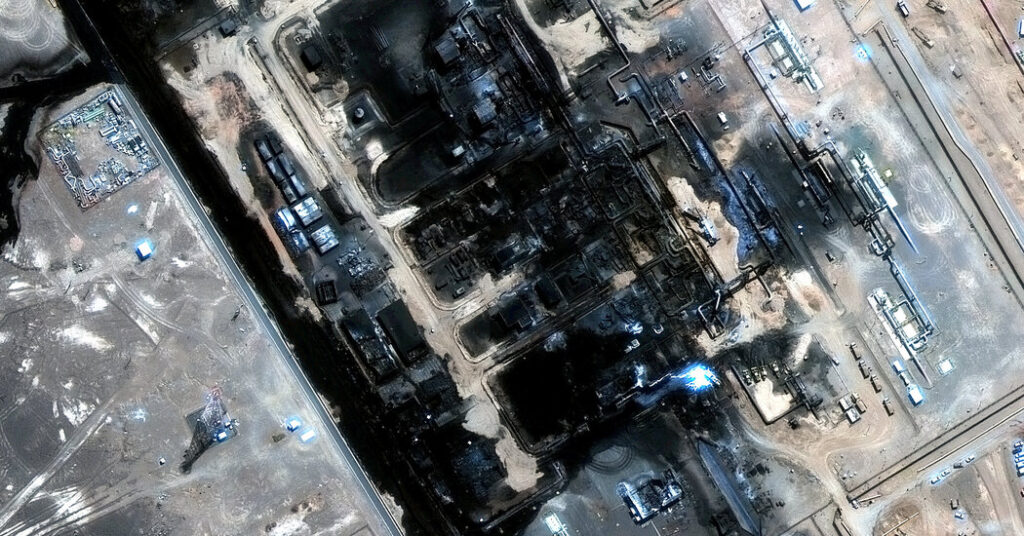
The renewed fighting has effectively reignited the Yemeni civil war, which had been largely quiet since a 2022 cease-fire. Saudi-aligned forces have attacked Houthi territory, while Houthi forces have repeatedly fired at sites in Saudi Arabia that they say are military and energy installations.
On Monday, the Saudi government’s civil defense issued alerts for the southern cities of Khamis Mushait and Abha, warning of incoming attacks. There were no reports of casualties.
The post Saudi Leader Meets U.S. General as Widening Conflict Threatens Oil Markets appeared first on New York Times.