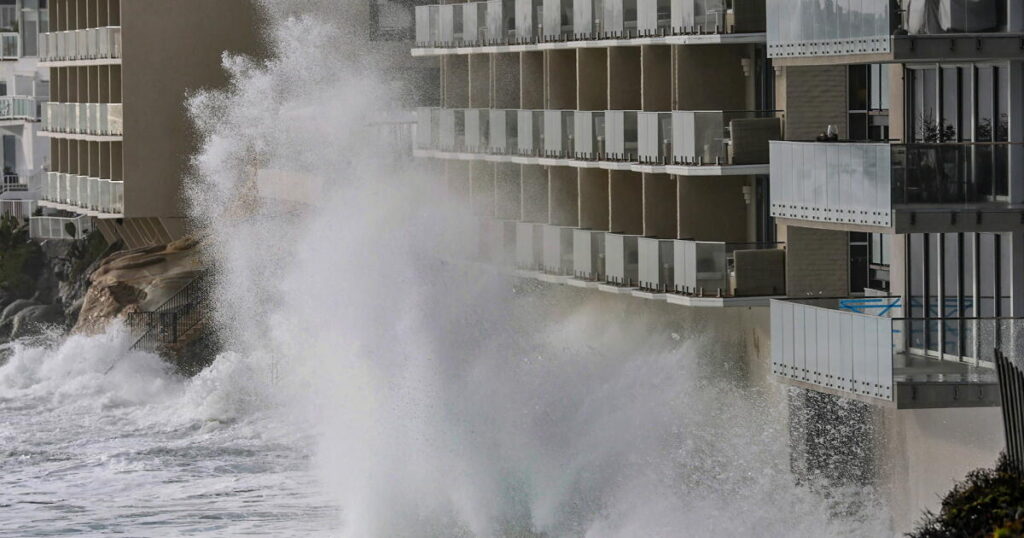
Coastal communities are beginning to assess the damage from waves and flooding as Southern California braces for more potentially destructive conditions from a “coastally trapped Kelvin wave.”
Homes from south Orange County to Malibu were flooded and severely damaged. Erosion chewed away the coast from Carlsbad to Long Beach.
Laguna Beach, Dana Point and Carlsbad last week declared a local state of emergency, citing coastal erosion and sand loss from the effects of a south swell brought on by Hurricane Marie. El Niño typically results in an unusually active hurricane season in the eastern Pacific, which is where Hurricane Marie formed.
“I’d been chatting with other cities and city managers up and down the coast, and I think we all had different levels of damage,” Laguna Beach City Manager Dave Kiff said. “I think Laguna’s was among the greatest, or most significant, but everybody talked about concern about sand and sand replenishment. They do have sand replenishment projects, from Newport to Huntington to Seal Beach, and then there’s some farther down south.”
Orange County officials announced that they were activating their emergency operations center, which is required when two cities in the county proclaim a local emergency.
“Our coastal cities are experiencing serious damage, and the county is mobilizing our emergency response,” Orange County Board of Supervisors Vice Chair Katrina Foley said in a statement.
Transportation officials posted a video showing severe erosion jeopardizing the train tracks used by Metrolink in San Clemente, with strong ocean waves crashing on the tracks and sediment crumbling onto the rocks below. “It is that serious,” Metrolink said in the post.
In San Diego County, Carlsbad declared a local emergencyin an effort to save Carlsbad Boulevard, also known as Old Highway 101, from severe erosion.
So what’s next?
- Another El Niño-influenced phenomenon — a “coastally trapped Kelvin wave” — is moving up the coast of Mexico and will soon hit the U.S. West Coast.
- The winter is expected to bring more damaging storms. Government forecasters say there’s now a 75% chance this latest El Niño will be stronger than any other since 1950. There is a 98% chance that El Niño will be “very strong” for the three-month period ending in December, the National Oceanic and Atmospheric Administration’s Climate Prediction Center said Thursday.
Here’s a rundown of what we know:
1. Kelvin is key
Until recently, Kelvin waves were a pretty obscure concept. But they’re fundamentally at the heart of El Niño: a climate pattern in which the ocean waters in the central and eastern equatorial Pacific heat up and spur changes in the atmosphere that can affect weather around the world.
Coastally trapped Kelvin waves have been known to exist for decades, as long as scientists have understood El Niño. “Coastally trapped” means they must follow a coastal boundary, with the shoreline to their right in the Northern Hemisphere, said Michael Jacox, research oceanographer with the National Oceanic and Atmospheric Administration’s Fisheries’ Ecosystem Science Division.
Only recently have computational capabilities progressed to the point that scientists such as Dillon Amaya have been able to model and track the waves.
“Now scientists have a way of seeing these things unfold in real time, and not to mention we’re experiencing one of the largest El Niños on record, which is going to correspond with some of the largest coastally trapped waves on record,” according to Amaya, an expert on this type of wave and an assistant professor at North Carolina State University’s Department of Marine, Earth and Atmospheric Sciences.
As El Niño develops, the typical east-to-west trade winds along the equator weaken or even reverse, “which allows a lot of really hot water and high sea surface heights to slosh back from the far western equatorial Pacific, where they typically sit, all the way to the east,” said Amaya, who earned his doctorate in oceanography from the Scripps Institution of Oceanography at UC San Diego.
That means typically warmer water, like around Indonesia, moves east to a normally cooler part of the Pacific, near Peru — pushed along by Kelvin waves. The Kelvin waves that move here are called “equatorially trapped Kelvin waves,” meaning these waves remain confined along the equator.
Upon hitting South America, the Kelvin wave splits into two, one heading north, toward California, and the other heading south.
2. Rising sea levels
This is when the Kelvin waves become coastally trapped.
“Along the coast, these waves elevate sea levels, increase ocean temperatures, and push cold, nutrient-rich waters deeper below the surface,” Jacox said.
As they travel, Kelvin waves can raise sea levels by as much as 6 to 12 inches — potentially for months.
“Those elevated sea levels, when combined with passing weather or storms, can substantially increase flood risk and risk for things like beach erosion,” Amaya said.
3. Timing
The coastally trapped Kelvin wave is currently on the west coast of Mexico. Amaya said he expected the wave to enter the Gulf of California on or around Saturday. Once there, it will take about 11 days for the wave to hug the gulf’s U-shaped coast and, from there, another seven days for it to travel from the southernmost tip of the Baja California peninsula — Cabo San Lucas — to San Diego.
It’ll then take about two to three days to reach L.A., and another two to three more to get to San Francisco.
That would put the wave’s arrival in Southern California in early October, although the exact timing remains uncertain.
“They’re pretty epic,” Amaya said. “They travel something like 25,000 kilometers [15,500 miles] all the way from the western equatorial Pacific up … to the Gulf of Alaska, and it takes about 120 days.”
4. Impact
This isn’t a surfable wave, and it wouldn’t be overtly noticeable to swimmers or boaters. But it is expected to increase the sea level off the California coast by another 6 inches or so, and its effects could last months.
It might not sound like much, but another 6 inches of sea level rise could further bludgeon the already battered California coast, especially if combined with the effects from a storm.
“We saw why that’s important recently, with houses across Southern California getting battered, especially at those high tides. We had hurricane-generated swells and high tides, and the combination was extremely damaging to these homes,” said Jonathan Warrick, research geologist with the U.S. Geological Survey. “When the water level is extra high, a foot or more higher than we expect it to be, then it can really wreak havoc.”
As it stands, the Golden State has already experienced about a foot of sea level rise over the last 125 years from human-caused global warming and the melting of the polar ice caps. And lately, the state has also seen abnormally high tides.
Turner writes for Times Community News.
The post ‘Pretty epic’ Kelvin wave is latest threat to SoCal coastal cities. How soon, and how bad? appeared first on Los Angeles Times.