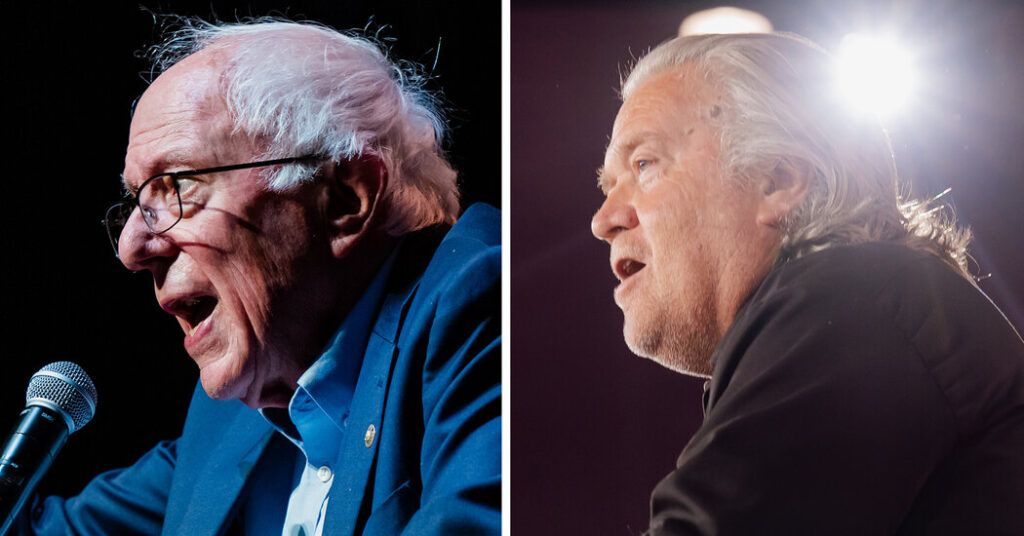
The growing fears of a techno-apocalypse caused by out-of-control artificial intelligence have brought two unlikely political figures into the same orbit: Senator Bernie Sanders and Steve Bannon.
Mr. Sanders, the democratic socialist from Vermont, and Mr. Bannon, the MAGA firebrand, will both call for a “pro-human” approach to A.I. at an event on Tuesday in Washington. (They will not share a stage, according to a spokesman for Mr. Sanders.)
The gathering will also feature members of Congress who are ideologically opposed: Representative Chip Roy of Texas, a Republican hard-line fiscal hawk, and Representative Greg Casar of Texas, the Democratic progressive caucus chair. Joseph Gordon-Levitt and Ashley Judd, both prominent actors, are also speaking at the conference, which Axios earlier reported on.
The specter of A.I.’s unchecked power has emerged as a significant issue in the midterm elections, with industry leaders issuing increasingly stark warnings about what some describe as a runaway technology.
Some candidates in competitive House and Senate races are calling for Congress to enact guardrails on the technology, while others, particularly progressive Democrats, have declared the need for a drop-dead halt on A.I. development until the government catches up. In Washington, lawmakers have increasingly called for action, but there has been no substantive response yet, and President Trump said on Monday that fears of A.I. taking over the world were a “HOAX.”
The new push to rein in the rapid advancement of A.I. comes as candidates seize on voter anger about the proliferation of the data centers that fuel the technology. That issue has quickly become potent for both parties, tapping into more quotidian but nonetheless crushing worries about the technology: jobs disappearing, water drying up and utility costs skyrocketing.
Dr. Abdul El-Sayed, the Democratic nominee for Senate in Michigan, who is running in a competitive race that could tip the balance of power, has been among the most aggressive proponents of restrictions.
He has urged turning A.I. companies into public trusts overseen by elected regulators, saying that doing so would make companies “far more focused on what is in the public good rather than what is for the private benefit of a few billionaires.”
“A.I. shouldn’t be able to deny you health care, it shouldn’t be able to deny you a job, it shouldn’t be able to fire you, it shouldn’t be able to fire a weapon,” Dr. El-Sayed said on Sunday on CBS News’s “Face the Nation.”
Dr. El-Sayed’s Republican opponent, former Representative Mike Rogers, has not been as outspoken about reining in A.I. But a day after Anthropic’s chief executive, Dario Amodei, urged tech companies to slow their development — and was quickly joined by other top industry executives — Mr. Rogers called for the same and said it would be a “top priority” to pass a national security framework on A.I.
“My experience as Intel Chairman taught me the time to stop a crisis is yesterday,” Mr. Rogers wrote on X on Sunday, referring to his tenure on the House Intelligence Committee.
Speaker Mike Johnson, Republican of Louisiana, said on Sunday that Congress should put up guardrails, but that hasty action could give Chinese companies an edge. On Monday, Mr. Johnson told reporters at the Capitol that he would probably meet with A.I. executives and Mr. Trump at the White House within the next week or two to discuss potential actions.
Senator Jon Ossoff of Georgia, a Democrat in a battleground race, accused Republicans of dragging their feet on regulating the industry.
“An ancient establishment barely capable of email sleepwalks into a technological revolution while the president dismantles precautions and calls us fools for worrying,” Mr. Ossoff said at a rally on Sunday in Athens. “A capable president would move swiftly to secure and reassure the American people.”
Mr. Trump has firmly opposed restrictions on A.I. On Monday, he sought to nip talk about guardrails in the bud, saying on Truth Social that the only safety precaution the industry needed was “a STRONG AND SMART (High IQ!) PRESIDENT.”
“And the U.S.A. has that, in spades!” Mr. Trump added, arguing that his administration already had “tremendous CRIMINAL and REGULATORY power over these companies!”
As with data centers, Democrats and those aligned with them have been particularly aggressive in pushing for further restrictions on the technology.
William Lawrence, the Democratic nominee for a swing House district in Michigan, has made opposition to data centers a major theme of his campaign. On Saturday, Mr. Lawrence, who is challenging Representative Tom Barrett, a Republican, said he supported halting A.I. research, too. Manny Rutinel, a Democrat in Colorado seeking to unseat a Republican House member, stopped short of calling for a moratorium on the technology’s development, but urged Congress to act.
“The wealthiest corporations on the planet are putting our families in danger,” Mr. Rutinel said on X last week.
The mounting warnings come after A.I. agents operated by OpenAI escaped their test environment in July and hacked into the database of another tech firm, Hugging Face. Soon after, more than 1,300 employees of A.I. companies signed a statement arguing that the technology could develop too quickly for humans to control it without government intervention. And last week, a public warning from an Anthropic researcher who resigned went viral. The researcher, Jacob Coxon, said that A.I. companies, even as they promised caution, were barreling toward developing “superhuman systems that can hack anything, revolutionize any field overnight, and acquire real power and resources.”
In August, Mr. Sanders implored the leaders of three top tech companies to halt their development of A.I.
“It is not too late to avoid disaster,” he wrote in a letter. “Stop building machines that humans cannot control.”
At the event on Tuesday, Mr. Sanders and other speakers plan to discuss topics including “keeping humans in charge, avoiding concentration of power, protecting the human experience, enhancing human agency and liberty, responsibility and accountability for A.I. systems, and the components needed to pivot to a pro-human future,” according to the Future of Life Institute, which is hosting the conference.
Representative Hakeem Jeffries of New York, the Democratic minority leader, said on Sunday that the House should take “decisive action.” But, like Mr. Johnson, he did not outline specific proposals.
Others have expressed skepticism that Silicon Valley leaders, including Mr. Amodei and Sam Altman of OpenAI, are calling for government intervention. A separate faction of A.I. industry figures have said that legislation could make it harder for smaller A.I. companies to compete.
On Monday, Vice President JD Vance echoed those concerns and dismissed fears about the dangers of A.I.
“I feel a little bit weird about the fact that you have so many frontier A.I. tech companies kind of coming to the government and begging the government to regulate them,” he told reporters. “It feels a little bit to me like a bit of a Trojan horse.”
Jess Bidgood contributed reporting.
The post Political Figures From Bernie Sanders to Steve Bannon Sound Alarms on A.I. appeared first on New York Times.