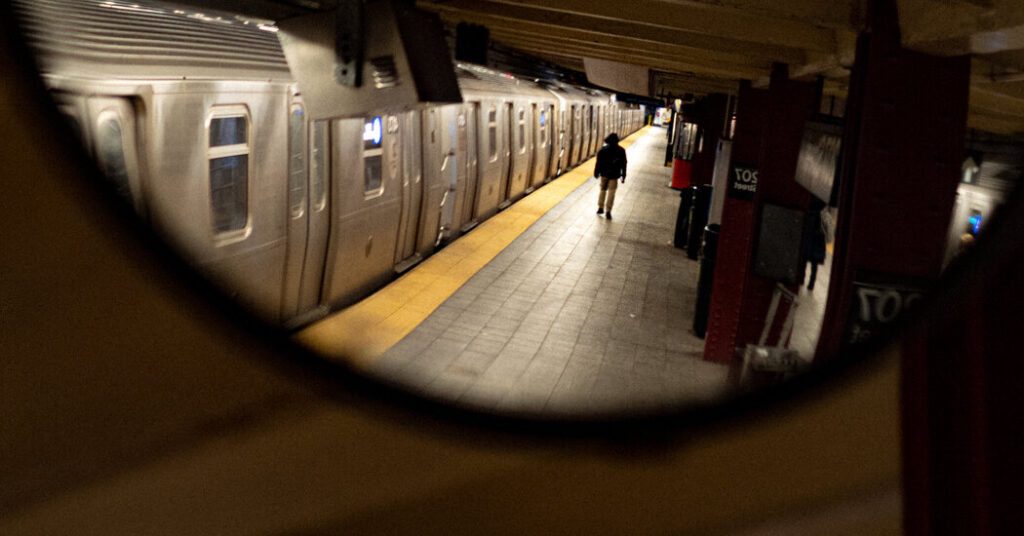
For a few moments on May 1, 2023, an extraordinary amount of American life was compressed into one New York subway car.
There was Jordan Neely, a 30-year-old Black man, homeless and suffering from mental illness, frightening passengers beneath a city still shaken by Covid. There was Daniel Penny, a white former Marine from Long Island who put him in a chokehold. There were bystanders facing a dilemma that would feel familiar to many Americans: wait for the system to work; take matters into their own hands; or withdraw. And hovering in the air of car No. 9774 was America’s deepening crisis of trust — in institutions, in strangers and even in the belief that anyone is coming to help.
When Mr. Neely died in that encounter and Mr. Penny was charged with killing him, an American tragedy was instantaneously reduced to an American Rorschach test: What did you see in Mr. Penny, a hero or a vigilante? Was Mr. Neely a victim or a menace? People retreated to their corners and posted before they knew much. Soon the story, having been picked over, fell out of consciousness.
Three years later, the case is worth revisiting for the mirror it holds up to the nation. A death on the subway that seemed to prove that Americans now inhabit perfectly sealed, irreconcilable moral universes actually revealed one of the last things we have in common — abandonment.
Start in that subway car screeching uptown.
In the flicker of a moment after Mr. Neely boarded the train and began to cry out for food and declare himself ready to go back to jail, even ready to die, and before Mr. Penny came up behind him and dropped him to the ground in a chokehold, a common feeling pervaded the car: No one’s coming. No one’s listening. I’m on my own.
Mr. Neely certainly had reason to feel that way. He had cycled through so many people and institutions that failed him, going back to when he was barely a teenager and his mother had been murdered — her cause of death also, remarkably, compression of the neck.
For a time, he had made a living, and even thrived, as a Michael Jackson impersonator on New York’s streets and below them in the subway system. Then, as mental illness took hold, he struggled and began to unravel, passing over and over through the so-called revolving door of hospitals and shelters and jails that take people in crisis and spit them out until the next time.
Dafna Yoran, the lead prosecutor in the 2024 trial of Mr. Penny, later described Mr. Neely as one of those people city dwellers walk past and typically ignore, but on the day he died, she argued, “Jordan Neely demanded to be seen.”
Mr. Penny claims to have felt his own, rather different version of abandonment. His lawyers argued that he sustained the chokehold for several long minutes, even after the train had arrived at the next station and most passengers had gotten off, because the law was absent.
“The government wasn’t there,” Steven Raiser, one of Mr. Penny’s lawyers, said in the courtroom. “The police were not there when the people on that train needed help. Danny was. And then, when he was the one that needed help, no help arrived. Not for him, and certainly not for Mr. Neely.”
In courtroom testimony, many passengers on that F train confessed their own sense of being left to themselves. In a 911 call played at the trial, a witness identified as “Latimer” pleaded with the police: “Could y’all get someone over here? Because he’s doing y’all justice.”
These sentiments will be familiar to many Americans. The defining political emotion of the age may be the sense that power, and with it the ability to push back on what bears down on you, is somewhere other than where you are, that you are unheard and unseen, that you are acted on but lack the means to act. Beneath so many disparate political phenomena — the Epstein files, A.I. doom, immigration, prices, housing, weak leadership — is that feeling of being undefended.
Why is a sense of abandonment so potent in America today — and so widespread across the divides of party and tribe and geography?
There is no shortage of culprits, and every political faction has its preferred one. But if you take the Penny-Neely case as a subway-car microcosm of America, it points toward an answer that is less convenient for any of them, because it implicates all of them. For many Americans, public authority has come to feel impossibly erratic.
Such authority is experienced by citizens as a strange mix of over-controlling and unhelpful, too strong where a lighter hand would do and too weak where more is needed. It is authority that people may experience as draconian even as those who wield it feel hamstrung; an authority that can feel at once oppressive and weak, gargantuan and hollow, omnipresent and absent.
Take the system of care for homeless people like Mr. Neely. So many Americans walk the streets of their cities and see people in crisis and perceive that the government is AWOL. They may not realize how, in fact, vast the apparatus of care is in a place like New York.
An army of outreach workers toils to build rapport and coax people off the streets. The problem is that their often remarkable compassion is not matched by that of the shelter system into which they are inviting people. Violence abounds in that system, and the authorities within it often seem more interested in exerting their perogative to enforce curfews and other rules than the bolder authority of transforming lives, getting people into apartments and ending the phenomenon of homelessness.
In mental health policy, authority can also be haphazard, too much and too little, here today, gone tomorrow. When Mr. Neely died, it was commonplace to hear that he had slipped through the cracks of the system. But this idea was false. Mr. Neely was regularly discussed in a meeting of senior city officials as a member of one of the “Top 50” lists of especially precarious New Yorkers whom city agencies track. The real problem was subtler — and more maddening.
His family wanted him forced into care, but they lacked the power to make that happen, and health care providers often turned him away: Mentally ill homeless people are not the American system’s favorite customers. City outreach workers tried to tend to him, but they lacked any authority to compel him when he simply chose to walk away. And the police, who did have stronger authority, weren’t invested in helping him so much as in preventing lawbreaking.
Underlying these problems was an abiding moral confusion about human self-determination and public power that is haunting many major cities today. When people in Mr. Neely’s kind of psychiatric crisis refuse help, does the state have the right to force them into a hospital and onto drugs in the name of their dignity?
So many in Mr. Neely’s situation are caught between those on the progressive side who overestimate the autonomy of people whose illness may prevent them from knowing they are ill, and activists on the right who decry the degradation of public space while resisting the public investment that serious care of the homeless requires.
It is impossible to walk down the streets or take public transportation in any major American city today and not see this confusion spelled out in human pain. And when so much suffering is forced to play out in public, it fosters unease, pity, annoyance and fear in the more privileged — who, in spite of their comparative fortune, can end up feeling abandoned in their own way.
In Mr. Neely’s short and tempestuous life, erratic authority was one of few constants. The state greatly overpoliced Mr. Neely when he was young and committing crimes no more serious than jumping subway turnstiles and sleeping outside. It arguably held him too loosely after his crimes escalated into violence.
In early 2023, while awaiting trial on Rikers Island for assault charges, he was diverted into one of the new alternative-to-incarceration programs that, in his case, even prosecutors championed. But once he was there, he was free to walk out the door unhindered. Within a few months, he was dead on the subway.
There are many possible responses to the sense of abandonment we feel around us. A hunger for agency — some agency, any agency — may show up in civic engagement, in activism, in mutual aid or in voting for authoritarians who promise order. But it also manifests in the most primordial form of all: taking matters into one’s own hands.
Starting in the first days after Mr. Neely’s death, Mr. Penny’s defenders in court and in public had framed him in those terms — as a hero standing up to entropy. In this narrative, popular on the political right, the left was responsible for this void of public authority by emasculating the police, promoting bail reform, tolerating street camps and minimizing severe mental illness.
Some online rightists were repeating an idea that Mr. Penny was a victim of “anarcho-tyranny”: government cracking down on good, solid, middle-class (white) citizens who step up to reject their city being taken over by hobos, junkies and criminals. “The government,” Mr. Penny’s lawyer Mr. Raiser said, “has the nerve to blame Danny for acting when police were not there.”
Then one day during jury deliberations in the Penny case, news rippled through the courtroom that the chief executive of UnitedHealthcare, Brian Thompson, had been shot and killed in Midtown Manhattan. Soon the murder suspect, Luigi Mangione, would be brought before the law, and some of the same reporters would pivot to covering a new case in the same building. And just as quickly as in the Penny case, Mr. Mangione began to be described by some on the left in the same terms as Mr. Penny was being framed on the right: as someone stepping into the void — in this case, into the Byzantine, claim-denying vacuum left by health insurance companies.
The two cases differed greatly, morally and otherwise: an unplanned chokehold that even prosecutors claimed began with good intentions, compared with a premeditated assassination. What was striking was how both stories were processed by many as tales of self-appointed avengers acting in the absence of dependable authority.
Shortly after the Thompson shooting, Mr. Penny was acquitted. And when his critics took to the microphones outside court, a variation on this theme of the void and vigilantism was heard. “Just like everybody else seeks justice on their own, just like everybody else has vigilantes, we need some Black vigilantes,” said Hawk Newsome, founder of the local group Black Lives Matter of Greater New York.
Mr. Newsome’s idea was not only physical self-defense, though. In a racist country, as he saw it, Black people needed to stop trusting that the system would help them. They needed, he said, to form their own schools, health system, media outlets and more.
Listening to that news conference, it struck me that the supporters of Mr. Penny and of Mr. Neely had disagreed on every substantive aspect of the case — the facts, the role race played, class, mental health, homelessness, policing, crime. But if you pulled back from their arguments so that you heard the deeper stories in their words, there were resonances.
They shared the sense of being undefended, that the cavalry was not coming. They shared the sense that the system was rigged, corrupted, driven by forces and factors that didn’t serve them. They shared the sense that the old ways of achieving the world you want — marching, voting, asking nicely — were dying. They shared the sense of Somebody do something! They shared the sense of pessimism about anyone doing anything, though, and therefore they shared the sense that sometimes the person to do something is you.
How can so many people feel the same basic thing — deserted — and so often end up at the throats of other people who also feel deserted?
Our common abandonment keeps failing to produce a common politics — solidarity across difference — because all too often, as in the Penny and Mangione cases, the way the story is told silos it. Each tribe has its own theory of who’s to blame and its favored expression of self-help. No one wants to associate the forms of D.I.Y. action that they find acceptable with those they reject. This makes it harder to see that taking matters into one’s own hands has become a rare thread of our common life, a final American glue.
When the Rev. Al Sharpton gave Mr. Neely’s eulogy, he tried to make a connection between one man’s act on the subway and the more chronic treatment of Mr. Neely by an entire city and its agencies. “The sad part about it, the sick part about it, is that he’d been choked much of his life.”
The civil rights leader pledged that, just as the choking, as he saw it, had been done not just by a man but by a whole city, so, too, the pursuit of justice in Mr. Neely’s name would require more than winning a case. It called for “a new city.”
That new city hasn’t yet come to pass, though. A country in which we keep failing to hear the rhymes in our different cries of pain, in which our experiences of desertion are turned into competition rather than common cause, is better at producing avengers than answers.
Anand Giridharadas is the author of the forthcoming book “Man in the Mirror: Hope, Struggle and Belonging in an American City.”
The Times is committed to publishing a diversity of letters to the editor. We’d like to hear what you think about this or any of our articles. Here are some tips. And here’s our email: [email protected].
Follow the New York Times Opinion section on Facebook, Instagram, TikTok, Bluesky, WhatsApp and Threads.
The post No One Is Coming to Save Us appeared first on New York Times.