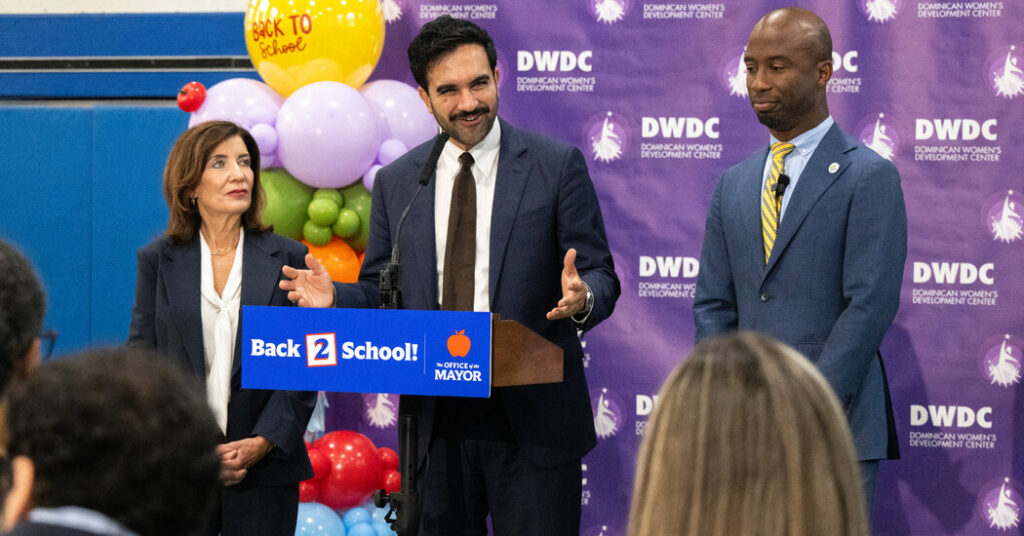
There isn’t much that Mayor Zohran Mamdani and New York City’s business community see eye to eye on.
The need for affordable child care is quickly becoming an exception.
A new group of city business leaders, called the NYC Child Care Business Council, has formed to help make the case that expanded child care is not a progressive fantasy but an economic necessity for a city that has seen an exodus of young families with children in recent years.
The plan is for the council to informally lobby other business leaders — some of whom may be wary of the mayor because of his enthusiasm for taxing the rich — pushing them to see child care as one where they can find common cause with City Hall.
Business leaders tend to be bullish on child care because more affordable care makes it easier for them to retain talent, said Julie Samuels, a member of the new council.
“If we make it easier for tech workers to stay here, they will,” said Ms. Samuels, who runs the tech advocacy group Tech:NYC. “And the companies will stay where the people they want to hire live.”
A report from the city’s Economic Development Corporation found that parents leaving the city or the work force cost New York City about $23 billion in 2022, and the group convening the business council is expected to release a report with the Boston Consulting Group containing updated findings later this fall.
“You cannot build a competitive work force on top of a broken child care system,” said Grace Rauh, who runs the watchdog group Citizens Union. The business council is being organized by the 5Boro Institute, a think tank within Citizens Union.
The council’s founding members include leaders of heavy-hitting groups like the Partnership for New York City, the Association for a Better New York and the Real Estate Board of New York. Other member organizations include Con Edison, the online retailer Etsy and the chambers of commerce for all five boroughs.
They will be entering the fray at a high-stakes moment for the future of child care in New York.
The need for low-cost or free care has emerged as something approaching a consensus issue among the many power centers in New York, including major philanthropies, the mayor, Gov. Kathy Hochul, the City Council and the State Legislature.
But a truly universal system could cost about $9 billion a year, according to a recent report by the Center for New York City Affairs at the New School. And there are deep divisions about how to actually pay for such a program.
Mr. Mamdani and his allies have called for a tax increase on New York City residents making more than $1 million a year.
But any tax hike would have to be approved in Albany, and the governor has not shown a willingness to raise taxes. Instead, Ms. Hochul pledged $1.2 billion earlier this year to kick off the city’s child care expansion. There is currently no funding plan after the money runs out.
Raising the funds through taxation is not an approach that some members of the NYC Child Care Business Council are likely to support.
James Whelan, who runs the Real Estate Board of New York, has called tax hikes “a nonstarter.” And Steve Fulop, head of the Partnership for New York City, said in an interview that “the pitch from the extreme political side — just tax everybody — ultimately will not accomplish the outcome they want.”
“Conceptually, we are supportive of child care,” Mr. Fulop added, “but there are a lot of questions around the details.”
It remains to be seen whether the new business council will ultimately become a parallel or complementary effort to the city’s push to expand free child care.
Emmy Liss, the director of the city’s child care office, said in a statement that she was supportive of the new council. “This council echoes what New Yorkers in all five boroughs made clear last year: Universal child care is a critical investment in our city’s future, and every New Yorker stands to benefit,” she said.
Even if some of the group’s members oppose the tax hike that Mr. Mamdani wants, they may try to persuade the governor to continue to fund the city’s child care expansion. Ms. Hochul is much closer to New York’s business community than the mayor and may look to business leaders for support if she decides to continue funneling significant state funds to the city’s child care push.
Jen Goodman, a spokeswoman for the governor, said Ms. Hochul was “grateful” that the council would bring “critical partners to the table as we work together on our shared commitment to deliver universal child care statewide.”
The group could also appeal to local philanthropies to help fill budget holes before the city finds a permanent funding source. The Robin Hood Foundation recently received a $100 million gift from the family of the Amazon founder Jeff Bezos, earmarked for preschool education in New York.
The city’s own fund-raising efforts have been much more modest. A push to raise $20 million for a new “child care action fund” aimed at paying for pilot programs within the child care expansion has so far brought in about $6 million.
The post Mamdani and New York’s Business Leaders Agree On at Least One Thing appeared first on New York Times.