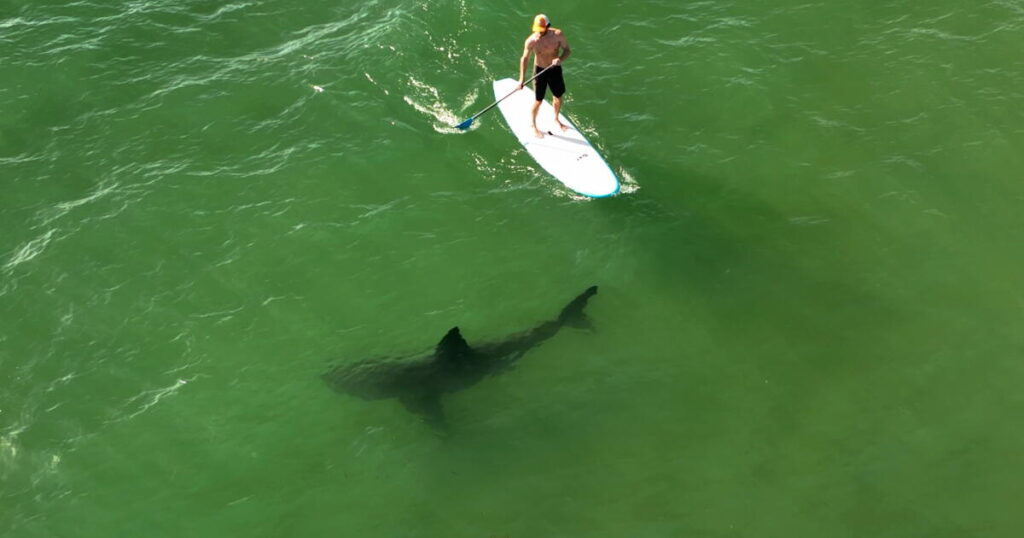
This year, as Southern Californians flock to the beaches to escape the heat, a familiar media narrative breaches the surface: It is the “Summer of the Shark.” Clickbait headlines and viral drone recordings of dark silhouettes cruising just beyond the surf dominate news feeds, painting a picture of a coastline under siege. But as a shark and marine conservationist, I see a vastly different and much more encouraging story unfolding.
Southern California’s nearshore waters serve as a vital, globally significant nursery for juvenile great white sharks. These young animals are here to take refuge in the warm shallows, targeting a comfortable zone of water temperatures. Feeding primarily on stingrays and schooling fish, these sharks rarely bite surfers or swimmers.
Marine biologist Chris Lowe of Cal State Long Beach has been tracking sharks in nearshore and coastal California waters for nearly two decades. The work of Lowe’s Shark Lab has provided a picture of the white shark population and movements in the Northeast Pacific with a focus on Southern California. Tag data and subsurface sensors have verified that more juvenile and young white sharks are indeed gathering near shore this year, moving north from Baja California to seek cooler waters. The increase in numbers of juveniles is related to increasing sea surface temperatures probably associated with climate change.
Although the number of juvenile white sharks has increased near shore, we’re not experiencing a sudden invasion of man-eaters or an uptick in bites or incidents involving sharks. With the warmer waters, Southern California’s sandy beaches are experiencing an increase in stingrays, causing hundreds of stings suffered by beachgoers. Since these venomous rays are a juvenile white shark’s favorite meal, it’s actually a benefit to have these stingray eaters near shore.
On average, Californians experience around three human-shark incidents per year, with an average of one fatality every 10 years. According to the California Department of Fish and Wildlife records, three surfers and one kayaker have been bitten in state waters in 2026. Two of these incidents occurred without injury and none of them were fatal. Three of these incidents were from white sharks, all north of Point Conception. The fourth was suffered by a spearfisherman in Del Mar, San Diego County, from a sevengill shark, a normally innocuous species unless there is a struggling fish nearby.
Most large adult sharks, which account for most serious injuries, are currently either far offshore in an annual migration west, or prefer waters north of Point Conception, where temperatures are cooler and the seals more abundant. Aside from a few pregnant mature females, most white sharks off Southern California are newborns, juveniles and subadults about 10 to 12 feet in length. The latter are teenage sharks and transfer their prey preferences from fish and rays to marine mammals. This learning curve may result in more serious injuries when a shark may confuse a human with their preferred prey of seals.
The ubiquity of affordable drones and high-definition action cameras allows us to observe our wild neighbors more closely than ever before. Amplified by social media, it is easy to understand the misconception that our waters are infested with sharks. The white shark was nearly fished to local extinction in the 1970s and 1980s, and seeing one was once an extreme rarity. Protected since 1993, the population of this species is still in the process of slow recovery.
However, the statistics remain comforting. Despite the millions of beachgoers sharing the water with these animals every summer, negative encounters are exceedingly rare. Despite the increase in juvenile sharks near shore, the rate of human encounters with white sharks remains within the statistical norm. Oceangoers face a vastly greater risk driving on the 405 Freeway to get to the beach than from a shark once they paddle out. In fact, the presence of these apex predators is a sign of a recovering, robust marine ecosystem. The presence of sharks is a success story of conservation efforts and fisheries management over the last few decades. The solution to our collective anxiety is not fear, but informed coexistence.
Sharing the ocean requires respecting it as a wilderness environment. Simple, commonsense practices can mitigate the unlikely danger. Applying technology can work in the benefit of public safety. Our lifeguards use drones, signage and temporary beach closures as methods to protect public safety when a large shark is sighted near shore. Citizens such as the Malibu Artist are sharing drone recordings of shark sightings with public safety agencies to inform the public where the sharks gather and when they are sighted near people.
Regulating human behavior is an additional tool to prevent accidents. Recreational fishermen attracting and catching protected white sharks at public piers and beaches have led to emergency measures by the California Department of Fish and Wildlife. New regulations have been implemented to protect public safety by restricting shark fishing gear on public piers and beaches this summer to avoid attracting or aggravating sharks.
Sharks have more to fear from humans than we do from them. Globally, fewer than 100 sharks bite people each year. In contrast, humans kill 80 million to 100 million sharks per year for their fins, as bycatch or for other products.
We must shift our perspective from terror to stewardship. Sharks are the white blood cells of our ocean. They maintain the intricate balance of marine food webs, which in turn regulate our climate and support the very life support systems of our planet. Education and supporting scientific research like Lowe’s is the most effective shark repellent we have, and community awareness is the key to ensuring both human safety and the survival of these magnificent animals.
David Wayne McGuire is a marine biologist, ocean explorer and the founder and director of Shark Stewards, a nonprofit dedicated to saving sharks and protecting the ocean.
The post Learning to coexist with Southern California’s white sharks appeared first on Los Angeles Times.