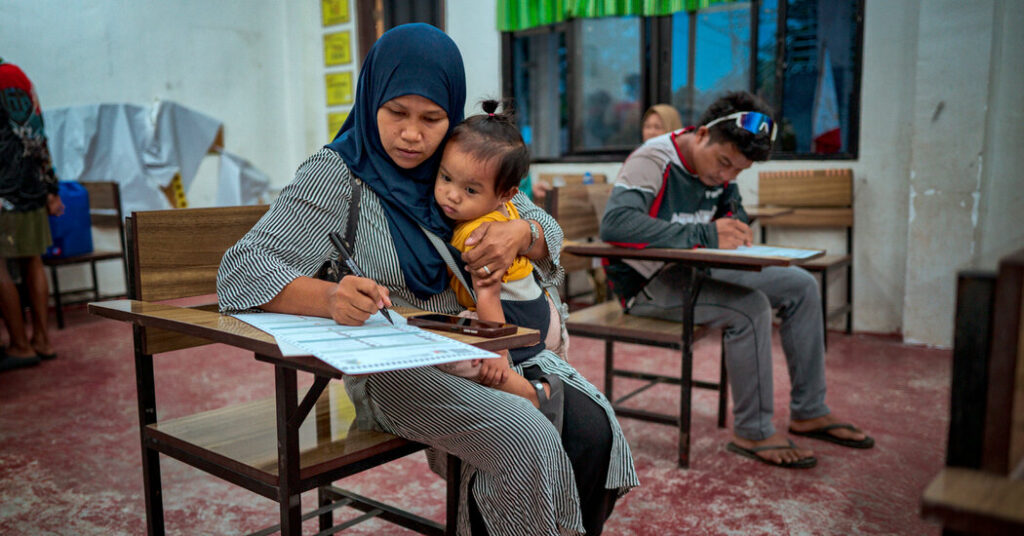
Hundreds of thousands of people cast ballots on Monday in the first parliamentary election of an autonomous region in the southern Philippines, which was long a center of Muslim separatist activity and where Islamic State fighters laid siege to a city less than a decade ago.
In a sign of how restive the region remains, there were reports of violence, including a shootout that local officials said had left three people dead and more than 15 wounded near a polling station late Sunday, hours before voting began. The authorities also said they had found ballot tampering in a remote area.
The Bangsamoro Autonomous Region in Muslim Mindanao was established in 2019, superseding an earlier autonomous zone that was considered to have benefited only a small number of Muslim families. Monday’s election had been delayed for years over security concerns. As many as 2.3 million voters were expected to select 80 representatives, who will then pick a chief minister from among themselves.
“The polls are historic because they test the durability of the peace process, institutionalize self-rule within the constitutional framework of the Philippines, and set a precedent for democratic consolidation in a region long defined by armed struggle,” said Rommel Banlaoi, a Manila-based political and security analyst.
The region — encompassing a large section of Mindanao, the second-largest island in the Philippines, plus other smaller islands — is the only one in the country that will be governed by a parliamentary system. For decades, it was home to a separatist movement led by the Moro Islamic Liberation Front, which fought a fierce uprising that left about 120,000 people dead and pushed pockets of the region into a cycle of extreme poverty and violence.
In 2014, the group dropped its bid for full independence in return for the right to self-rule. Many fighters joined a “transitional authority” that was to be replaced eventually by the region’s own parliament. But delays in the peace process frustrated some residents. In 2017, helped by fighters from Southeast Asia and the Middle East, a local faction of the Islamic State took over the city of Marawi, leading to a five-month battle that left hundreds dead.
Yasmin Busran-Lao, a peace and women’s rights advocate, cast her ballot at about noon on Monday at a Marawi precinct heavily guarded by the Philippine military. The city, parts of which have been rebuilt in recent years, had many checkpoints and roadblocks, she said.
“You can’t help but feel worried because when you see a lot of soldiers, they are preparing for conflict,” said Ms. Busran-Lao, whose ancestral home was laid to rubble during the 2017 siege. “I was hesitant to go out and vote.”
She noted that the region remained home to groups affiliated with the Islamic State and added, “This vote is meant for us to choose our leaders who will help rebuild.”
Farther south, the city of Cotabato, the seat of the autonomous government, was under the control of the Philippine Commission on Elections. That takeover followed the shootout and another episode, in which a suspect was injured after a homemade bomb that he was carrying prematurely exploded, said George Garcia, the commission’s chairman.
The authorities also found that some ballots had been tampered with in the remote municipality of Maluso on Basilan Island, he said.
“We determined, as of last night, ballots in 36 out of the 68 precincts had been compromised,” he told reporters in a text message, noting that the names on the ballots had already been chosen in advance.
The post Landmark Vote Held in Restive Muslim Autonomous Region in the Philippines appeared first on New York Times.