The Haitian hotel housekeepers, restaurant cooks and Uber drivers who quietly help power Key West’s tourism economy are disappearing.
Some have been detained by Border Patrol agents since late July, when the Trump administration ended a legal protection that had allowed 330,000 Haitians to live and work in the United States.
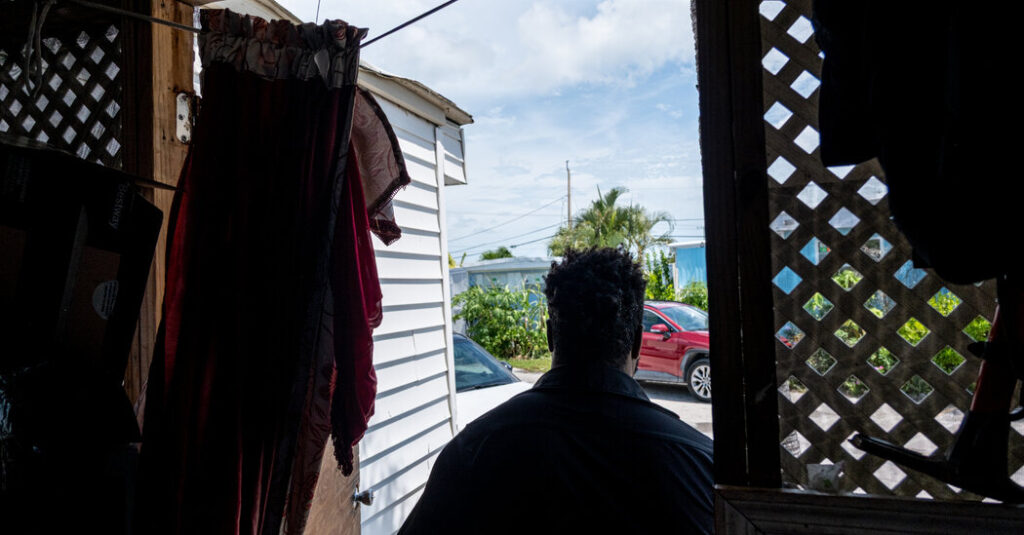
Others are retreating from public spaces, afraid to go about their routines on the mile-wide island that’s typically crowded with partying tourists, sunburned fishermen and cruise ship day-trippers. Many Haitians — along with Hispanic immigrants — have stopped riding bicycles to work, a common form of transportation in Key West, for fear of attracting law enforcement attention.
It’s a situation familiar to communities across Florida; the state has the nation’s largest Haitian population, including tens of thousands who have lost the legal safeguard known as Temporary Protected Status, which the United States had granted them because of the violence and instability in their home country.
But Key West is unique, a remote sliver of land surrounded by open water, linked to Miami by a single highway running more than 100 miles through the island chain known as the Florida Keys. In public, it is often difficult for immigrants to escape the notice of agents.
“There’s no outrunning anybody here,” said Lucy Hawk, co-founder of the Key West Immigrant Support Network.
Key West also stands out for its outsize reliance on tourism — and on immigrants to fill those jobs. Wayne Dapser, a local immigration lawyer, estimated that there were at least 5,000 Haitians living in and around a city of 25,000.
President Trump’s immigration crackdown is hampering labor markets across the nation, but it has been a particularly thorny subject in the Keys, where Republicans long ago surpassed Democrats in numbers. (Key West is the exception, with a Democratic mayor and a liberal-leaning population.)
Bill Lay, a Key West businessman who owns an Italian restaurant and a catering company, said he has grown increasingly frustrated because his employees with valid work permits keep getting detained. Mr. Lay, who votes Republican, said he supports efforts to deport immigrants with criminal records — “the worst of the worst,” he said.
“But that’s not necessarily what’s happening here,” he added. “If this continues, this will devastate the local economy down here.”
Even before Haitian immigrants lost T.P.S., workers from other countries were being swept up in arrests by Border Patrol, which handles much of the immigration enforcement in the Keys.
When Mayor Sam Kaufman visited Hispanic-owned restaurants last month, owners shared stories of line cooks, busboys and delivery drivers, some with valid work permits, getting detained and deported. Those who remained were being crushed with extra work, with some owners delivering food themselves.
Mr. Kaufman noted that Key West was too far from the mainland to bus in workers.
“The price of labor is going to shoot up,” he said. “There is going to be real competition to retain the work force.”
At Jose’s Latin Food, a Nicaraguan restaurant, Clementina and José Amador, the owners, now open six days a week instead of seven. Mr. Amador does all the cooking because several kitchen workers decided to leave Key West to avoid immigration agents.
“We don’t know if we’re going to make it,” Mrs. Amador said.
For Haitians in Key West, T.P.S. afforded a buffer from the immigration crackdown, until the Supreme Court allowed the Trump administration to end the program on July 27.
The impact was immediate, said Steven Nekhaila, 32, a former Libertarian Party national chairman whose family owns two Wendy’s restaurants in Key West. Mr. Nekhaila let go several Haitian employees whose work permits became invalid when they lost T.P.S. He is still short of help.
Even immigrants with valid work permits become so unnerved by reports of arrests that they sometimes call in sick, Mr. Nekhaila added. “They don’t want to risk being detained, even if they’re lawful,” he said.
The labor shortage will most likely be more palpable as summer turns to fall and tourism picks up.
Last month at Roy’s Trailer Park on nearby Stock Island, a group of Haitian men sat in a courtyard area over sweating bottles of Prestige beer, a popular Haitian brand. An Uber driver named Jean A., who asked that his full last name not be used for fear of being detained, said many Haitians in Key West worked multiple jobs that would be hard to fill if they continued to disappear, in part because Americans don’t want them.
When tourism picks up in the fall and winter, Key West will feel the impact more acutely, he said.
Key West first became a flashpoint for immigration enforcement more than a year ago, when the city commission withdrew from an agreement that allowed its police department to assist Immigration and Customs Enforcement. The commissioners reversed course a week later, under pressure from the administration of Gov. Ron DeSantis, a Republican. His administration has threatened to remove local officials who do not cooperate.
Arrests have picked up across the Keys since T.P.S. for Haitians ended, according to immigration lawyers and the Key West Immigrant Support Network. There were at least 65 immigration detentions in the Lower Keys in August, up from 20 in July, said Ms. Hawk, the co-founder of the network, which donates groceries for immigrants too scared to leave their homes and arranges transportation for them.
Nearly 30 of those detained in August were Haitians, including a man whose detention outside an upscale Key West restaurant was captured on video. The footage showed a border agent repeatedly striking the man.
The Department of Homeland Security declined to discuss immigration enforcement operations in the Florida Keys.
“Temporary Protected Status is exactly that — temporary,” the agency said in response to a question about enforcement activity. “For too long, T.P.S. has been allowed to function as a de facto amnesty program despite Congress never intending it to be permanent.”
The number of Haitians in the Keys surged after President Barack Obama granted T.P.S. because of Haiti’s 2010 earthquake. Many more arrived during the Biden administration, as conditions in Haiti deteriorated further and Mr. Biden expanded protections for them.
Many joined relatives in Key West, drawn to a walkable city that, despite few affordable housing options, offered jobs without the need to own a car, Mr. Dapser said.
One such person, a 41-year-old father of two, said he had fled gang violence in Haiti for Brazil, before joining relatives in Key West in 2022. The man, who did not want his name used for fear of attracting immigration authorities, works at a supermarket deli, earning $19 an hour.
He lost T.P.S. in July. He is still able to work because of a pending asylum claim, but that offers little guarantee against immigration detention. Inside their tiny trailer home, he and his wife anxiously monitor WhatsApp for immigration enforcement updates as they care for their young children.
The risk that parishioners may be arrested is now too great for the Rev. Jean Eliézaire Jean, who presides over the Haitian congregation at First Congregational Church of Key West. Last month, he paused in-person church services and Bible study, pivoting to online sessions.
“To reopen, we have to get confidence everybody will be safe,” he said. “But when?”
The post Key West Feels the Pain of Trump Decision on Haitians appeared first on New York Times.