About a year ago, at B’Tselem, the Israeli human rights organization I lead, we realized we were struggling to explain what was happening in the West Bank. The problem was not a lack of information. Quite the opposite: By then, for almost three years, day after day, we had documented homes being burned and demolished, communities being expelled, children being shot and killed, roads being blocked and humiliating assertions of Jewish supremacy by settlers and by the Israeli government alike. Forms of violence once relatively rare in the West Bank, including aerial bombardment, large-scale destruction of residential areas and mass displacement, had become routine.
The question we kept returning to was how to find words for a reality no single incident could capture. We eventually realized that describing the larger system required listening to two political languages at once. These are not parallel vocabularies. One is the language the Israeli system uses to explain and legitimize what it does; the other is the language of the Palestinian people living under Israeli rule, describing what that rule does to their lives. Political language does more than describe reality. It shapes what people can justify and what they can ignore. For Palestinians living under Israeli rule and for many observers around the world, blocked roads, demolished homes, expulsions and violence are elements of blatantly unjust domination. Israeli political language can make that same reality seem necessary, even natural.
As a Jewish Israeli, I grew up inside that language. It turned violent domination into “security,” dispossession into “settlement” and large-scale violence into “self-defense.” That language draws much of its power from real fear. I know that fear. I grew up with it. That fear has many sources, including decades of armed attacks against Israelis. The Hamas-led attack of Oct. 7, 2023, has intensified it. Israeli political language manipulates it by dehumanizing Palestinians, collapsing them into a single category — namely, a threat. It uses violence by some to justify the control and oppression of an entire population. This is one way apartheid sustains itself.
The language I grew up with did not require me to deny Palestinian suffering. I could acknowledge it, even be horrified by it, while still regarding the system that produced it as fundamentally legitimate. Today, after years of deepening dehumanization, Palestinian suffering is simply ignored in much of Israeli public discourse. That is why the language of those who live under this system matters so much. The people who witness, endure and survive under that power can describe what their lives look like: unprotected, shaped by fear, vulnerability and uncertainty.
On Monday, B’Tselem is publishing a report on the process unfolding in the West Bank. It tells a story with deep roots. From the mass expulsion and displacement of Palestinians during the Nakba in 1948, when hundreds of thousands of Palestinians were displaced or expelled and the subsequent refusal of refugees’ right to return, through occupation, settlements and apartheid, Israeli policy has repeatedly worked to entrench Jewish sovereignty while making Palestinian presence and political life more precarious.
Many Israelis recoil at the term “settler colonialism.” That reaction is not accidental. Israeli political language has taught us to hear the term as a denial of Jewish history and belonging. Jewish historical, religious and cultural ties to this land are real, as is the long history of persecution and violence against Jews in many parts of the world. None of that changes the fact that exclusive Jewish sovereignty was built through Palestinian dispossession. The politics have shifted over time, but the underlying logic has remained the same: Israel has preserved a political order that places Jews above Palestinians in rights, power and control over the land.
Over the past three years, this longstanding project in the West Bank has accelerated, grown more violent and moved further into the open. Israeli leaders increasingly state these aims outright: permanent Jewish sovereignty, the denial of Palestinian self-determination and the push for Palestinians to leave. Bezalel Smotrich, Israel’s finance minister and a minister in the Defense Ministry who has sweeping powers over Israeli rule in the West Bank, laid out a plan in 2017 that gives Palestinians three options: abandon their national claims and accept life under Jewish supremacy, leave or face military force if they resist.
Mr. Smotrich did not invent this project, but his plan makes its logic unusually explicit and he now says he is using his powers to advance it. It is known in English as the Decisive Plan. In Hebrew, however, the word he uses — “hachra’ah” — carries a stronger political meaning than “decisive.” It means bringing a struggle to an irreversible end through the final defeat of the other side.
“Hachra’ah” is not an isolated example. A whole political and military vocabulary turns coercion into something that sounds technical and routine. “Initiating friction” means deliberately creating confrontations with Palestinian residents over their land, often through violence and intimidation, until communities are worn down and people leave. In current Israeli military usage, “shaping operations” describes physically remaking the landscape, including uprooting thousands of olive trees that sustain Palestinian livelihoods. “Encouraging emigration” casts fleeing intimidation and violence as a voluntary choice. Then there is “total victory,” a phrase that became central to Israeli political discourse during the assault on Gaza and was widely embraced as a national goal.
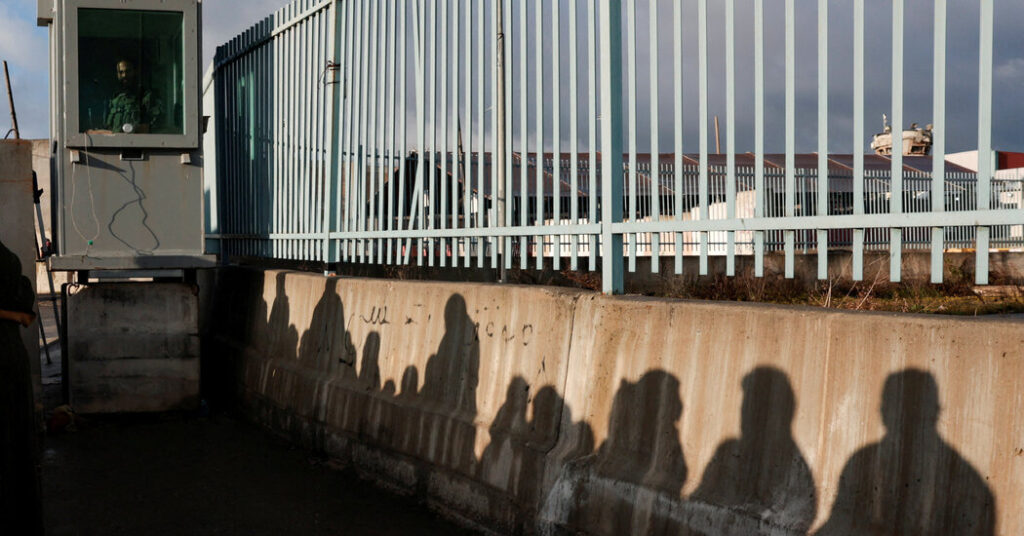
For Palestinians, the reality behind these phrases is concrete: Restrictions and attacks close in from every direction. The road to work can be blocked. An armed settler can enter your land. A family member can be arrested.
Political language is not made only of words. It is also written into the landscape. Over the past two years, organized settler campaigns have put up thousands of Israeli flags along roads, on hilltops and at the entrances to Palestinian villages. For many Jewish Israelis, these flags are a source of pride, presenting Israeli sovereignty over the land as already established. For Palestinians, the same flags assert a sovereignty imposed on them and backed by force they have no real power to challenge. Removing a flag could bring armed settlers or soldiers and end in arrest, assault or worse.
In the report B’Tselem has written, we tried to read these political languages together. The word we settled on to describe what these seemingly separate acts add up to is “elimination.” The logic of elimination does not require every Palestinian to disappear. It seeks to make Palestinian collective life increasingly impossible while securing permanent Israeli Jewish control. In Gaza, the logic of elimination has taken its most extreme form: genocide. In the West Bank, it dismantles the conditions that allow Palestinians to remain on their land and live as a society and a people.
And yet, even as Israel states its goals openly, international governments and institutions keep recasting those aims in conventional political language: a conflict to be managed, an occupation expected to end, an extremist government that needs to be restrained. That reframing lets governments condemn violence without confronting the system behind it. It lets them remain within a reassuring political story, rather than facing their obligations under international law and exerting the sustained pressure it would take to reverse it. It obscures the larger reality: a new phase of the political project to make Israeli Jewish control permanent while dismantling the conditions for Palestinian collective life.
We began this work because we could not find words adequate to describe a reality unfolding before us. Perhaps that difficulty is part of how a colonial order works: Over time, even a reality saturated with violence, fear and destruction can begin to look unchangeable and inevitable. Our task was to make it visible again as something made, not given. What appeared as separate events should be recognized for what they are: political choices in a project of supremacy, dispossession and elimination. To refuse the language that rationalizes the violence inflicted on Palestinians must also mean refusing the system that produces it and insisting that it be brought to an end.
Yuli Novak is the executive director of B’Tselem, the Israeli Information Center for Human Rights in the Occupied Territories.
The Times is committed to publishing a diversity of letters to the editor. We’d like to hear what you think about this or any of our articles. Here are some tips. And here’s our email: [email protected].
Follow the New York Times Opinion section on Facebook, Instagram, TikTok, Bluesky, WhatsApp and Threads.
The post Israel’s Elimination Project appeared first on New York Times.