In a step forward for the cutting-edge field of brain-computer interfaces, a patient with a paralyzing neurological disorder used a brain implant to converse in real time, even when she was simply thinking about what to say, a company said it would announce on Monday.
The development, by the company Paradromics, marks the latest advance for these experimental devices, known as B.C.I.s — systems that involve implanting electrodes in the brain that read neurological signals and decode those signals through artificial intelligence.
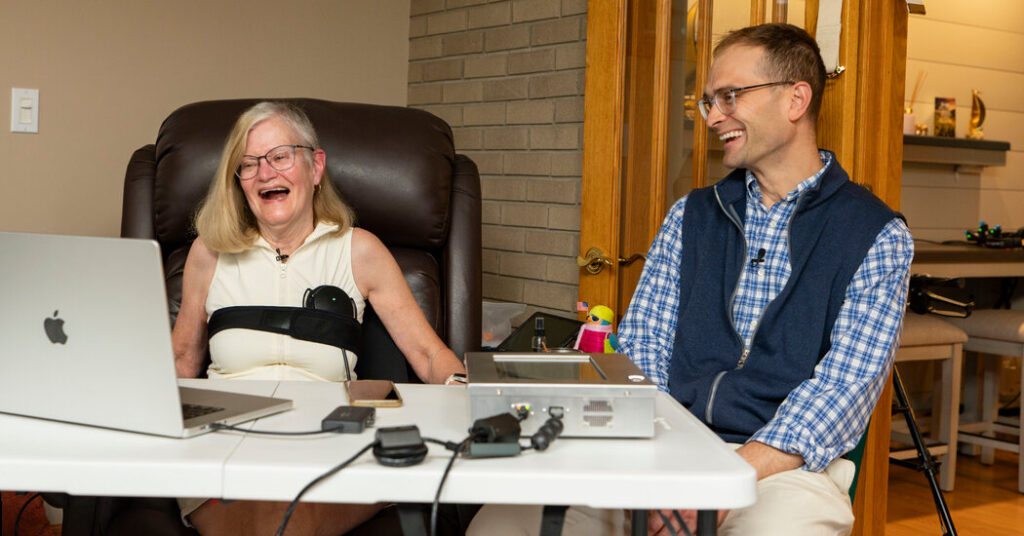
The 68-year-old Michigan woman, who has lost most of her speaking ability, was able to use the device to have spontaneous conversations via a computer-generated voice, including on the phone with her grandchildren. When she physically tried to speak, her brain generated signals that were read by the electrodes, transmitted through A.I. and displayed on the computer screen, which spoke the words aloud. The system could also produce speech when the woman imagined what to say without moving her speaking muscles.
Because the Paradromics system is wireless and doesn’t require the patient to be connected by a cord to a computer, experts said, it offers a demonstration of how patients who have lost the ability to speak might be able to eventually use the technology in their daily lives, greatly improving their ability to communicate with family, friends and co-workers.
The woman, the first patient in the Paradromics clinical trial, was implanted with the company’s Connexus B.C.I. system, which contains more than 400 electrodes, in June at University of Michigan Health.
The trial will include 10 patients around the country with various disorders that cause speech and limb paralysis, such as stroke and amyotrophic lateral sclerosis, said Dr. William Marks, chief clinical officer of Paradromics.
The patient, whose name was not disclosed, has primary lateral sclerosis, which weakens neurons that control movement for talking, swallowing and walking. She retains some ability to use her speaking muscles, but her words are barely understandable to most listeners, Dr. Marks said.
The results reported Monday have not yet been peer-reviewed or published in a journal.
Matt Angle, the founder and chief executive officer of Paradromics, also said the system was able to detect and tell the difference among signals the woman’s brain generated during different activities related to communication. There were distinct patterns generated when the woman was physically trying to talk, thinking of what to say or hearing what others said.
“We can see the representation of words and phonemes whether she tries to say it, she imagines it, or even if she just listens to it” Dr. Angle said.
Experts said that while aspects of Paradromics’s developments have also been achieved by others working on brain-computer interface technology, the company’s results are notable, particularly because the system is wireless and self-contained.
“Their demonstration gets us one step closer to clinical reality for restoring speech communication for people with severe paralysis,” said Dr. Edward Chang, the chairman of neurological surgery at the University of California, San Francisco, who is not involved in the Paradromics trial and whose lab has pioneered and advanced developments in the brain-computer interface field. He added, “It’s wonderful how much progress has been made since we first showed this was possible just five years ago.”
His lab and other researchers have also studied imagined speech representations in the brain and have enabled patients to produce spontaneous speech. But in much of the research, people needed to be connected to a computer with a cable attached to a port in the head, an arrangement that posed a risk that the site might become infected and required people to be tethered to the computer.
A video provided to The New York Times by Paradromics showed the woman being asked earlier this month by members of the research team to say whatever she’d like. She smiled and slowly spoke a scarcely intelligible sentence, which the system quickly decoded and read out with a computerized voice that said, “OK, I have a lot to say.”
Later in the video, she was asked what advice she would like to give to her grandchildren. “Pray continuously,” she said. Asked if she felt she was learning how to use the device better, she said, “It’s a work in process.”
Vikash Gilja, Paradromics’s chief scientific officer, said that the system worked just as well when the patient whispered, which was less effortful for her. If she imagined the words, the decoding was a little less clear, “almost like it comes in and out of focus,” Dr. Gilja said, adding that he thought it would improve as the patient practiced.
One goal of the technology, he said, is to make it easier for patients to learn how to use the system without the burden of trying to move their muscles for speech. Being able to distinguish the patterns of brain signals for imagining speech and listening to it is also important, he added, so that patients can control whether and when they would want their internal monologues to be shared with others.
With advances in technology and artificial intelligence, the brain-computer interface field is making strides.
In another development on Monday, a study by Dr. Chang’s team published in Nature Neuroscience showed that, in three patients with paralyzing conditions, a single array of implanted electrodes could simultaneously decode signals for speech and physical gestures like a hand wave, a thumbs up and a head nod. Previously, brain-computer interfaces have addressed either speech or movement deficits, but the new study put those functions together and found that, by doing so, patients’ ability to communicate improved.
“It is a step towards B.C.I.s that can control the whole body in the digital world,” Dr. Chang said. “Like in the movie ‘Avatar.’”
Companies and researchers have a variety of brain-computer interface approaches. The University of California, San Francisco, team’s method surgically places electrodes on the brain surface. The approach of Paradromics and Neuralink, another company in the field, involves surgery to implant electrodes below the brain’s surface. Other approaches are less invasive, including one that involves electrodes delivered into the brain with a catheter inserted in a blood vessel in the neck.
The less invasive approaches are intended to be more affordable and minimize the potential risks of brain surgery, while the more surgically invasive approaches are designed to detect more specific signals, recording from individual neurons. Some electrode arrays that penetrate the brain’s surface have had good performance only for several months because of issues with stability or scarring, but others “have enabled meaningful long-term performance,” Dr. Chang said. “An important milestone for Paradromics will be to prove that their technology remains stable in patients for many years.”
The Food and Drug Administration’s investigational device program granted permission for the clinical trial, and company officials said they expected Paradromics would need to complete a larger trial before applying for F.D.A. approval of the device in several years.
The post ‘I Have a Lot to Say’: Brain Implant Helps a Disabled Patient Speak appeared first on New York Times.