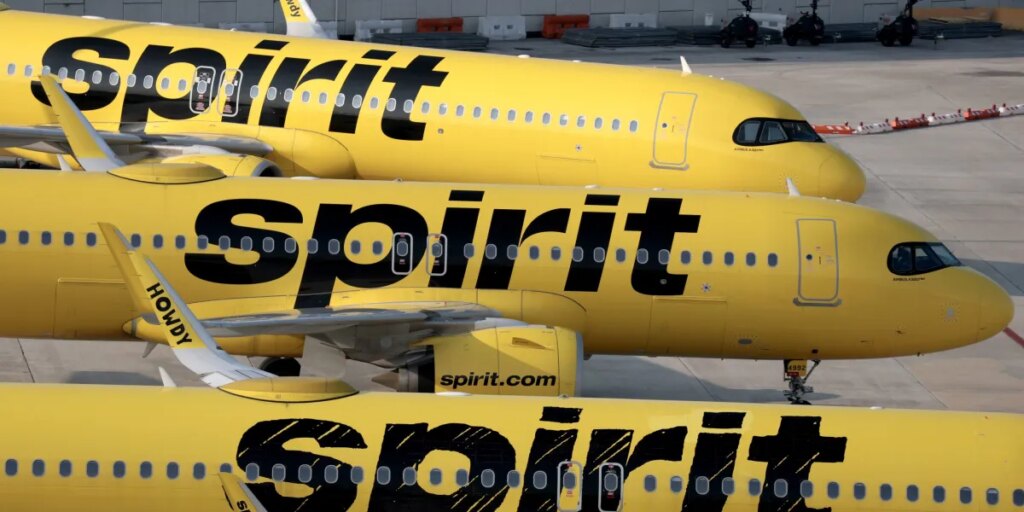
In a sign of just how valuable corporate data has become to AI companies, a little-known startup has swept in to try to preempt Google’s bid to purchase decades-worth of documents, emails, and data from bankrupt Spirit Airlines. Micro1, which was founded in 2022 and is based in Palo Alto, has proposed paying $12.5 million for the trove of records, beating Google’s previous top bid of $10 million. Google itself had beaten out Mercor, which provides data to AI companies, which had bid $7.5 million.
The sale has already proved controversial, with unions representing flight attendants and consumer privacy advocates filing legal objections on the grounds that sensitive personal information of former Spirit employees and customers is contained in the data set and may not be properly redacted or anonymized prior to its transfer to Google. A court-appointed privacy watchdog reviewing Google’s proposed purchase of the Spirit data has said it needs more time to investigate Micro1 if the bankruptcy court considers the company as the buyer. The startup has offered additional privacy promises as part of its bid, as well as offering a 25% price premium.
Consumer privacy ombudsman Lucy Thomson also disclosed in a report filed with the bankruptcy court on the night of Sept.8 that Google had offered to narrow the personal data included in the sale as the parties negotiate safeguards for passenger information embedded in Spirit’s operational systems. Google’s lawyers told her the de-identified data would be used to train AI models.
So far, no sale has received court approval. A hearing is scheduled for Sept. 16.
Who is Micro1?
Micro1 got its start helping companies hire engineers. Ali Ansari founded the business in 2022 while studying computer science and math at UC Berkeley. Its early products included an AI interviewer and a marketplace for technical workers. In early 2025, micro1 moved into supplying human-generated training data. Its specialists also evaluate models and help build simulated environments where AI agents can practice tasks.
Explaining the Spirit proposal in a LinkedIn post, Ansari described AI’s future as a bet on “the messiness of the real world and the brilliance of the humans working inside it.” He said this “realism” lets training environments and tasks match conditions models face in deployment. Micro1 says it can organize and de-identify corporate records for use in model training.
Investors valued Micro1 at $500 million when it raised a $35 million Series A in September 2025. By August 2026, its gross annualized run rate had reached $500 million, TechCrunch reported, citing an unnamed person familiar with the company.
Its court filing in the Spirit bankruptcy proceedings describes a fast-moving data-buying operation. Micro1 said it had completed more than 50 data transactions in the preceding 45 days, without identifying the sellers, prices, or AI-lab customers. It offered to buy Spirit’s archive with cash on hand and cover the cost of de-identification and independent review.
Micro1 also proposed excluding sensitive employment material, storing records in the U.S., destroying raw employment records after processing and giving an independent reviewer a 1% sample of the de-identified assets before onward transfer. It said subsequent transfers would be confined to “named AI-laboratory customers” bound by confidentiality and no-reassociation agreements, although the filing did not name them.
Separately, the pilots’ union argued in its objection to the Google deal that some safety records should remain confidential even after de-identification.
Is $12.5 million a normal price for data?
There is no reliable market average for a failed company’s data. Public figures mix completed deals, micro1’s unsigned proposal and companies’ advertised rates. Among the few examples, $12.5 million is the largest amount identified for this article.
Jonathan Siddharth, the CEO of Turing, which provides human experts and training data to AI developers, told The Informationthat his company had bought five to ten failed-startup codebases, paying an average in the tens of thousands of dollars for each. In April, Dori Yona, the CEO of a company called SimpleClosure, which helps startups shut down and sell their assets, told Forbes the service had processed nearly 100 deals in the preceding year, recovering more than $1 million. He said payments were typically between $10,000 and $100,000 per company. In the same article, cielo24’s former CEO said the transcription company received hundreds of thousands of dollars for 13 years of Slack messages, Jira tickets, emails and Google Drive files. Micro1’s website advertises payments of $100,000 to more than $2 million for approved data packages.
SimpleClosure said in September that its number of AI buyers had grown ninefold compared with 2025. More than 350 companies have listed assets since April on AssetHub, its marketplace for selling or licensing company code and workplace data to AI labs. The marketplace now accepts operating companies alongside those winding down.
Spirit’s scale helps explain the price bidders are willing to pay for its data. The asset schedule lists about 100 million emails, 500 million Microsoft Teams items, code and operational records. Customer profiles and lists are excluded, and passenger fields embedded in included systems must be de-identified.
Frontier models learn from enormous collections of books, websites and public code. A 2025 Epoch AI report, commissioned by Google DeepMind, projected that the available supply of public human-generated text could be fully used before 2030 under prevailing trends. That’s why AI companies are desperate to find fresh data sources.
Private records showing how work unfolds have also become increasingly valuable as AI companies seek to sell AI agents—which can perform actions for users, not just generate documents. While a language model can learn from a finished document or piece of code, an agent needs to learn how to choose actions, use tools, respond to intermediate results and recover from mistakes. AI companies call the record of those steps a trajectory.
Spirit’s archive could supply ingredients for such tasks, for example, an IT ticket linked to a Teams discussion, a code change and an operational result. If those links can be reconstructed, they could support exercises that test whether an agent reaches the right result.
The post Google wants Spirit Airlines’ data. Micro1 wants to pay more. appeared first on Fortune.