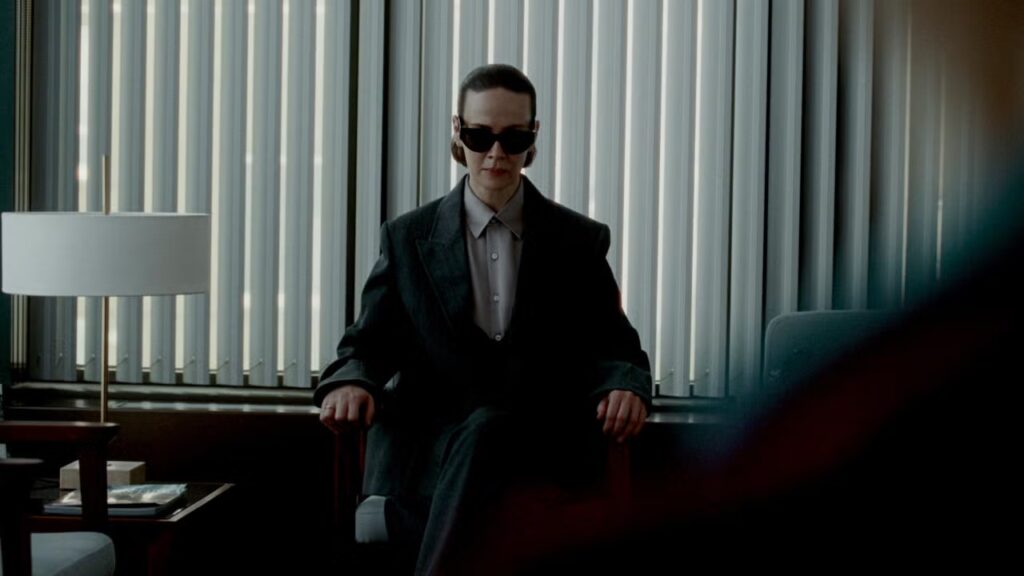
Director Cody Fern’s “Closing Night” offers up a foursome of powerhouse performances from its central actors, but does not know what to do with them — other than make them go to war. It’s a film that acts as a strong showcase for its actors to let loose, and once the finer points of this story lock into place, where it’s going won’t be a surprise to anyone. This “it’s about the journey not the destination” approach would work fine if said journey crescendoed more naturally rather than hobbled towards predictability.
Then again, if you are to witness people crashing out, you won’t find a better coterie than the group Fern has assembled here, who all play fluctuating types of open wounds. The film’s inciting action takes place when renowned movie star Sandra Vale (Sarah Paulson) sends invitations to the members of her estranged family to attend the opening night of her Broadway play. When her sister April (Naomi Watts) and mother, Diane (Dianne Wiest), receive the invite, they react as if they’re hearing from the dead.
April’s more open to seeing Sandra than their mother, but that’s not saying much. For Theo (Toby Wallace), April’s son, he sees the meet-up as a potential way to finally get to know the aunt that has been kept mysteriously at bay for his whole life. It is serendipitous timing, as he and his partner, Lucy (Odessa A’zion), have found out Lucy is pregnant, and could use the support of a wider family network as they navigate next steps.
Is there a difference between news that’s never shared and lies that are never addressed? This idea forms the thematic spine of Fern’s script, which he co-wrote with actor Devon Bostick, as April, Sandra, Theo and Lucy realize that reconciliation and community come at a cost they’re not ready to pay. What we see are people who have formed their sense of self around resentment, which acts as a filter that makes it hard to see the truth: even if they see evidence of change, a calloused heart casts a biased spell. When Fern and Bostick’s script tries to ruminate on the irony of this duplicity, of being unable to see someone in a new way because of how they’ve been in the past, it is at its most gripping.
The only issue is that the filmmakers aren’t able to figure out a way to express this idea in any way other than structuring their script to incorporate a series of shouting matches, wherein permutations of the characters are paired at a given moment to argue.
Paulson’s Sandra is the standout, who can’t be described in any other way than a force of nature. She’s all id, unresolved mommy issues, icy stares, draped in lavish coats and designer sunglasses. Sandra is irascible, but Paulson always finds a way to remind the audience of the humanity that exists beneath her vociferousness. Yves Bélanger’s cinematography is also worth noting, mainly for the patience with which he’s willing to linger on the characters’ faces. He lets them fully unravel, awkward pauses, stuttered words and all, which makes it hard to predict what a character might say next. It communicates a sense that we’re watching real people, whose confessions and diatribes aren’t edited but come from an unvarnished place.
The film is perhaps unintentionally humorous, and I choose that word carefully, because I wonder whether the moments that I found myself and the audience laughing were due to purposefulness on Fern and Bostick’s part, or if it came from a mismatch between the drama happening on screen and the characters’ reactions to it. Once Paulson’s Sandra receives a life-threatening diagnosis, there are jokes about self-harm and suicide that feel inappropriate to laugh at. That may very well be by design, but the lack of clarity I felt about these moments of cringe was frequent enough to make me wonder whether the duo had a firm enough grip on their script or if they were aided by performers who added more to their material.
Fern delights in centering his film on ways siblings, parents and lovers test the unearthing of buried truths, when characters finally say what they’ve always wanted to but previously lacked the language for. It’s a film about how the secrets we bury don’t die from asphyxiation, and don’t just become stronger and uglier the more they remain hidden; they also find ways to infiltrate other parts of our lives.
It’s a message worth hearing, and this film, rather than acting as a coda for these ideas, can instead just be a rehearsal for Fern to craft something with more nuance later down the line.
The post ‘Closing Night’ Review: A Ferocious Sarah Paulson Buoys Cody Fern’s Directorial Debut appeared first on TheWrap.