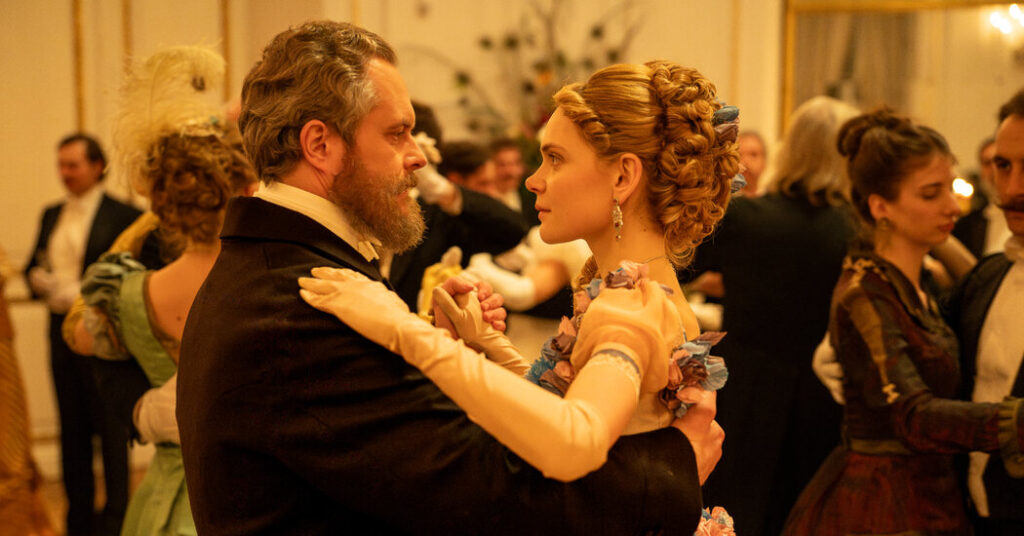
It’s an epic novel with many elements of Edith Wharton or Henry James: wry commentary on class and the upper crust; intrigue and scandal in luxurious drawing rooms; and a tale of doomed love. But rather than New York or London, it’s set in 19th-century Warsaw.
The novel, Boleslaw Prus’s “The Doll,” is revered across Poland as a masterpiece, yet abroad it’s more obscure. The London Review of Books once called it “perhaps the least known major 19th-century novel.”
That could change on Wednesday with the release of a lavish six-part Polish-language adaptation on Netflix that has the potential to introduce “The Doll” to millions of international viewers searching for the next “Bridgerton” or “The Gilded Age.”
In a twist of timing, a separate film adaptation will be released in Polish movie theaters on Sept. 30. The closeness of the releases, the first screen versions of “The Doll” since a 1977 TV mini-series, has led to jokes in Poland about “Dollheimer,” a reference to the “Barbenheimer” phenomenon.
Katarzyna Zechenter, an associate professor at University College London, said that Polish literature had been dismissed abroad and was rarely translated in the decades after World War II, when Poland was under Communist rule. “Selling it, distributing it, making film adaptations — there was no market for it,” she said.
But, she added, that is changing. “Poland is becoming an important Central European society,” both politically and culturally, Zechenter said. “That’s why Prus makes sense now.”
“The Doll,” or “Lalka” in Polish, was first serialized in a newspaper and then published as a book in 1890. It follows Stanislaw Wokulski, a wealthy Warsaw businessman from the emerging merchant class who develops an infatuation with Izabela Lecka, a beautiful aristocrat who, as Prus writes, “knew how to tyrannize men with her coldness.”
It is a darker and more twisted love story than those in your average “Bridgerton” season.
Like much of the Polish aristocracy at the time, Izabela and her father are in financial decline. For Izabela, there’s constant pressure to marry someone rich, but she chafes at being forced into it.
So she responds to Stanislaw’s desperate advances by using him for his money. “Bite by bite, we will devour Mr. Wokulski,” she tells her father. “And he will be glad that he can look at me from the plate.”
The show has all the usual frills of extravagant period drama: balls, duels, corsets and palaces, as well as elaborate wigs and mustaches. Recreating 19th-century Warsaw, which was largely destroyed in World War II, involved filming in several other Polish cities and using ornately designed sets and C.G.I.
But some complexities that were central to the almost 700-page novel are missing. When “The Doll” was published, the area around Warsaw was part of the Russian Empire, and certain plot elements were changed to pass Czarist censors. The book explores at length the local aristocracy’s decline, the eruption of Polish nationalism and debates about the role of science in society.
That’s a lot of context to weave into a limited series or a movie, which is why adaptations tend to zero in on what Zechenter called “the horrible love affair.”
That, too, needed some adjusting, said Pawel Maslona, the Netflix series’ director and co-writer. The series is not necessarily a faithful adaptation, but a reinterpretation of the book, he said, which he viewed as a starting point, the way “Americans approach the myth of the Batman.”
Izabela was particularly ripe for an update. In the past, she was viewed as a greedy, vapid villain. (She was also frequently assumed to be “the doll” of the title, though Prus disputed this after the book was published.) Today, readers and viewers might see her as trapped by, and reacting against, the constraints put on her as a woman.
Sandra Drzymalska, who plays Izabela in the show, said that even though Izabela was “spoiled” and “a bit rude,” the actress had wanted to make her “a modern girl” who “wants to be something more” than someone’s wife. A major focus of the series is a subplot about Izabela’s ambition to write for a progressive newspaper run by women.
Drzymalska said this drive for self-improvement was ultimately why her Izabela ends up falling for the social climber Stanislaw. “They understand each other,” Drzymalska said, because they both “want to be something else.”
Stanislaw’s love is often characterized as “obsessive” in descriptions of the novel, and its intensity plays a role in his downfall. He uses Izabela’s need for money to control her, and in one sequence in the Netflix show he painstakingly builds a replica of her bedroom in his own home. That might be why the trailer uses Radiohead’s “Creep” in the background.
Modernizations aside, the real question might be how some Polish audiences, or other devotees of the novel, will feel about some of the wilder plot changes. The last episode contains twists likely to shock even a casual reader of “The Doll.”
Maslona said the “crazy direction” that the series eventually takes ended up being “a little bit surprising, even for us.”
The post Can a Polish Epic Become the World’s Next Period Drama Hit? appeared first on New York Times.