In the coming season, many museums across the country appear to be keeping their heads down. This is likely a response to bullying from the White House, with its claims that the Smithsonian museums focus too heavily on slavery, civil rights and immigration, and its recent purge of public artwork from a U.S. embassy for being too “woke.”
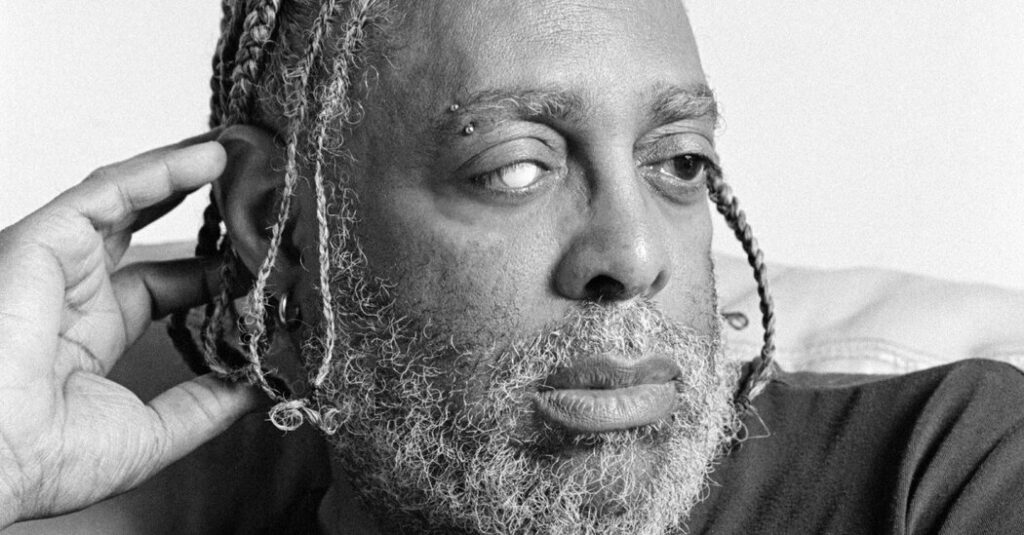
Marquee exhibitions this fall dealing with liberationist themes around race or gender will, judging by advance schedules, be few. Which automatically gives the New Museum’s survey of work by the artist-filmmaker Arthur Jafa hot-button status.
“The show will certainly be an alternative way to ‘celebrate’ the 250th anniversary of this country,” Massimiliano Gioni, the director of the New Museum and a curator of the exhibition, told me.
Jafa (pronounced Jay-fa) is best known for his 2016 film, “Love Is the Message, the Message Is Death,” which starts with a video clip of police gunning down a Black man, followed by another of Barack Obama singing “Amazing Grace.” It continues with a rapid-fire seven-minute visual essay on anti-Black racism and Black-generated creativity, set to a gospel-tinged anthem by Kanye West.
The piece attracted rapturous art world attention when it debuted at Gavin Brown’s Harlem gallery three years into the Black Lives Matter movement, and four months into the first Trump presidency. Soon afterward, it ended up being streamed on the websites of more than a dozen museums, becoming a de facto gesture of protest in a high-stakes political moment.
Three years later, Jafa’s similarly montage-format, found-image “The White Album,” a coruscating perp-walk tour of American white supremacist culture, won the Golden Lion best artist award at the Venice Biennale. (Jafa also has work in this year’s Venice show.)
Both films will be centerpieces of the New Museum exhibition, Jafa’s largest museum survey to date. Opening Sept. 24 through Jan. 3, it is titled “I Am Tony,” a quirky reference to Tony Williams, Miles Davis’s empyreal drummer. Together the films project alternately outraged and euphoric versions of United States racial history.
”The whole Trump, the whole MAGA thing, is such a willful attempt to disremember,” Jafa said in an interview over the summer. “I like to hope that the arc of the moral universe bends toward justice, but that doesn’t mean that we’re not going to go through some horrifying times.”
Yet he also insisted, “I’m not a protest artist. It’s not my thing. I know my themes find themselves in conflict with American delusions about history. And I’m told a politician saw one of my shows and said, ‘This is incredible. We’ve got to mobilize people!’ As I’ve said many times, I’m not in the uplift business. I’m in the undertaker business.”
Which I take to mean that Jafa, 65, views his art as investigative, even autopsical, rather than remedial in intent.
We met in the small two-story building that is Jafa’s studio in a once-fancy, now-scruffy neighborhood in South Los Angeles, his home-base city for the past several years. The crashpad-ish, mattress-on-the-floor space is filled with stacks of photos and shelves of books: “Atlas of the Transatlantic Slave Trade,” “Marcel Duchamp: Box in a Valise,” “Bernini,” “Jean-Michel Basquiat: The Notebooks,” “The Jazz of Physics,” “Jesus in the Talmud.”
It’s a kind of walk-in scrapbook, which has been the basic format of Jafa’s poly-cultural, multidisciplinary work all along, exemplified in Jafa’s recent D.J.-style curation (teasing, confusing, this-surprise-next-to-that) of “Artist’s Choice” at the Museum of Modern Art in New York. Drawing from the museum’s collection, Jafa matched up graffiti art, quilts and African photography with classic paintings by Piet Mondrian and Mark Rothko.
Eclectic could also describe Jafa’s personal history. He was born Arthur Jafa Fielder in 1960 in Tupelo, Miss. He soon moved with his family to Clarksdale, a more integrated city that advertises itself as “Home of the Blues” — Sam Cooke, Muddy Waters and John Lee Hooker were born there or raised nearby. But it was in the heart of the Delta region notorious for its track record of racist killings, including that of Emmett Till.
Although Jafa’s parents were Baptist, they enrolled him in a Roman Catholic school with the hope that he’d get a stimulating education. He did.
“I ended up obsessed with the Catholic Church,” he said. “It’s all over my work. I think a lot of my exhibition practice is clearly informed by my having been an altar boy for eight or nine years. That’s highly structured activity. The priest says a certain thing and you ring a bell, then you light a candle.” It gave him, he said, a sense of “processional order.” He briefly entered a seminary with the intention of becoming a priest.
The church experience also seems to have given him a perception of images as a source of drama when placed in unexpected ways next to one another, as happens in his videos. You don’t get this so much in Black art produced in the United States, he explained, where the church is primarily Protestant and without icons. But it’s strong in a society that’s Catholic, like that of Haiti or Brazil.
“You find this particular kind of visual drama in an artist like Jean-Michel Basquiat,” Jafa added. “It’s no accident that he had a Haitian father and a Puerto Rican mother.” (Of his own relationship to religion Jafa has said, “I’m not a believer, but I believe in Black people believing.”)
Jafa describes himself as having been a moody, bookish kid who, starting young, compiled volumes from images he clipped from newspapers, comics and magazines, an accumulative habit he maintains. He was also an avid moviegoer. He remembers seeing, at age 10, Stanley Kubrick’s “2001: A Space Odyssey” and being blown away. “The lights go down, the movie begins, and it’s like being buried alive,” he has written about the experience.
(He came close to duplicating it in the 2021 near-abstract video called “AGHDRA,” a digital animation of a churning sea — the Atlantic? — as black as a late Rothko painting and accompanied by a score of pop soul songs slowed to the speed of laments.)
Jafa attended Howard University in Washington to study architecture but wound up learning filmmaking and took it up professionally as cinematographer for the 1991 film “Daughters of the Dust,” written and directed by his then-wife Julie Dash. (They divorced after the collaboration and have a daughter, N’Zinga Fielder.) He went on to work as a cameraman on Spike Lee’s 1994 film “Crooklyn,” and in 1999 on Kubrick’s “Eyes Wide Shut.”
Feeling restless with his career, Jafa started making sculptures from found materials. He wanted to make films of his own but got little support. An out-of-the-blue invitation to be in a gallery show brought him to New York City, followed by inclusion in the 2000 Whitney Biennial. But he found the mostly white art world a dispiriting environment and largely dropped out of circulation for almost a decade.
This interlude gave him time to ponder the context in which he wanted to have his art made and seen. “I grew up with some artists who thought ‘I’m an artist first, not a Black artist,’” he told me. “They were running away from being Black in order to be seen as ‘universal.’ My art is super-Black. My interests are super-Black. But for me, Black is not a narrow idea.”
By 1992, in a conversation with a close friend, the critic Greg Tate, Jafa formulated a statement of personal ambition: to create “a Black cinema with the power, beauty and alienation of Black music.”
And this is the ambition he pursued when he returned to art full time. “When I made ‘Love Is the Message,’ I was in my 50s,” Jafa said. “So my career got a late start. But it’s always better to be a little late than a little early, I was told by my dealer Barbara Gladstone.”
In the catalog accompanying his New Museum show, Jafa defines Blackness as a specific identity, one forged in the holds of slave ships: “One’s status as an African isn’t just overridden, it’s overwritten. Different ethnicities, gender, all that stuff gets leveled. By the time we get to the Americas we are Black.”
In his telling, it was music — ineffable, irrepressible — that became, in its many forms (gospel, jazz, blues, reggae, hip-hop), the expression of this Blackness, and the model, in its moods and energies, for his work.
Encouraged by the filmmaker Kahlil Joseph, the painter Kerry James Marshall and other friends, he returned to filmmaking with experimental videos pieced together from internet-harvested images.
One of the nine videos in the New Museum show, “akingdoncomethas,” a 2018 feature-length compilation of musical and oratorical performances in Black churches, is, right up front, about the power and beauty of Blackness.
In most of his films made before and after this one, bursts of brightness recur, in shots of artists, athletes, musical performers and political heroes. But what repeatedly hold attention are images of alienation.
Many are appropriated documents of race-based violence: an 1863 photograph of an enslaved man’s back scarred from whipping; a 2015 security camera shot of the neo-Nazi Dylann Roof entering a Black church in Charleston, S.C., and exiting after killing nine parishioners.
There are examples of staged violence in “I Am Tony.” Jafa’s 2024 remake of the concluding splatter-film scene of Martin Scorsese’s “Taxi Driver” replaces the gunned-down white characters of the original with Black actors and repeats the massacre with minor changes, 17 times. (ARTnews called it “a nauseating disappointment” in a review.)
And there’s a fair amount of theatrical, in-your-face freakishness in the show, as in a 2018 photographic self-portrait titled “La Scala,” in which Jafa vamps, in drag, as the 19th-century New York transgender sex worker Mary Jones.
Blackness, the message is, whether by fate or by choice, is always outside the circle of safety. Its ever-threatened status is both the root of its identity, and the source of its power.
According to Jafa, among the pioneers of modern art, it was Duchamp, not Picasso, who got the message right. In a 2015 essay titled “My Black Death,” Jafa wrote that both men were riveted by African sculptures brought, as colonialist trophies, to Paris. Picasso adopted the look of the sculptures to change Western art — think of the jagged facial shapes, inspired by African masks, of the women in his 1907 painting “Les Demoiselles d’Avignon.”
Duchamp understood that what was truly revolutionary about African objects was not their form but their social, which also meant spiritual, function. They were alive, which made them fundamentally unassimilable, alien, in a secularized Modernist context.
“As much as he has been praised, there isn’t a consensus about the way A.J. presents Black imagery,” Gioni said, using the artist’s nickname.
Indeed, some people have problems both with what might be perceived as a provocative dynamic in Jafa’s art, and others with his longstanding collaborative relationship with Kanye West — Jafa directed his 2020 music video for “Wash Us in the Blood” — who is known for making antisemitic and pro-Nazi statements.
Jafa defended their connection in an email after our interview: “Love Ye. He’s been incredibly supportive of me. He’s a person and artist I deeply respect and clearly a genius. Plus, I’m not into discarding Black folk simply for things they say. And, just imagine if we held the President and crew to those same standards.”
What the New Museum exhibition will actually contain remains something of a question, even for Gioni and Gary Carrion-Murayari, the curators. In his L.A. studio, Jafa walked me through a digital mock-up of a two-floor-plus installation, to which he could still be adding up to the last minute a new mural-scale abstract painting titled “More Real” and a new video focusing on Michael Jackson, in addition to sculpture, photographs, paintings and wallpapers.
“A.J. has always challenged accepted ideas around finality. He wants the exhibition to be unstable,” Gioni said, before inquiring if, by chance, I had noticed whether a 2002 sculptural installation the museum had asked the artist to reconstruct was included in his mock-up. Yes, it was. And I could understand why the museum wanted it. Combining the body of a ruined Pontiac Trans Am, references to Blaxploitation films of the 1960s and a John Coltrane recording, the piece was an early embodiment of Jafa’s complex, mortality-haunted take on Blackness, and of the “big bang” (as he calls it) effect he gets by putting found “readymade” materials together.
But, Jafa said, sitting back after the computer tour, he isn’t really much focused on individual works in the show, “which I think of as being an experience, like a record album, a conceptual rock album, like Jimi Hendrix’s ‘Electric Ladyland.’ I want it to be like a D.J. set.”
He’s already looking beyond the show toward an extended residency in Bahia, Brazil. “It’s not like I’m taking a break from the art world exactly,” he said, “but I feel like I’m coming to the end of a certain cycle. I’m increasingly not interested in making art that’s good or bad. I just want to make things tailored to my own obsessions. I really want to make movies.”
“And a movie I want to make,” he added, “is about Larry Levan,” the gay Black D.J. who, at the 1980s Manhattan nightclub Paradise Garage, produced marathon, multiracial dance events that helped revolutionize the way Blackness could be accurately perceived as a disruptive outsider presence that continues to shape and inspire the culture at large. (Levan died in 1992, at 38, of heart disease.)
For Jafa, Levan embodied this force. “He’s like a patron saint of my aesthetic,” Jafa said, “because he was a D.J., acknowledged as the greatest D.J. of all time. For me, he and Duchamp” — another great disrupter — “are right there together. That’s the space I’m operating in.”
Cinematography by Sophia Alloggiamento.
The post Arthur Jafa, the Great Disrupter, Readies a ‘Big Bang’ appeared first on New York Times.