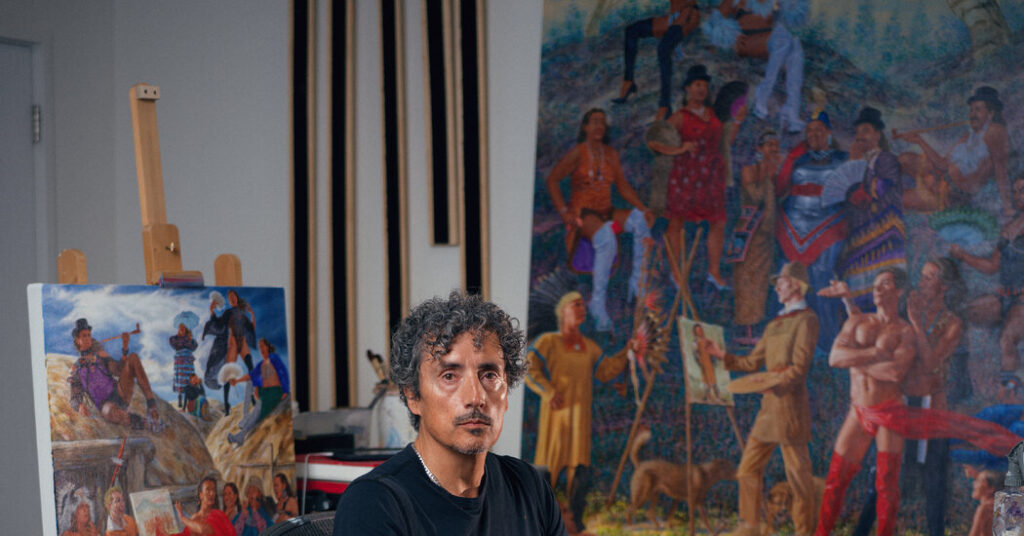
The artist Kent Monkman has a mischievous, gender-fluid, often scantily clad alter ego, and he doesn’t mind being upstaged by her. She was hard to miss in the two gigantic paintings he did for the Metropolitan Museum of Art’s Great Hall in 2019.
Who was this trickster goddess in stilettos and not much else? Why did she seem aware of viewers watching her from outside the frames?
Monkman is happy to seduce his audiences into these questions, leaving them to wonder. The Cree, two-spirit artist has gained a following in museums because of his ability to attract viewers to his romantic, slightly askew landscapes. He seeks to unsettle and entertain; after all, an alternative pronunciation of his alter ego’s name, Miss Chief Eagle Testickle, is “Mischief Egotistical.”
In November, Monkman’s subversive approach to these landscapes and ethnographic portraiture will appear in an institution that has rarely shown such transgressive work: the Frick Collection, a Gilded Age coal tycoon’s mansion whose collection usually veers toward Rembrandt and Velázquez. Monkman’s exhibition, “Officer and Laughing Girl,” is inspired by a 17th-century Vermeer painting of the same name in the museum’s collection and will include paintings in which Miss Chief sits face to face with white authority figures through the centuries.
It arrives at a fraught moment in America, when nationalist ideas like “manifest destiny” are returning to public discourse and President Trump has declared that Lake Ontario should become Lake America.
Monkman is the first Native artist to have an exhibition at the Frick. His suite of commissioned paintings started as a 2023 book project with the collection’s chief curator Aimee Ng, who encouraged Monkman to explore Vermeer’s “Officer and Laughing Girl.” Monkman has turned the canvas into a time machine, borrowing the composition for a standoff through the centuries between Native groups and white settlers. The Dutch are here. The fur trappers are here. Even Gen. George Custer is here, with a portrait of his nemesis, Sitting Bull, hanging in the background. The final painting of the series, arriving at the present, includes a bald tech executive with an uncanny resemblance to Jeff Bezos.
“History paintings are meant to be morally edifying,” said Ng, explaining that while the genre normally reinforces an audience’s beliefs, Monkman’s bold interventions provoke more questions. “He asks if this is the history you know. Is it everyone’s history? What parts of that history are fictionalized?”
Monkman, 60, asked himself similar questions as a child visiting the Manitoba Museum in Winnipeg, Canada. “We encountered Indigenous people living on skid row around the museum,” he recalled. “Inside the museum we saw historical displays and representations of Indigenous peoples, but the museum offered no education about the devastation of the colonial project or the policies of genocide and dispossession.” (The museum has since updated its exhibitions, oftentimes in consultation with First Nations groups.)
In Winnipeg, he was raised on the stories of his great-grandmother, Caroline Everette, a Cree woman born in 1875 whose family the Canadian government forcibly relocated three times. She had 13 children; most were sent to residential schools, which were known for their cruel attempts at stripping students of their Indigenous identities. Only three survived into adulthood, including Monkman’s grandmother. The artist has frequently painted images of the residential schools that feature Indigenous children with short hair, huddled together.
“I feel like my worldview is shaped by being Cree,” Monkman said as we drove through the back streets of Toronto. “There was no backup plan to being an artist.”
We had just visited the foundry where his first public artwork was being assembled with the help of a robotic arm, which was carving beavers from foam blocks, and the sculptor Danella Duranti, who was molding wax into the shape of the large rodents’ fur under Monkman’s supervision. She had pinned one critter’s arms to its stomach, which had imbued it with the coquettish look of Botticelli’s “The Birth of Venus.” Other showstoppers included a lyre-playing beaver, an astronomer beaver and a beaver couple intertwined in the lowest level of their shared dam.
The complexity of this bestial bacchanal has led to delays. Monkman expected the finished artwork to be installed this fall on the lookout point of a new art trail that is part of a $1.4 billion development project on Toronto’s waterfront — once the two dozen beavers were foamed, waxed, cast, bronzed and welded into place.
There is crossover with his project at the Frick; Monkman’s self-described “beaver era” extends to the green toile wallpaper he designed for the exhibition, featuring illustrations of beavers painting, shooting arrows and drinking wine.
Compared with some of Monkman’s previous artworks, the beavers are tame. The artist often depicts sex and violence in his work. In 2020, he apologized for a painting that included a sexually explicit depiction of Prime Minister Justin Trudeau.
Ng said the artist was a good partner to museums. She assured that his commission wouldn’t cross a line with Frick audiences, who tend to have more conservative attitudes about contemporary art. “He is not not going to be Kent,” Ng said, adding that she still anticipated pushback from viewers who “have a certain view of Vermeer that they want to keep sacred.”
For other curators who have worked with the artist over the last couple of decades, Monkman has distinguished himself as attuned to his audiences. Recurring figures like Miss Chief and the beavers are part of his artistic universe, giving viewers an entry point.
“Nothing is by chance,” said Randall Griffey, a former Met curator and one of Monkman’s greatest supporters. He changed the trajectory of the artist’s career in 2019 with the Met’s first Great Hall commission. Then, as head curator of the Smithsonian American Art Museum, Griffey acquired Monkman’s portrait of Teddy Syrette, a two-spirit Anishinaabe member draped in a pride flag, which is expected to be part of the institution’s major rehang this fall.
“I always appreciate his sense of humor,” said Griffey, who is now the program director for American art at the Henry Luce Foundation, a nonprofit that provided a grant for Monkman’s exhibition at the Frick. “Kent is an effective communicator, and his best work is sumptuous enough to draw you in,” Griffey said.
In the 1980s, Monkman worked as a storyboard illustrator. There was something freeing about the low stakes of his creations for marketing firms. “I worked on ads for companies like 7Up, and I knew that thousands of my drawings would just end up in the trash,” he said. He also earned a steady income and learned how to market oneself.
“We grew up poor, so being able to support myself was essential,” Monkman added. “Studying illustration was the closest I could get to being an artist as a teenager and young man.”
For most of his artistic career, Monkman has worked independently from the gallery system. No dealers subsidize his production costs or the salaries of his 18 employees, many of whom have taken over functions of the gallery that manages his portfolio and sells his work.
“If I don’t have that drive as an artist, then who else will?” Monkman asked. “I learned a long time ago that it won’t come from anybody else. Naïvely as a young artist, I thought a gallery would take care of an artist and advance everything for them. I learned that doesn’t really happen.”
Having control over his career, Monkman said, allowed him to dream bigger.
“He is expanding at some risk,” said Ng, the Frick curator. She pointed to a renewed engagement with abstract painting, which he largely abandoned in the 2000s. She also mentioned a fictitious memoir of Miss Chief that he wrote with Gisèle Gordon, a former girlfriend; an upcoming opera that recently had a workshop featuring Laurent Bergeron, his longtime romantic partner; and plans to build a Monkman museum on his 450-acre estate in Prince Edward County, about two hours east of Toronto.
Monkman keeps his friends close, recruiting them for projects as reference models alongside dozens of Indigenous people recruited through online posts. The models are photographed with props designed by his studio assistants and in poses directed by the artist to evoke historical paintings. A Photoshop composite informs the final image, which Monkman paints alongside his assistants.
Bergeron, who declined to be interviewed, appears in multiple paintings as white authority figures like General Custer or a more frequent subject: George Catlin, a 19th-century artist who specialized in painting Indigenous people.
Some historians have argued that Catlin’s paintings romanticized Native tribes at a time when many people believed that those groups were on the verge of extinction. As Catlin wrote in letters, he preferred to see Indigenous people as “the living monuments of a noble race,” arguing that his work should be treated as a national treasure. It was — the Smithsonian eventually acquired more than 500 of his paintings after his death.
“He was such an impresario,” Monkman said in his studio as he presented two new artworks imagining the frosty reception Catlin receives from the Indigenous people he painted. Monkman stepped back from the large canvases to get a better look. “He is a very clear depiction of an artist and his ego,” he said.
Monkman declined to explain what it meant to cast his lover as the antagonist in his paintings but said there was a practicality to it. “Laurent, as a natural performer, is an excellent model and actor, and we have a lot of fun with the collaboration,” he explained.
Monkman’s own avatar, Miss Chief, emerged in 2003 as a response to Catlin’s dominance in historical depictions of Native peoples. She walked on water, with an erection, in the beaming sunlight. She rode in a scallop sled across the Atlantic Ocean, gripping reins tied to a dolphin. She shrugged at a Mark Rothko painting while passing it on horseback.
She was a contrapuntal force of ego, allowing Monkman to imagine encounters with consequential figures like Catlin or — soon — reclining in the sunny room of a Vermeer painting. She was often pursued but never conquered.
The post An Indigenous Painter Sees a Vermeer, and the Sparks Fly appeared first on New York Times.