Times Insider explains who we are and what we do and delivers behind-the-scenes insights into how our journalism comes together.
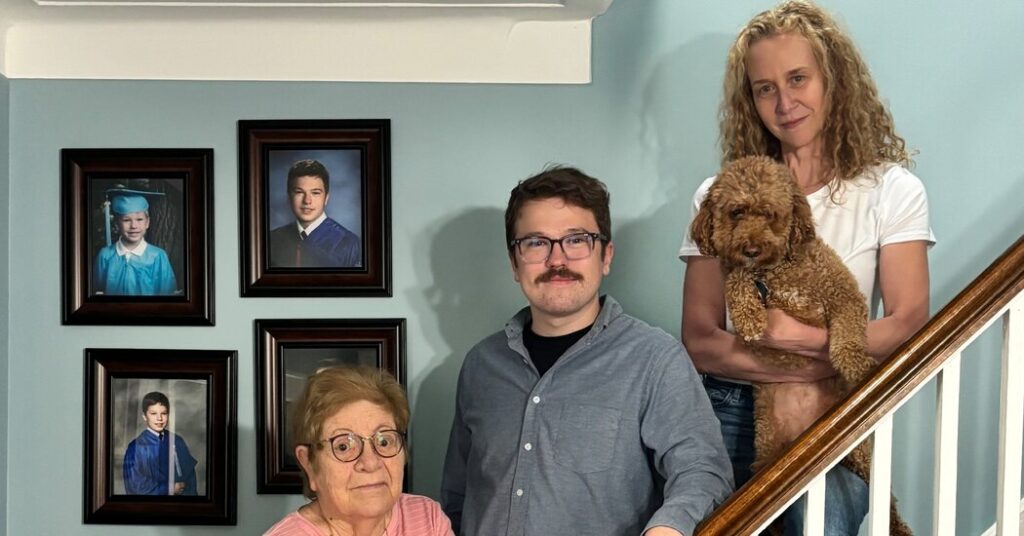
When Jeanne Maurer, 85, told me last year that she was lonely after the sudden death of her dog, Zak, I could hardly bear it. I showed up on her doorstep a few weeks later, Zabar’s bag in one hand and my dog’s leash in the other.
Over chicken salad on pumpernickel, we sat at her dining room table for hours, talking about her life before and after her daughter Jill Maurer Campbell was killed on Sept. 11, 2001. Jeanne had always tried to hold in her emotions. But when Zak died, “I couldn’t stop crying for weeks,” she told me. It came flowing out of her, “all that grief.”
For years, I had known Jill’s son, Jake Campbell, whom Jeanne had raised with her husband, Joseph, after their daughter was killed at 31. (A fire department captain, Joe died of a cancer linked to 9/11 toxins, in 2014.)
I met Jake, 25, in 2018, reaching out to him on Facebook after reading a heart-rending article about him in The Wall Street Journal. We became friends and grew particularly close in the last several years.
His Grandma Jeanne is a warm, doting woman who won’t let you help clear the dishes. “Fuhgeddaboutit,” she will say when you try.
I bonded with her last year when Jake invited me to join them at the annual ceremony to commemorate the attack on the World Trade Center.
As they walked near one of the reflecting pools, I noticed Jake take his grandmother’s hand in a gesture of protection and affection. In my imagination, I could envision the scene in years past. Jake as a little boy and Jeanne, his avuncular and loving grandmother, clasping his hand.
How had the years shifted their dynamics of grief? Had they?
Perhaps, I thought, I could write about Jake and Jeanne and how they had each tried in their own ways to cope with Jill’s death and the gaping absence it left in their lives.
The resulting article was published last week in The Times.
It is unusual, as a reporter at The Times, to write about people you have personal relationships with. Even more, we rarely make ourselves part of our stories. In fact, my job demands that I fade into the background and observe people and circumstances from an emotional distance.
Writing about Jake and Jeanne would call on me to do the opposite — to write about people I know and care for, and to insert myself into the story so readers would be well aware of my connection. Doing so would force me to walk a complicated line as a journalist, prioritizing angles that were relevant to readers without sacrificing personal relationships that I value.
But I also realized that these relationships — especially the one with Jake, which has let me watch him mature from a teenager into a man — would allow me to draw them out to discuss the intimacies of grief in a way that an arm’s-length, dispassionate reporter could not.
In June, with the 25th anniversary of Sept. 11 approaching, I asked Jake if he would consider letting me report a story. He talked to his grandmother, and they agreed.
Then I pitched the idea to my editors, making clear my personal relationship and the requirement that I integrate myself into the story. Let’s give it a try, they told me.
I devoted most of August to reporting this article — speaking to Jake, on video and over the phone; meeting with Jeanne in person, with my dog sitting at her feet. (“Don’t come over without Gertie,” she told me.)
Despite knowing Jeanne and Jake as I do, I was unprepared for the emotional depth of the conversations.
When Jake, a Catholic, explained to me, a Jew, that he had healed some of his wounds by thinking of Jesus’ lesson that the only answer to “pain and suffering” is “to treat people with kindness,” I felt I was in the presence of a sage.
When Jeanne, Jake and I sat down together, and Jeanne said she struggled to believe in God because of the suffering of children, Jake told her that he believed in God because of the example of goodness Jeanne herself modeled. “What could have happened to me?” he asked her. “Where could my life have gone?” My heart was pounding.
I wrote multiple drafts. It was hard to get the balance right, hard to know how little or how much of myself to include. Once the story was in reasonably good shape, I fact-checked what I had written with Jake and Jeanne in the exact way that I fact-check most of my stories. I went line by line.
I was a bit worried that they would try to take back some of the intimacies they had shared once they realized their words would be laid bare in The Times. But they did not.
There were moments when I had to highlight details I thought the story needed despite Jeanne’s concern. I managed this as I would manage such an issue in any story, with transparency.
For example, she shared with me her struggle between missing Jake, who now lives in New Hampshire, and her strong desire that he not make life choices out of concern for her. “Don’t tell Jake,” she said. “I don’t want him to feel like he has to be home with Grandma.”
But it seemed important to me to ask Jake about how he manages the pull he feels between the home of his childhood and the home he is trying to build. “Jeanne,” I told her, “I promise you that Jake knows.” (He did.)
The day after the article was published, I once again joined Jeanne and Jake (and this year, Jake’s girlfriend, Abby,) at the annual ceremony at ground zero.
Grandmother and grandson stood side by side at the spot where Jill’s name is cut into the bronze memorial. “Another year,” Jeanne said. As they walked away, Jake grasped his grandmother’s hand.
The post A 9/11 Story That Forced Our Reporter to Make an Unusual Choice appeared first on New York Times.