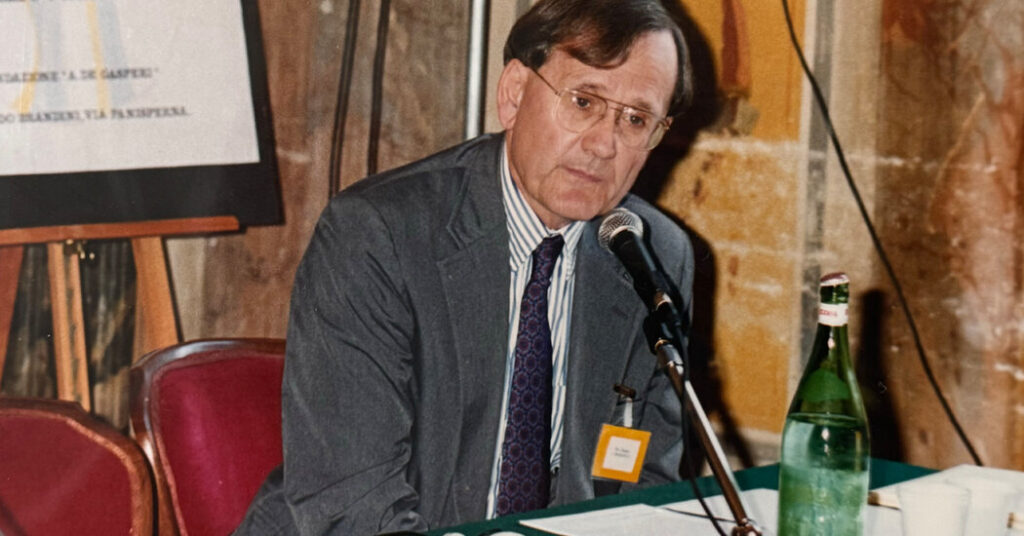
Thomas Graham Jr., an American lawyer and diplomat who played a central role in negotiating nuclear arms treaties for nearly 30 years during the Cold War and for several years afterward, died on Sept. 3 at his home in Washington. He was 92.
His death was confirmed by his stepdaughter, Missy Ryan.
Mr. Graham dedicated his life’s work to eliminating, or at least lessening, the overwhelming threat of nuclear annihilation that hung over the globe for decades.
Beginning in 1970, when he joined the Arms Control and Disarmament Agency as a young lawyer, Mr. Graham had a hand in every one of the alphabet-soup of arms control treaties — some 20, including SALT and START — that were once a main focus of American national security policy. He served four presidents as chief counsel of the now-disbanded agency and was President Bill Clinton’s special representative for arms control from 1994 until retiring in 1997, achieving the rank of ambassador.
In treaties involving nuclear nonproliferation or the construction and deployment of intercontinental ballistic missiles, Mr. Graham was at the center of the bureaucratic intrigue that in some cases moved these agreements forward or held them back. The U.S. and the Soviets pushed and pulled for years about the number of missiles and other weapons they would stockpile in their arsenals.
Mr. Graham attempted to allay the disarmament worries of hawks on Capitol Hill who were always fearful the Soviet Union was gaining an advantage.
He helped set off a roiling Cold War debate in 1985 with a legal memorandum that said the Reagan administration’s proposed Strategic Defense Initiative, the so-called “Star Wars” land and space-based antimissile system, technically violated the 1972 antiballistic missile treaty. The reaction was furious, with the Democratically-controlled Congress blocking efforts to reinterpret the treaty.
Mr. Graham negotiated with wily Soviets over missile stockpile limits and pushed with success in 1995 to extend indefinitely the 1970 Treaty on the Nonproliferation of Nuclear Weapons, whose signatories included the United States, Britain, France, China and Russia.
Long after he had left government service, Mr. Graham could recall with extraordinary precision the exact number of missiles, launchers, submarines and other armaments at issue in the SALT II treaty — the landmark 1970s arms limitation treaty never ratified by the Senate. He had total command of the details and of the extent of the respective nuclear arsenals of the two world superpowers. The numbers haunted him.
“In retrospect, it is just unbelievably preposterous what we did,” he said in an oral history with the Association for Diplomatic Studies and Training in 2013. “The U.S. built over 70,000 nuclear weapons and the Soviets built 55,000 and at the peak, which was in the 1960s for the U.S., we had 32,500 nuclear weapons in our arsenal and the Soviets for many years had 45,000 in their arsenal, far more weapons than there ever possibly could have been missions for, even in the most all out of nuclear wars.”
The looming specter of these arsenals was not simply an abstraction for Mr. Graham; some in the U.S. defense establishment believed they might eventually be deployed. “There remained members of Congress and defense intellectuals who retained the concept of the possibility of the use of nuclear weapons in war,” he said in the interview.
The threat of use drove him to treat his Soviet negotiating counterparts with respect. “Very capable, very professional, very serious people,” he said in the interview. The chief Soviet negotiator, Vladimir S. Semyonov, “gave one the impression of being hard-line, immovable and difficult,” Mr. Graham said. “He was that, but he was also a professional. He wanted progress.”
As did Mr. Graham, which sometimes opened him up to attacks from congressmen and conservative officials that he was giving up too much. But for Mr. Graham — sometimes a Republican, sometimes a Democrat — it was never a matter of ideology.
“Tom was someone who devoted his career to reducing the risk of nuclear proliferation,” said Daryl G. Kimball, executive director of the Arms Control Association, a Washington, D.C., policy and lobbying group.
“He was passionate about preventing nuclear war and proliferation.” Mr. Kimball said, adding that Mr. Graham’s success in obtaining an indefinite extension of the Nuclear Nonproliferation Treaty was “incredibly important.”
Thomas Graham Jr. was born on Oct., 9 1933, in Louisville, Ky., the only child of Thomas Graham, an investment banker also involved in local Democratic politics, and Charlotte (Henriques) Graham.
He attended Louisville Male High School and grew up with “notions that you were supposed to make something of yourself and do something with your life and contribute to the community,” he said in the oral history.
He graduated in 1955 with a bachelor’s degree from Princeton University’s Woodrow Wilson School of International Affairs and attended the Institut d’Études Politiques in Paris, popularly known as Sciences Po, before serving in the Army from 1956 to 1958.
At Harvard Law School, he took a course from a professor, Henry Kissinger, with whom he later worked in the Nixon administration and regarded warily. After graduating in 1961, he held a variety of jobs on Capitol Hill and worked for Nixon’s presidential campaign in 1968.
His books included “Disarmament Sketches: Three Decades of Arms Control and International Law” (2002), “Common Sense on Weapons of Mass Destruction” (2004) and “The Alternate Route: Nuclear-Weapon Free Zone” (2017).
Besides his stepdaughter, Mr. Graham is survived by his wife of 43 years, Christine Ryan; two daughters, Eliza Graham and Clover Graham Hackett, from his earlier marriage to Clover Nicholas, which ended in divorce; one son, Tommy, also from his marriage to Ms. Nicholas; a stepson, Thomas Ryan; and seven grandchildren.
Through years of tortuous negotiations with the Soviets, of taking and of giving, Mr. Graham was guided by one overriding principle, he said in the oral history: “The view very definitely was, that we’ve got to work out some arrangement with the Soviets to moderate this competition, or it would get out of control.”
Kirsten Noyes contributed research.
The post Thomas Graham Jr., Resolute Arms Control Negotiator, Dies at 92 appeared first on New York Times.