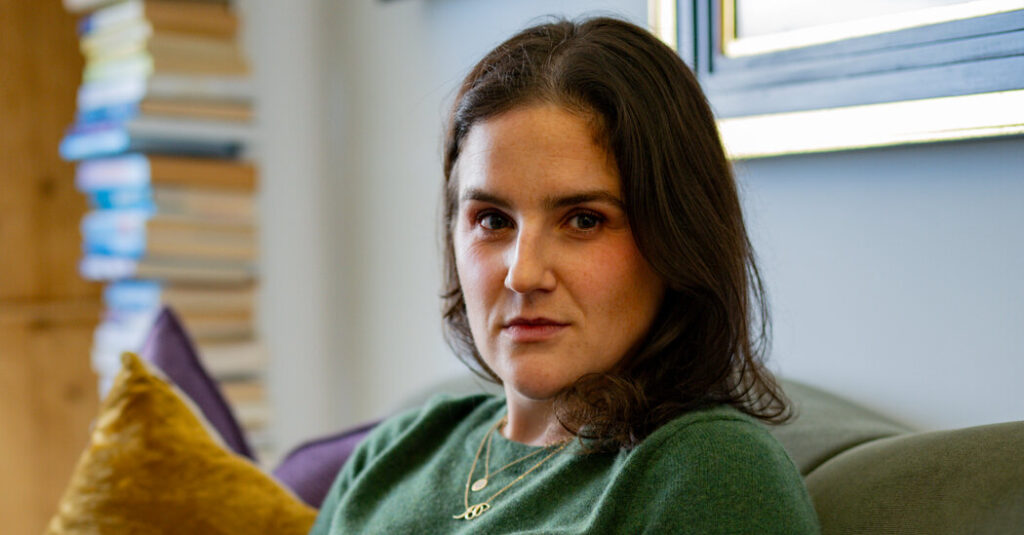
When Jodi Innerfield was laid off from her marketing strategy job at Salesforce in 2024, she had already survived several stressful rounds of layoffs and been considering her longevity at big companies.
Rather than search for a role at another firm, Ms. Innerfield, 39, decided to start consulting and working with clients on her own.
It was not the career progression she had envisioned for herself. Ms. Innerfield followed what she was told was a guaranteed script for success: She went from the honor roll to the Ivy League, and then from business school to Salesforce. But the script was no longer working for her.
Many workers like Ms. Innerfield have become increasingly disenchanted working in corporate roles, as some of the country’s most profitable companies lay off workers and demand ever more of remaining employees.
Just 28 percent of workers say now is a good time to find a quality job, down from 70 percent in 2022, according to a recent Gallup poll. And they have never been more dissatisfied with their pay or their ability to get ahead, a recent survey by the New York Federal Reserve Bank found.
Discontented with large companies’ current version of work, those who choose self-employment are more likely to report having a “quality” job, according to the American Job Quality Study released by Gallup in 2025, which surveyed over 18,000 working U.S. adults.
Ms. Innerfield now works with multiple clients consulting on business to business marketing and said she was on track to surpass her Salesforce salary in her second year of self-employment. She values the autonomy and flexibility of her new lifestyle.
“Working for somebody else felt like — or was seen as — stability, because that’s what was true in my parents’ age and my grandparents’ age,” said Ms. Innerfield, who lives in Manhattan. “But that’s just not the case anymore. Nothing is stable.”
A ‘Quality Jobs Crisis’
That self-employment can feel more secure than an office job tis a reflection of the current “quality jobs crisis” in the United States, said Kathryn Anne Edwards, an economist and columnist at Bloomberg.
“The dignity of workers writ large in the United States is at a low point,” she said, pointing to workplace trends like the erratic shift scheduling and frequent reorganizations that hourly and white-collar workers endure.
The reversal of work-from-home policies is also a major driver of distrust among the white-collar work force, Ms. Edwards said, and annual pay raises that aren’t keeping pace with inflation are also inspiring some workers to look outside the corporate box.
Job seekers report sending countless résumés into the digital ether or being ghosted after endless rounds of interviews. More long-term unemployed workers are giving up on looking for a new job, according to the U.S. Bureau of Labor Statistics.
“Right now, a lot of people are freelancing because of layoffs,” said Priya Rathod, workplace trends editor at Indeed. “But we’re also seeing people who still have a job, and they’re looking at everything going around them, and they’re deciding to build independence before they’re forced to.”
A Different Kind of Stress
Self-employment has its drawbacks, of course, and success is not guaranteed. Long hours are the norm, and it may be difficult to set boundaries between work and personal time. Self-employed workers also cover their own payroll taxes and may lose access to valuable benefits including retirement contributions, paid leave, and unemployment insurance. More than half of self-employed workers say they are not contributing to a retirement account, according to the American Job Quality Study.
And then there’s health insurance. How to pay for coverage in a country with few affordable options for working age Americans is perhaps the biggest and most formidable challenge, especially as premiums keep rising. And those with medical conditions may not want to risk losing employer-sponsored health insurance.
Some workers, like Ms. Innerfield, are able to stay on their employer’s health insurance plan for up to 18 months after they leave their employer through the Consolidated Omnibus Budget Reconciliation Act of 1985, or COBRA. In this case, the worker takes on the entire cost of the health plan premiums, which can range from a few hundred to a few thousand dollars per month, depending on the plan and their family size.
Others pay for health insurance through state marketplaces, which can also cost thousands of dollars each month. Insurers are also proposing a median premium increase of 15 percent in 2027, according to the Kaiser Family Foundation. The high cost is why self-employed workers are nearly three times as likely as employees to have no health insurance, according to the Job Quality Study.
After her COBRA coverage ended, Ms. Innerfield bought marketplace coverage that has lower-cost premiums, but less comprehensive benefits. She picked a high-deductible plan that is eligible for a health savings account so that she can invest for her future medical costs.
Grace Dennison knows these challenges well. Her transition to self-employment began after her role as a merchandising director at Under Armour was eliminated last year. Post-layoff, Ms. Dennison, 42, and her husband thought long and hard about what her next move should be.
High-level merchandising jobs are few and far between in Baltimore, where they live, and Ms. Dennison did not want to uproot her family to take a job in a different city. Her husband also has worked as a public-school teacher in Baltimore for many years and qualifies for a pension, which they did not want to lose.
Ms. Dennison decided to work for herself, offering merchandising consulting services to companies and other organizations. Her freelance career is off to a slow start, she said, but she is confident that signing a couple clients will be enough for her family to reach all of their financial goals. The couple, who have one child, are lucky to be able to rely on her husband’s salary and health insurance, her severance, and savings for the time being, she said.
“I am very grateful for the financial position we are in that has allowed me time and space to pursue work outside of a traditional corporate career,” Ms. Dennison said.
Controlling Earnings and Retirement Savings
For Devin Lee, working for herself was a way to make more than she ever could at an office job. After a few years working corporate jobs, she started a home organizing business from her home in Portland, Ore., in 2017. When Covid shut that business down, she started working independently as a systems strategist who helps creative agencies run more efficiently.
She has considered going back to the corporate world after feeling that she took on too much. But as she has learned more about her business’s slow and busy seasons, she has been able to make her job more sustainable.
“I say I’m allowed to have an existential crisis and quit once a year,” said Ms. Lee, 35. “I just have to hire myself back the next day.”
Ultimately, she said there was more security in running her own business than working for someone else.
“To a certain extent, I can control how much money I make,” she said. “Because if I want to make more money, I can figure out how to scale my business.
“It’s hard, but I can decide to take that path. Whereas when I’m working at a different job, it’s somebody else’s decision if I get a raise or if I get a title change.”
When it works, self-employed workers can make far more than their salaried peers, a 2025 working paper from the National Bureau of Economic Research found.
Ms. Dennison prioritized retirement savings early in her career, and feels that she and her husband are in good enough shape that she can withstand a pause in retirement contributions for a short while. Ms. Innerfield established a Solo 401(k), which allows her to contribute up to $24,500 as an employee plus an additional 25 percent of compensation as an employer this year.
Another option for self-employed workers with a higher contribution limit than a traditional individual retirement account is the Simplified Employee Pension I.R.A., which has a limit of 25 percent of compensation or $72,000 in 2026, whichever is lesser.
“A $5,000 in an employer match certainly isn’t enough to get me to go back to corporate,” Ms. Innerfield joked.
The post Taking a Chance on Self-Employment Over a Corporate 9-to-5 appeared first on New York Times.