Opera, that most extraordinary expression of private emotions and social conflicts, faces major problems these days. This complex, powerful art form is struggling with financial woes, aging audiences and perceived irrelevance, prompting constant hand-wringing by opera professionals over what to do about it. Opera lovers are even worrying about the genre’s survival.
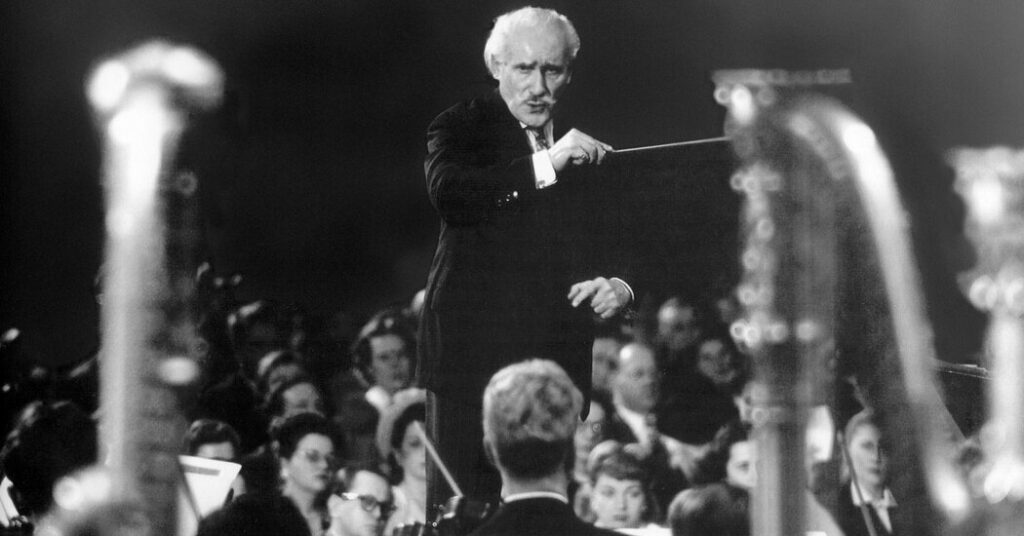
One such fan, an acquaintance of mine, surprised me the other day by asking, “What would Toscanini say about the opera world today?” It’s a good question to ask about one of the greatest conductors of modern times, one who led early performances of some pillars of the repertoire.
Arturo Toscanini (1867-1957) was certainly the product of a very different era. When he was born, Gioacchino Rossini was still alive and Giuseppe Verdi was at the height of his career. During most of Toscanini’s lifetime, opera in his native Italy and in many other parts of Europe was a widely popular art form that often paid for itself through ticket sales alone. Today, it’s a cultural outcropping overwhelmed by the mass entertainment industrial complex. Most performances cost more than they can earn at the box office, and substantial subsidies or donations are required to keep them afloat.
Still, as his biographer, I’m sure that Toscanini would have strong opinions about what’s right and what’s wrong with opera today. He would embrace new works and new staging techniques, strip powers from overbearing stage directors while still championing innovation and fight for clarity in the music and action. Politically outspoken, he might also have sharp words about the resurgence of the far right in Italy and the United States — the countries in which this artist with a fierce sense of justice carried out most of his work.
For most classical music lovers today, Toscanini’s name evokes the image of an old man energetically conducting a symphony orchestra, because during the last quarter-century of his nearly 70-year career he worked mainly in the concert hall.
Yet from his debut at the age of 19 until his early 60s, he was focused on the lyric theater. He conducted thousands of performances of some 118 operas, including the world premieres of “Pagliacci,” “La Bohème” and “Turandot,” the first Italian productions of “Siegfried,” “Götterdämmerung,” “Eugene Onegin,” “Salome” and “Pelléas et Mélisande” and the North American premiere of “Boris Godunov.”
Those current staples were daring and new at the time and satisfied a hunger for hearing fresh works. He surely would encourage — at least in principle — today’s trend of presenting more contemporary works at the Metropolitan Opera and other major houses.
Toscanini was a reformer. Every time he took charge of a major opera house, he presided over fundamental changes in the administration. At Turin’s opera house, the Teatro Regio, in 1895, at Milan’s Teatro alla Scala in 1898 and at New York’s Metropolitan Opera (where he was initially a co-principal conductor, with Gustav Mahler) in 1908, he brought in a salaried general manager, replacing an impresario who had profited from placing his own singers in productions. He also brought in a board of guarantors whose members pledged to make up any financial deficits.
He fought to have orchestra pits installed at the Teatro Regio and La Scala. Previously, musicians had played at the main-floor level, a practice that had become acoustically and physically unsustainable given the size and power of the orchestras required by the likes of Richard Wagner and Richard Strauss. He modernized lighting systems, and he had clunky, old-fashioned painted front-drops, which moved up and down at the beginnings and ends of scenes, replaced with laterally opening curtains that could quickly reveal the sweep of the entire stage.
Most important, as an early believer in Wagner’s ideas about opera as a genres-encompassing art form, Toscanini worked to unify vocal, orchestral, dramatic and scenic elements into totally convincing works of art. During the 1920s he came as close as anyone ever has to realizing that goal, when he turned La Scala into the most admired and productive opera ensemble in Europe. He did so by establishing a system in which he and his carefully selected assistants worked for weeks with singers on every detail of their roles, to achieve accuracy, expressivity and clear enunciation. Neither Toscanini nor any of the conductors who worked alongside him would have considered doing less, but today such thoroughness has become a rarity.
I feel sure that he would favor, today, bringing in theatrical innovations to realize composers’ visions and to present the most compelling experiences for audiences. He would be enthusiastic about the use of high-definition video and abstract visual techniques in staging operas that aren’t set within specific historical periods.
But I am dead certain that Toscanini would be categorically opposed to the current dictatorship of the stage director, especially with respect to productions that ignore the words of operas’ libretti and often even the sense of operas’ plots. His lifelong goal, as an interpreter of works created by others, was to come as close as possible to realizing what those creators were expressing. He pursued that objective with terrifying single-mindedness, and he required his collaborators to support his pursuit of this artistic ethic.
Speaking of ethics: During the 1930s and ’40s, Toscanini was the most famous opponent among musicians of the regimes of Benito Mussolini and Adolf Hitler. He refused to conduct in Italy, after 1931, and in Nazi-controlled Germany and Austria. He detested racism, and during his self-imposed exile from Fascist Italy he did everything in his power to help endangered Jews and others immigrate to America, the country he saw as a beacon of democracy.
What would Toscanini say about the rising spirit of authoritarianism in America and elsewhere in the world? That is not for me to say, but I do know what the homesick 74-year-old maestro wrote in 1941 to an Italian musician who had accepted Fascism even after the passage of the antisemitic 1938 racial laws: “You are living amid the shame — the dishonor, without showing a sign of revolt.” As for himself, he continued, “I would pray God to take my life away even immediately, if it weren’t for my firm, never forgotten hope to first see the criminals swept off the face of the earth.”
Harvey Sachs is the author of “Toscanini: Musician of Conscience.”
The Times is committed to publishing a diversity of letters to the editor. We’d like to hear what you think about this or any of our articles. Here are some tips. And here’s our email: [email protected].
Follow the New York Times Opinion section on Facebook, Instagram, TikTok, Bluesky, WhatsApp and Threads.
The post Opera Is in Trouble. Let’s Channel the Maestro. appeared first on New York Times.