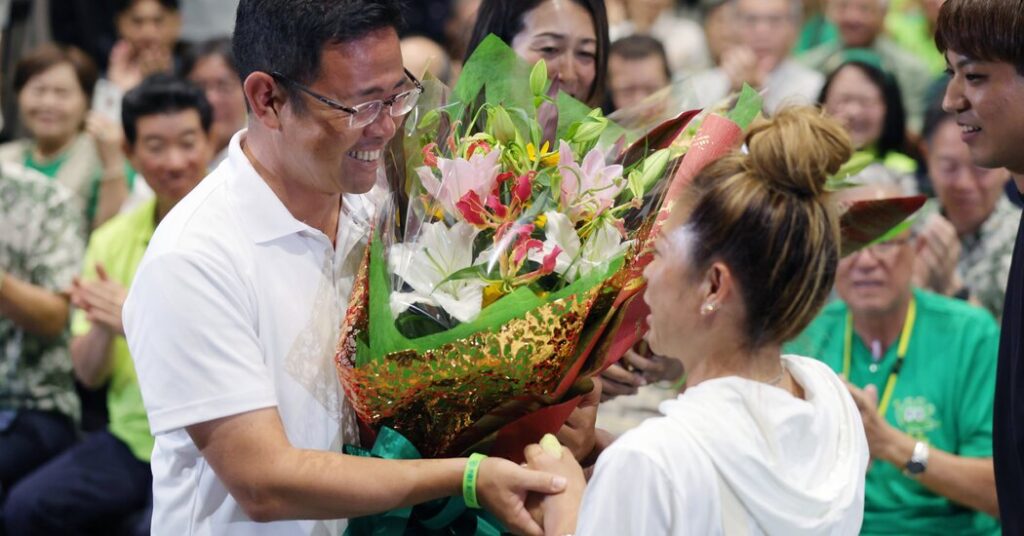
A 42-year-old conservative politician was projected to prevail on Sunday in the race to be governor of Okinawa, a win for Japan’s hawkish prime minister, Sanae Takaichi, as she seeks to accelerate a military buildup to counter China.
Genta Koja, a deputy mayor of Naha, the Okinawan capital, was expected to unseat a two-term governor, Denny Tamaki, who had criticized Ms. Takaichi’s defense policies and opposed the construction of new American armed forces facilities on Okinawa island. When he takes office later this month, Mr. Koja will be the youngest governor in the history of the Okinawa prefecture, a group of subtropical islands in southern Japan.
NHK, the public broadcaster, relying on exit poll data, said that Mr. Koja had won about 60 percent of the votes on Sunday, compared with about 40 percent for Mr. Tamaki, the son of a Japanese mother and a U.S. Marine, who had the backing of left-leaning parties in Japan.
“I interpret the results as a choice by many to move Okinawa forward,” Mr. Koja said in a comment to NHK on Sunday after he was projected to win.
Only about 2 percent of votes had been tallied as of late Sunday, but they showed Mr. Koja in the lead.
Mr. Tamaki conceded the election in a statement, saying: “I want to heed the will of the people. There was still much I wanted to accomplish in a third term, but I intend to use this result as a source of strength.”
Mr. Koja’s expected victory would be a blow to Okinawa’s pacifist movement, which for years has opposed the American military presence on the island. Okinawa, with a population of 1.5 million, hosts 70 percent of Japan’s American bases despite accounting for only 0.6 percent of the country’s landmass. (The United States seized Okinawa from Japan after World War II; it returned the island in 1972 but has continued to operate bases there.)
Many members of older generations, who still have memories of the war, have rejected the central government’s plans to make Okinawa a bulwark in its efforts to counter Chinese military aggression. They say the presence of more troops makes the island even more of a target.
Ms. Takaichi, who took office last year, has pushed forward with plans to further militarize Okinawa by sending more troops to the area and expanding missile and electronic warfare capabilities.
Okinawa, the southernmost prefecture of Japan, is strategically significant because it sits close to China and Taiwan. It has long had a large American military footprint, with roughly 30,000 active-duty personnel, which has been a source of tension on the island for decades, amid concerns about pollution, noise and crime.
Mr. Koja, who was backed by Ms. Takaichi’s Liberal Democratic Party and other conservative parties, had expressed a willingness during the campaign to work with the Americans. He said he would support a plan to transfer a busy air base used by the Marines from southern Okinawa to a less populated coastal area in the north. Mr. Tamaki had fiercely opposed the plan for years and made it a signature campaign issue.
Mr. Koja also spoke forcefully about rising security threats in the region, including from China, and the need to modernize Japan’s military, known as the Self-Defense Forces.
“It is an undeniable fact that the security environment surrounding Okinawa has become increasingly severe, making the Japan-U.S. security alliance and the deterrent capabilities of the Self-Defense Forces essential,” he said at a debate last month.
There has been rising concern in Okinawa about China’s growing assertiveness in recent years, especially among younger islanders, who were core to Mr. Koja’s victory, according to exit poll data reported by NHK.
Yet despite geopolitical questions, voters appeared most concerned about the economy. Wages in Okinawa are below the national average; prices have risen; and unemployment and child poverty are concerns in many areas.
Mr. Koja promised to put in place policies that would help lift wages, and he said he would provide more support to parents for child care. He also vowed to do more to promote tourism.
Masaaki Gabe, a professor emeritus at the University of the Ryukyus in Okinawa, said Mr. Koja would face pressure to improve the economy.
“The people of Okinawa want prosperity,” he said.
Yet for Okinawan citizens, including the crowds of pacifist activists who still hold regular protests outside American bases, it is becoming increasingly difficult to oppose the defense buildup, Mr. Gabe said, as the central government has grown more assertive in its push to militarize the region.
“The situation has reached a point,” he said, “where the prefecture has almost no authority to resist.”
The post Okinawa Set to Elect Conservative Amid Fears About China and Economy appeared first on New York Times.