A planned meeting between Iran and several Gulf Arab countries it attacked during the war was indefinitely postponed on Sunday, underscoring how diplomatic efforts have struggled to defuse a widening Mideast conflict.
Iranian officials had said they expected to meet Arab counterparts in Oman on Monday to discuss the status of the Strait of Hormuz, the critical Persian Gulf waterway for global oil and gas exports. But late on Sunday night, Badr Albusaidi, the Omani foreign minister, said the gathering had been postponed “in the interests of consensus.”
Talks between Iran and the United States to reopen the waterway similarly show little sign of progress, with the countries exchanging strikes in recent weeks. Iran has maintained its effective blockade of the strait, throttling the Gulf Arab states’ oil exports and roiling global markets. Last week, the price of Brent crude, the international benchmark, briefly jumped to about $110 a barrel, its highest level for months, before dropping to about $105.
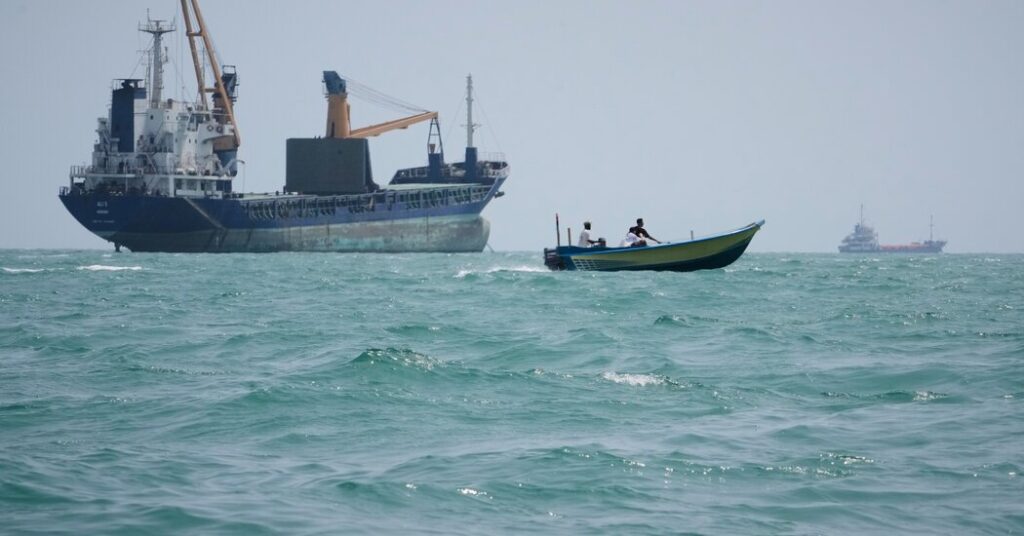
On Sunday, a ship in the Strait of Hormuz was hit by a projectile, causing a fire on the vessel, according to the United Kingdom Maritime Trade Operations, a monitoring group run by the British navy. The governor of Qeshm, an island in southern Iran, said on Iranian state media that an Iranian commercial vessel had been attacked, killing one person and injuring four.
U.S. Central Command, which oversees American military operations in the region, did not respond to a request for comment.
Iran and Oman, which border the strait, have been negotiating for weeks over how to reopen the waterway, discussing arrangements that would likely involve some kind of service fee. Before the war, ships could travel freely through the Strait of Hormuz.
Even if a deal is reached, however, Iranian officials have demanded concessions from the United States before ending their blockade, including lifting sanctions on Iran and releasing Iranian assets frozen overseas. The Trump administration is unlikely to take those steps without Iran agreeing to curb its nuclear program.
Yemen has emerged as another front in the fighting. The Iranian-backed Houthi militants there seized the strategic port of Mokha and the island of Perim in the Bab al-Mandab Strait in the Red Sea last week from the Saudi-backed, internationally-recognized government. They have also attacked Saudi energy sites and sought to blockade Saudi shipping.
Saudi Arabia was forced to shut its East-West Pipeline on Friday after it was targeted by drones from Iraq. That pipeline has been a critical lifeline for the country’s oil exports, after Iran blockaded the Strait of Hormuz. No one took responsibility for the attack, but Iraq has long harbored well-armed militias backed by Iran.
On Sunday, Houthi forces attacked a military site near the southern city of Sharurah, Yahya Saree, a Houthi military spokesman, said on social media. Saudi officials said at least two people had been wounded and a mosque was damaged when a projectile fell in a neighboring province, state news media reported.
Iran and its allies have repeatedly attacked neighboring countries during the war, saying they were targeting the U.S. soldiers and military assets they hosted.
But as the conflict has dragged on, Gulf states like the United Arab Emirates and Qatar are having to manage their relationship with a newly emboldened Iran. The aborted attempt at the joint meeting underscored how difficult it is to forge a common approach, however.
“This has been an enemy that’s been shooting at them, and they’ve been collateral damage between the U.S. and Iran for all these months. Yet they need to also engage with Iran,” said Bader al-Saif, an assistant professor of history at Kuwait University.
“These are pragmatic countries — they want to make sure things move on in the right direction so their domestic plans don’t get disrupted,” he added.
Some Gulf countries have signaled that they are open to dialogue. Crown Prince Khaled bin Mohamed Al Nahyan, the Emirati heir apparent, met with President Masoud Pezeshkian of Iran on the sidelines of the BRICS summit in India on Saturday — the first public meeting between senior leaders of the countries since the beginning of the war.
But not all Gulf countries are on the same page. Even before the meeting was postponed, Bahrain, which has repeatedly been targeted by Iranian missiles and drones, said that it would not participate.
Iran has signaled that it could escalate militarily as President Trump tries to squeeze the country with an economic pressure campaign. Senior Iranian officials have said they might be willing to return to the cease-fire agreement that briefly paused the war in June, but they have made new demands which the Trump administration has refused to accept.
The truce collapsed in July, and the United States and Iran are in a period of uncertainty that some observers have described as “no war, no peace.” Mr. Trump said he has come close to launching a massive attack on Iran but pulled back, in part following pleas from Gulf countries worried about the cost of return to full war.
Vivian NereimandSanam Mahoozi contributed reporting.
The post Meeting Between Iran, Arab States Postponed as Mideast Diplomacy Stalls appeared first on New York Times.