On a foggy, rainy day in 1984, a Scandinavian Airlines flight from Oslo overshot the runway while landing at John F. Kennedy International Airport in New York. The DC-10 skidded 600 feet off the pavement and plunged into a frigid creek, forcing some passengers to swim to safety. But the 177 people on board escaped without any fatalities.
That’s when Pam Phillips got the assignment of a lifetime: Stop this from happening again.
Phillips worked in technical support for the four airports run by the Port Authority of New York and New Jersey, including JFK. And JFK was a tricky case: It was hemmed in by dense housing and open water. She couldn’t just add more space after the runway to stop a plane from hitting the water.
So Phillips assembled a group of experts — some from the aviation world, but also professors who studied runaway truck ramps and an official from Britain who worked on runaway trains. The idea she and others came up with would eventually lead to changes at airports nationwide.
“I was nervous about taking on such a daunting project,” Phillips recalled.
This is how aviation safety is supposed to work. Investigators dig into what caused an accident and others figure out how to prevent it from happening again. But there’s not always an absolute solution.
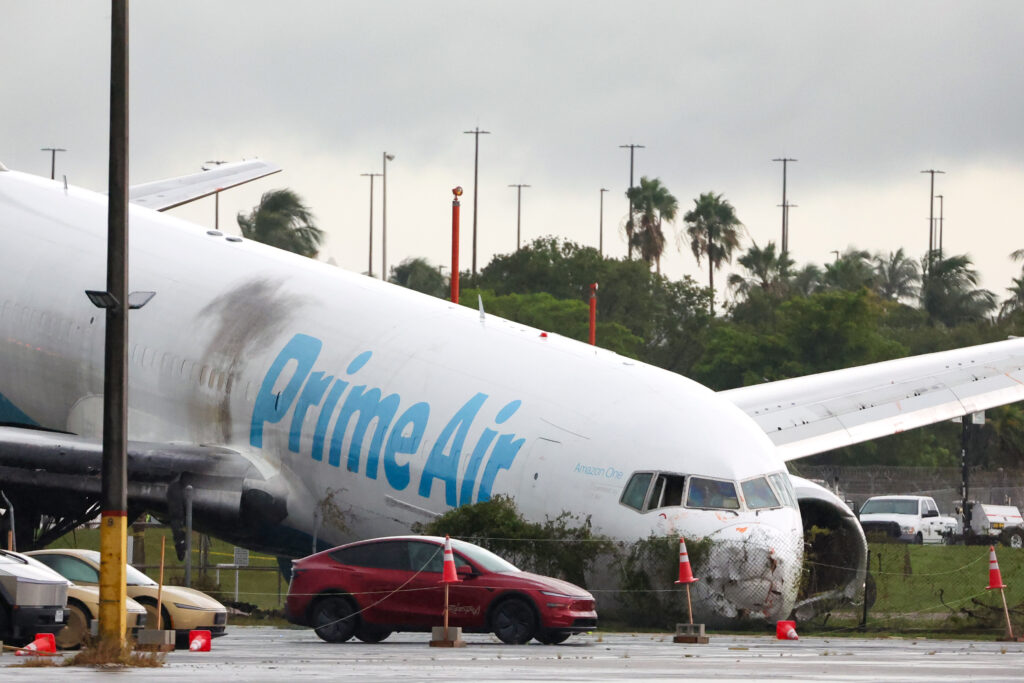
The National Transportation Safety Board is looking into the Sept. 6 crash of an Amazon-branded cargo plane, which overran the runway at Miami International Airport by 1,300 feet, slamming into two vehicles and killing five people on the ground. The NTSB appears to be focused on the plane’s speed and pilot decision-making. But another issue is whether there was anything more the airport could have done to stop the plane.
Runway excursions, as they’re called, occur more frequently than any other kind of aviation accident — more than midflight loss of control or crashing into the ground, according to the International Air Transport Association. There are on average about 10 accidents a year worldwide. The International Civil Aviation Organization considers runway excursions to be one of its five global high-risk categories of accidents.
“It’s been an issue for a number of years,” said Hassan Shahidi, president of the nonprofit Flight Safety Foundation.
Runaway planes have bedeviled aviation experts, in part, because they can be caused by so many different factors. The points of failure can include pilot error, surprise tailwinds and rain-slick runways. Often multiple factors are at play.
In May, the NTSB called for changes to how landing distances on wet runways are calculated, saying the agency studied 11 runway overrun incidents and found the matrix sometimes failed to predict how heavy rainfall affected braking.
“We are never going to be able to get to zero” accidents, said Manuel Ayres, an airport engineer who has spent years researching this type of crash. “It’s just not feasible.”
In the U.S., accident prevention has centered on giving airplanes more room for things to go wrong. Most major airports are required to have flat, unobstructed areas surrounding each runway. FAA standards generally call for runway safety areas that extend 1,000 feet beyond a runway and 250 feet along both sides.
A Miami airport official said its relevant runway has the required safety area and “has consistently met federal airfield safety requirements.”
But some airports lack room. That was the problem at JFK.
After the 1984 crash, Phillips brought together officials from the FAA and experts from the University of Dayton to design a way to quickly slow massive commercial jets. And they needed to find a surface that could do that without severely damaging an aircraft.
They tried rigid planks of home insulation foam, Phillips said. Those caught fire too easily. Then they tried aerated cement. They ran a test with a rolling airplane to see how it crushed the surface. That did the trick.
“It was like driving off the road into sand,” Phillips said.
Their creation was called the Engineered Materials Arresting System, known as EMAS.
In 1996, JFK installed the nation’s first EMAS. It was placed on the same runway that the Scandinavian Airlines jet overshot. Three years later, an American Eagle flight ran off the runway, but the jet was stopped by the new 400-foot-long EMAS. The NTSB later determined that without the special surface, the plane and the 30 people on board would’ve ended up in the surrounding creek.
But the push for these systems at other airports was slow to build.
That began to change after a fatal runway overrun in Little Rock in 1999. The FAA created a program to identify and work on deficient runway safety areas.
Two high-profile accidents in 2005 added more urgency.
The first was at Teterboro Airport in New Jersey, where a business jet failed to take off and instead left the runway going about 126 mph. The plane crashed through a fence, crossed a highway and then struck a car and building. No one died.
Then, on a snowy day in December, a Southwest flight overran a runway at Chicago Midway International Airport. It crashed through two fences and collided with a car on a nearby road, killing a 6-year-old boy inside the vehicle.
The NTSB investigation revealed that one year before the crash, the FAA and Chicago airport officials had discussed ways to improve Midway’s runway safety areas, but no action was taken. A simulation found an installed EMAS could have stopped the Southwest jet, the NTSB said.
In 2006, a frustrated Congress and the FAA funded a massive program to address runway safety areas at airports nationwide. The FAA distributed about $3 billion over the next decade to improve approximately 1,000 runways at more than 500 airports.
So far, 26 planes have been stopped by EMAS at U.S. airports, according to the FAA, including twice at Teterboro Airport, which had the stop pads installed after the 2005 crash there. The FAA list also includes a jet in 2016 that overshot a LaGuardia Airport runway in New York while carrying Mike Pence, then the vice-presidential nominee.
The FAA does not keep a comparable count for runway safety areas.
But neither of these safety systems is designed to stop every runaway plane.
The dimensions reflect historical accident patterns, not a guarantee.
FAA research looked at previous incidents and found that 90 percent of air-carrier overruns stopped within 1,000 feet and that roughly 90 percent of aircraft left the runway at 70 knots — about 80 mph — or less. A standard EMAS installation is designed to stop most aircraft entering at that speed.
Ayres, who has studied runway excursions, calculated for a previous study that adding 600 feet to the 1,000-foot buffer would reduce the probability of escaping the zone during a landing from 5.5 percent to 1 percent.
“It’s about what’s feasible,” Ayres said. “You can increase it up to 3,000 feet and you will still have problems. And it will cost billions of dollars.”
The current standard works, he said.
“It’s an acceptable risk.”
In the Miami crash, the Amazon-branded cargo plane was traveling about 130 mph when it ran off Runway 30, according to Flightradar24 tracking data.
The NTSB said the plane traveled 1,300 feet beyond the runway.
The jet’s speed and distance traveled meant it likely would’ve blown through the tools meant to stop runaway planes.
The post It’s the most common aviation accident. But how to stop it? appeared first on Washington Post.