Gun violence in Sweden has dropped after surging for years.
Top Swedish companies, like Volvo, IKEA and Spotify, remain global powerhouses, helping the economy grow faster than most places in Europe.
And Sweden has produced more billionaires than just about any country its size.
With national elections set for Sunday and the big picture reasonably good, one might think that Sweden’s incumbent center-right government would cruise back to power.
But the issues that matter most to voters have shifted in ways that have helped left-leaning political parties, bucking a trend in Europe. The latest polls show a center-left coalition with a narrow lead over its center-right rivals before voting starts.
Scandinavia is often ahead of the curve when it comes to social trends, and Sweden (as well as Denmark) offers a picture of what might happen when hot-button issues like migration recede and voters swing their attention elsewhere.
That does not mean that Sweden’s far-right politicians, who have propped up the current government, are a spent force. In fact, if the right manages to squeak to victory, it has promised, for the first time, to give them a share of power.
That would be a seismic change in Sweden and another victory for Europe’s nationalists, following the far right’s success in Germany’s recent elections.
The Left Rises
A decade ago, Sweden welcomed huge numbers of migrants, which prompted a backlash, just as it did in many places. Then the pandemic hit. Then Russia invaded Ukraine, causing energy prices to spike and leaving Swedes, like many Europeans, feeling less secure.
Right-wing parties in Sweden, like those in Britain, Italy, France and Germany, tapped into that unease and grew more popular.
Today, compared to other parts of Europe, Sweden’s economy has bounced back faster, and inflation, migration and shootings have decreased. As a result, analysts say, the political winds have turned.
“It was a tougher situation four years ago,” said Jens Rydgren, a sociology professor at Stockholm University.
As he munched on a chokladboll (a freshly rolled chocolate ball) at a Stockholm bakery, Mr. Rydgren said that many Swedes were refocusing on the classic Scandinavian priorities: public health care, good schools, the environment.
“And traditionally, the center left owns these issues,” he said.
The party leading the polls is the Social Democrats, the country’s stalwart center-left organization, at 27 percent. With its allies, the left is predicted to get 51 percent of the vote.
The Far Right Is Still Strong
Sweden’s No. 2 most popular party is the Sweden Democrats. The organization has neo-Nazi roots and is polling at 19 percent, a remarkably high level for what was once a fringe party. Its popularity has stayed relatively steady even if its more centrist allies have lost some steam.
At a Sweden Democrat rally the other night, Jimmie Akesson, the party leader, paced a stage lit up with pyrotechnics.
“Do you remember what Sweden looked like four years ago?” he belted out. “Do we want to go back to that?”
“No!” the crowd yelled back.
The Sweden Democrats hold the most seats in Parliament on their side of the aisle and their support shores up the center-right coalition. The government has adopted many of their tough-on-crime policies and imposed a much harsher immigration system, tightening up the rules on asylum seekers and making it easier to deport people.
But because of the Sweden Democrats’ past connections to white supremacist groups, the party was not given any ministries.
This election could change that. The Sweden Democrats have asked for half the seats in the cabinet if a center-right coalition returns to power. If that happens, it would radically alter the direction of the country, with the government taking an even more severe approach to migration and crime.
Christopher Jarnvall, a Sweden Democrat municipal official in the town of Norrköping, said that if Sweden didn’t insist that immigrants embrace a traditional Swedish identity, the country’s cohesion would be at stake.
“We want to make Sweden Sweden again,” he said, echoing a far-right slogan.
Expect a High Turnout
In Sweden’s previous general election, 84 percent of eligible voters cast ballots. The country, with its 11 million people, tends to get excited about elections.
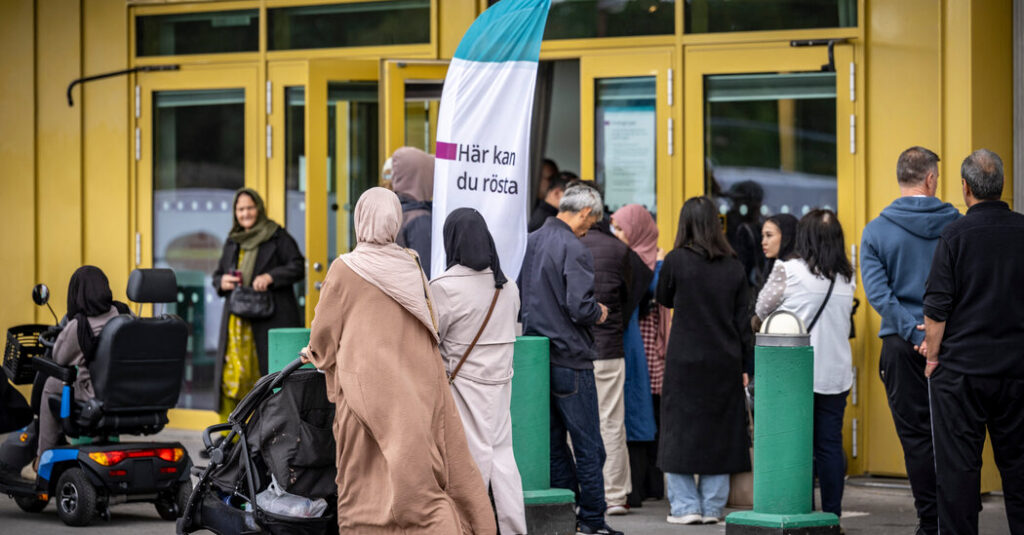
“Valstugor,” or election cabins, pop up across the country, in town squares or busy areas, where party workers mingle with voters.
On Thursday, in downtown Stockholm, Mohammed Al-isawi, 19, bobbed through the crowd. Born in Iraq and now a student with a part-time job, he fled the war and came to Sweden 10 years ago with his family. He’s voting for the first time and leaning left.
He said he was troubled by the anti-immigrant talk coming from the right.
“That feels rather extreme,” he said.
When Will Results Come In?
The polls close at 8 p.m. local time, and preliminary results are expected three hours later.
But Sweden’s political landscape is fragmented among more than a half-dozen parties, including the Moderates, the Liberals, the Green Party and the Christian Democrats. Analysts say that negotiations to form the next government could take days or even weeks.
The post In the Home of Volvo and Spotify, an Election Shows Shifting Priorities appeared first on New York Times.