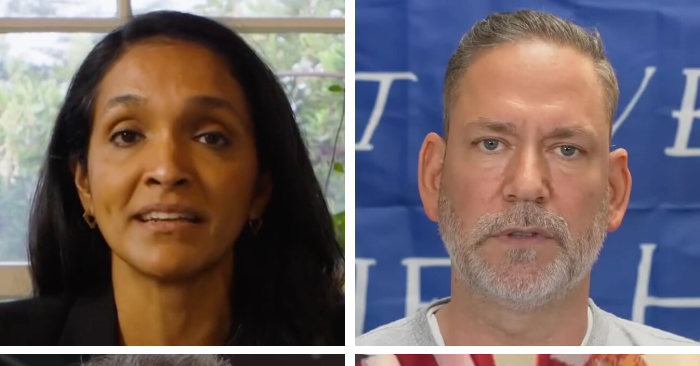
Affordability has become the buzzword of the midterm campaigns.
Around the country, candidates are trying hard to relate to voters’ economic pain. But Republicans are handicapped by the grind of war, promises they made on inflation during the 2024 campaign and a president who alternatively insists that prices have declined and then dismisses the issue as a con job created by Democrats.
Democrats may still have to answer for inflation that hit a four-decade high as the Covid-19 pandemic was receding; Republicans continue to blame today’s economic woes on the Biden administration.
Though the overall economy is resilient — 162,000 jobs were added to the market in August — voters across the political divide rank the cost of living as a top issue in public polls. Even those who can comfortably cover the basics worry about their economic future.
“Candidates are responding to what people are feeling, what people know on a day-to-day basis and what they see at the grocery stores or gas station. You can’t out-message their reality,” said Todd Belt, a professor at George Washington University’s Graduate School of Political Management. “We are now seeing more specific, material ways the candidate plans to make things better.”
The basic pitch
“I feel your pain.”
Democrats seized on affordability as a five-alarm crisis, recasting an issue that helped propel Mr. Trump’s return to the White House into a midterm weakness for Republicans. Voters have expressed deep skepticism of President Trump’s handling of the economy.
In local, state and national races, candidates — both incumbents running on their records and newcomers with fresh approaches — are promising to lower the price of necessities such as groceries, gas, utilities, housing, child care and health care. Solutions include suspending gas taxes, imposing rent caps and renegotiating drug prices in government programs like Medicare.
They are going on “affordability tours,” speaking in small-town diners, craft breweries, steel mills and even picket lines to pitch their version of the American dream and hear firsthand the choices some voters are being forced to make to pay their bills.
Roy Cooper, a Democrat running for the Senate in North Carolina, calls his tour “Make Stuff Cost Less.” Byron Donalds, the Republican nominee for governor in Florida, refers to his as the “Defending the Florida Dream” tour. And in South Carolina, Dr. Annie Andrews, the Democratic nominee for the Senate, is hosting a tour called “Gas, Grits and Groceries.”
With less than two months before the midterm elections, candidates are focusing on big-ticket necessities that have increased in price in recent years. The spikes, combined with stagnant wages have hit American workers hard. Here are examples of political ads and candidates speaking directly to voters:
Housing
“We need to be far more efficient.”
Many midterm candidates have focused, at least in part, on how to bring down the price of housing — typically the biggest household budget item.
Since the start of the pandemic, the price of homes has climbed by around 50 percent. About a third of American households are “housing cost burdened,” meaning they spend more than 30 percent of their income on housing.
By last year, the median age of first-time home buyers had risen to 40 years old. And while rental prices have decreased in some markets, they are still more expensive than prepandemic levels. In June, Congress passed the first major legislative package to address the housing crisis in more than 30 years with strong bipartisan support, but its impact will take time.
Both Republicans and Democrats have promised a range of fixes including reforming bureaucratic permit processing to help build faster and reduce construction costs, and restricting the sale of single-family homes or rental housing to private equity firms.
Groceries
“Stop these chaotic tariffs.”
Groceries and gas, two of the most unavoidable reminders of cost-of-living increases, continue to take perhaps the most palpable toll on family budgets. Fuel prices that rose with the Iran war are again spiking, with the national average over $4 per gallon and diesel at a record high. Food prices are up by about 3 percent year over year, according to the Consumer Price Index.
The president’s tariffs have increased the cost of some imported food and farm implements. Counter tariffs imposed by trading partners have further strained farm budgets, raising the costs of meat and produce.
Candidates, particularly Democrats, are tapping into voter anger and linking some of the increases to what they characterize as corporate greed.
To drive down pricing, candidates are pushing to roll back the tariffs and local sales taxes on some food items, while questioning grocery store mergers and what they call price gouging. Others have focused on suspending gas taxes for relief, at least temporarily.
Child care
“The work force behind the work force.”
Working Americans have long struggled with the costs of child care. In recent years, the prices have skyrocketed as government funding drops, operating costs increase and child-care worker shortages arise, especially as the president cracks down on immigration.
Now, families earning the median income in every state spend far more than the 7 percent of household income that the Department of Health and Human Services considers affordable. In a 2025 poll by the American Family Survey, seven in 10 Americans said raising children is unaffordable, an increase of 13 percentage points over a year earlier.
Many candidates are framing the conversation as a work force issue that requires investment. Some Democrats are pushing for universal child care as a publicly funded solution. Some Republicans favor lowering costs through tax credits.
Health care
“A way to help forgive medical debt.”
The price of getting sick has long loomed as a crushing threat for many Americans, but the issue was brought into sharp focus when Republicans lawmakers allowed enhanced government subsidies for health coverage under the Affordable Care Act to lapse. Many Americans’ insurance premiums more than doubled when the subsidies expired.
Health care costs are among the top economic concerns of voters across the political spectrum. Annual premiums for employer-covered family health coverage reached about $27,000 on average in 2025. Workers contributed $6,850 a year, on average toward the cost of family coverage, according to a survey by KFF, a health research group.
And changes to Medicaid eligibility, which were passed to help pay for spending and tax cuts in Mr. Trump’s signature domestic policy law, the One Big Beautiful Bill Act, could further strain family budgets.
Utilities
“That’s a hidden tax in people’s electric bill.”
Over the past few years, millions of Americans have been hit with higher electricity bills — the result of complicated forces that are different from state to state. Residential electricity prices have risen 13 percent on average since 2022, according to the Energy Information Administration.
Republicans and Democrats point to different causes.
Republican candidates have proposed eliminating electrification mandates and prioritizing natural and domestically produced gas while opposing renewable energy as costly.
Democratic candidates have pinned the blame on energy-devouring data centers and pledged to stop them or build protections. They have also pushed to expand tax credits for wind, solar and other renewable energy sources to expand supply.
James Thomas contributed video production.
The post How Candidates Have Addressed Affordability in the Midterm Campaigns appeared first on New York Times.