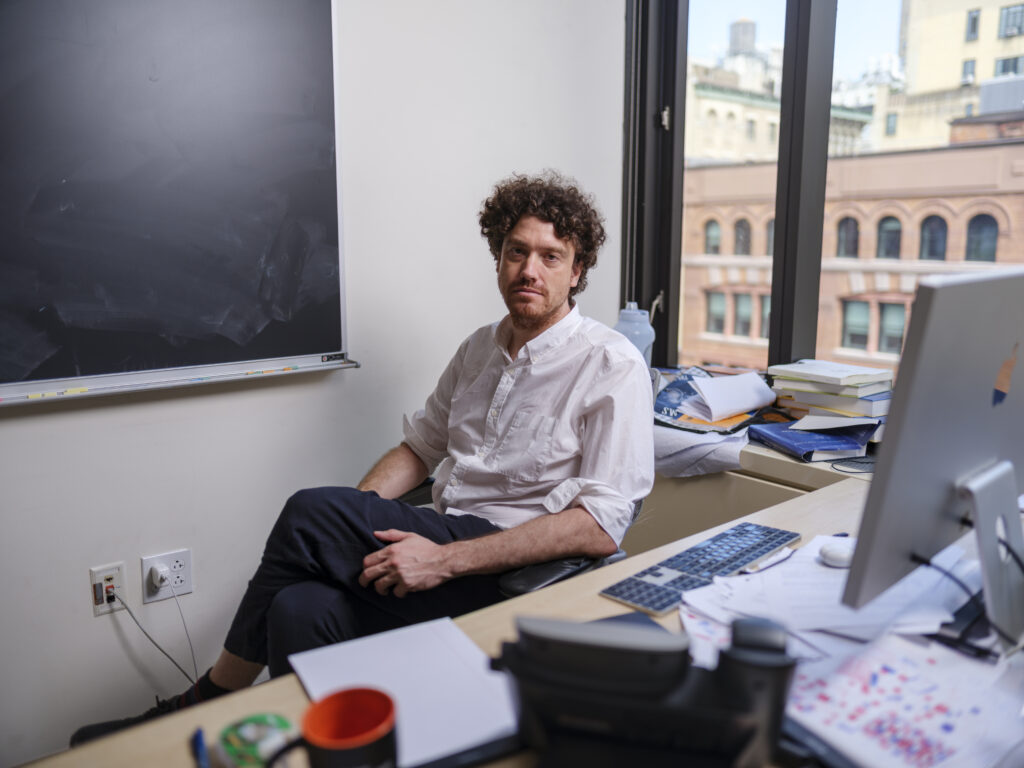
Tristan Buckmaster thought he was on the verge of the most important discovery of his mathematical career when he heard that ChatGPT maker OpenAI was interested in the same problem — and had launched an intense effort to solve it, too.
Last month, Buckmaster, a professor at New York University, and Levent Alpöge, a mathematician at Anthropic, privately achieved a major breakthrough on one of math’s most challenging questions, the Navier-Stokes problem. They hoped their idea could be extended to a full solution — maybe in as little as a month’s time.
Because Navier-Stokes was one of the Millennium Prize problems, identified as far-reaching goals to motivate the field, a verified solution promised a $1 million award from the Clay Mathematics Institute and would make any researcher an overnight mathematical sensation. It was a thrilling prospect.
But as Buckmaster and Alpöge were making sense of their results, OpenAI researchers launched a swarm of “agents” to attack all six of the open Millennium Prize questions. After just days of work and nearly 5 million messages sent between independently thinking AI agents taking on different roles, OpenAI announced Tuesday that the Navier-Stokes problem had been solved.
It was an achievement that led to no shortage of boasting from the company, which is preparing to go public and trying to best its rival Anthropic. OpenAI’s push to solve the Millennium Prize problems was spurred by a rumor online that Anthropic had solved at least one of them. (The Washington Post has a content partnership with OpenAI.)
“One of the most amazing moments for me in OpenAI history was watching this happen over the past week,” CEO Sam Altman wrote on social media after the announcement.
And there may be more to come.
“Since the completion of Navier-Stokes we have made substantial progress on another Millennium Prize problem. We are working through how to share these results thoughtfully,” said spokesperson Laurance Fauconnet.
Buckmaster and Alpöge, meanwhile, have had to contend with some disappointment.
Buckmaster acknowledged in an interview that he had thought of the Millennium Prize “sort of like a guiding star.” But then he said: “I think people interpret it like it was my goal in life to solve the Navier-Stokes problem. It wasn’t at all. … I just want to be part of its story.”
It’s not quite a story of man versus machine — like IBM’s Deep Blue besting chess grandmaster Garry Kasparov in the 1990s. Buckmaster and Alpöge had been using AI models to help accelerate their work. Buckmaster worked with commercially available versions of ChatGPT and Claude, paid for out of his research funds, and Alpöge worked with internal models accessible to him as an Anthropic employee.
They had been somewhat stunned, Buckmaster said, with how the models seemed to have overtaken their abilities — and how much the world might need to “rethink what mathematics is about.”
Then OpenAI’s announcement prompted questions about whether this could be a case of a machine stealing from man. Buckmaster publicly floated the idea that OpenAI’s models may have improperly accessed his inputs while he was working on the problem.
OpenAI denies the allegation. “After investigating, we can say with full confidence that no user inputs past July 3rd could have influenced this system in any way,” Fauconnet said.
But the episode has underscored the clash between the fast-moving, hype-conscious, opaque tendencies of Silicon Valley and the deliberative, often collaborative, well-established norms of theoretical math research.
Far from an elegant proof
Mathematicians outside OpenAI are still trying to make sense of OpenAI’s result, which runs a dense 166 pages.
While some of the company’s employees are mathematicians, none of them had research-level expertise in the Navier-Stokes problem, making them “unable to meaningfully contribute to the mathematical content,” according to OpenAI researcher Sebastien Bubeck. OpenAI has formally verified that the solution is correct by using a programming language to check the logic step by step.
For many mathematicians, understanding is as prized as correctness. Under normal circumstances, a result of this magnitude could take a year or two to be revealed and digested via presentations and a formally published paper, said Javier Gomez-Serrano, an expert on Navier-Stokes at Brown University. The Clay Mathematics Institute only considers submissions after they have been published in a journal for two years and have achieved “general acceptance in the global mathematics community.”
“What I don’t think the mathematical community will accept is the write-up as it is,” Gomez-Serrano said of OpenAI’s solution, which he is currently trying to read. “It’s incomprehensible.”
Academia is competitive, and human beings beat one another to new research findings all the time. But the introduction of an AI company has complicated things, Buckmaster said.
“The warning of AI and math, that was my original story,” he said. “And now the story is about: Is it ethical for the AI companies to scoop their customers?”
Years of work vs. days
Buckmaster grew up in Australia and said he became interested in the Navier-Stokes problem before he even really knew what it meant. He recalled being inspired by James Gleick’s “Chaos: Making a New Science,” a popular science book that explores the study of butterfly effects and unpredictable phenomena.
“It was always my intent to study fluids,” he said. “The place I feel most at peace at is being in the ocean.”
“I’m obsessed with fluids, basically,” he added with a chuckle.
The Navier-Stokes equations were developed in the 19th century to model the flow of fluids like water, which helps to describe phenomena such as weather, ocean currents and the way air slips over the wing of a plane. But the equations are tricky to solve, involving factors like the pressure and the thickness, or viscosity, of the fluid. Mathematicians were not sure whether the equations would always have physically viable solutions or if there were situations in which they might break down.
For years, Buckmaster sought what mathematicians call a “blowup”: an impossible scenario in which, according to the equations, a fluid would end up achieving infinite speed in a finite period of time, like the swirl of cream in a cup of coffee spinning infinitely quickly if you just wait long enough.
Buckmaster was eager to explore the utility of artificial intelligence. He successfully used deep learning tools to find good candidates for blowups for simpler versions of the Navier-Stokes equations, including a 2025 collaboration with Google DeepMind.
Then, last September, Alpöge proposed that he and Buckmaster collaborate to try to crack the Navier-Stokes problem with the help of AI.
“Basically for ideological reasons I fear a world in which corporations are the ones with claim to the deepest pure math work, and since it seems to me there will be only one Millennium Problem solved in the foreseeable future, I wanted to email you on a lark to ask if you’d considered working on the problem in the traditional mathematical way,” Alpöge wrote to Buckmaster.
Alpöge would be working in a private capacity, not on behalf of Anthropic. (He did not respond to an interview request for this article.)
In mid-August, the pair achieved a much-sought “blowup” for the Euler (pronounced “oiler”) equations, a related set of fluid equations that did not account for the challenging viscosity portion of Navier-Stokes. But the initial AI-generated proof was difficult to parse — among “the most horrendous I have ever read,” Buckmaster would later recount online. The researchers spent weeks trying to pick through it.
In the meantime, rumors began to circulate on social media that Anthropic had resolved one, or possibly two, of the Millennium Prize problems.
AI companies’ interest in mathematics is multifold. Some AI researchers start as mathematicians and are curious about testing their AI models on open math questions. Mathematics is also a convenient way to evaluate and demonstrate the models’ improving capabilities. But the Millennium Prize problems are bigger than any problem previously resolved by an AI system, and so those problems have become a sort of crown jewel for companies looking to showcase their technology.
On Sept. 1, OpenAI decided to launch an intense effort, using a system of agents from an unreleased model, on the unsolved problems on the Millennium Prize list, plus some smaller, related questions.
It took about 50 hours and 100 agents working in coordination to land on a “blowup” for the Euler equations — like Buckmaster and Alpöge, but one step ahead, without relying on adding external force to the fluid.
After that result, the company decided to direct its resources toward attacking the full Navier-Stokes problem. This stage involved about 10,000 agents. They worked for about 88 hours, nearly four days. And on Sept. 5, they arrived at a solution. It took another 17 hours to verify that they were correct: The AI had beaten Buckmaster, Alpöge and the mathematics community to a solution.
Although it all happened incredibly fast, the effort was staggering: about 300 billion tokens of AI-generated output, the equivalent of roughly 40 copies of all the content on English-language Wikipedia. Billed at the commercial rates of its most advanced public model, Astra, that much computing power would cost up to $15 million.
The company said it does not intend to claim the prize money.
The question of credit
It was Buckmaster who reached out to OpenAI. He had heard something was afoot, and on Sept. 3, while the company’s AI agents were working away, he sent an email to find out what was actually happening.
Four days later, he met with OpenAI’s Bubeck, who by then had news to share about the agents and their result.
Buckmaster could still claim victory, Bubeck suggested, by using computing power from OpenAI to try to reach his own complete solution, or by serving as the lead author on a write-up of OpenAI’s result.
There was an issue, though: Alpöge’s association with Anthropic.
Bubeck later said on social media that he didn’t intend to deny anyone credit but didn’t see how a competitor’s employee could co-author OpenAI’s work or access OpenAI’s internal systems.
Recounting the exchange, Buckmaster later told The Post that he wasn’t willing to “throw Levent under the bus,” and so coordination with OpenAI broke down.
Nearing midnight on Labor Day, Buckmaster posted a paper on his findings with Alpöge, along with a lengthy statement laying out the sequence of events. OpenAI announced its finding the next morning.
If a human researcher had solved one of the Millennium Prize problems, there would have no doubt been some jealousy within the theoretical math research community — the only other solved Millennium Prize problem came with its own controversies. But there also would have been a good deal of celebration.
As it was, leading mathematicians signed an open letter Friday arguing that the “goals of the AI companies and the goals of the mathematical community are severely misaligned.”
Terence Tao, a prominent mathematician at UCLA, wrote on social media: “We have now seen that even the rumor of someone working on a problem can trigger a massive amount of AI-powered effort to flatten it before the original research project has time to reach its full potential. The incentives may now be pointing in the direction of no longer sharing any promising research directions with the broader community, which would reverse centuries of traditions of open science and do serious long-term damage to the future of the field.”
Lost in OpenAI’s version of events, in Buckmaster’s view, is the work of human mathematicians who built up the mountain of theory to make a solution to Navier-Stokes possible. He credits in particular two Spanish mathematicians, Diego Córdoba and Luis Martínez-Zoroa, who developed some of the techniques around forced blowups. Those research avenues were promising enough that someone might have been able to solve Navier-Stokes in “the next few years,” Martínez-Zoroa said in an interview.
There is another disturbing possibility for Buckmaster: that OpenAI’s models may have had some sort of visibility into his conversations with the company’s tools, even though he opted out of having his data being used for training. The AI agents, he said, took “exactly the next step” that he and his collaborator would have, trying for a breakthrough without involving external forces in the equations.
OpenAI initially said that its researchers — and its AI agents — did not access any specific user data, and that it did not see Buckmaster’s results before he released them publicly.
Amid the furor over Buckmaster’s allegations, the company then said it could not immediately rule out whether “de-identified data derived from their usage of our products helped improve our models.”
But after investigating, OpenAI said it had ruled out that possibility for Buckmaster’s most recent use of the models.
“We can say categorically that it is impossible for Dr. Buckmaster’s Codex prompts over the last two months to have influenced the system in any way, including training,” Fauconnet said.
To that, said Buckmaster: “I just don’t believe them.”
The post He was close to a huge math breakthrough. Then he got scooped by AI. appeared first on Washington Post.