Farm to People, a Brooklyn-based online farmers’ market that announced a major expansion on Sunday, almost didn’t make it.
David Robinov, a filmmaker-turned-healthy food entrepreneur, started the company in 2012 after visiting farmers’ markets in Europe. “I started thinking, how could we change the idea of going to supermarkets and get food directly from farmers?” he said.
But a year later, the business nearly shuttered because of prohibitive freight costs and the logistics of shipping orders directly from farms to customers. That’s when David Robinov’s son, Michael Ray Robinov, and his son’s partner, Anina von Haeften, stepped in.
They decided to focus instead on becoming the link between consumers and farmers, and worked to move from shipping groceries to delivering them. This required some adjustments, but the company went from filling 300 orders a week in 2019 to having more than 13,000 monthly customers today.
And on Sunday, the company announced its first outside investment of $5 million, which it says it will use to open a 40,000-square-foot facility in the Bronx in 2027.
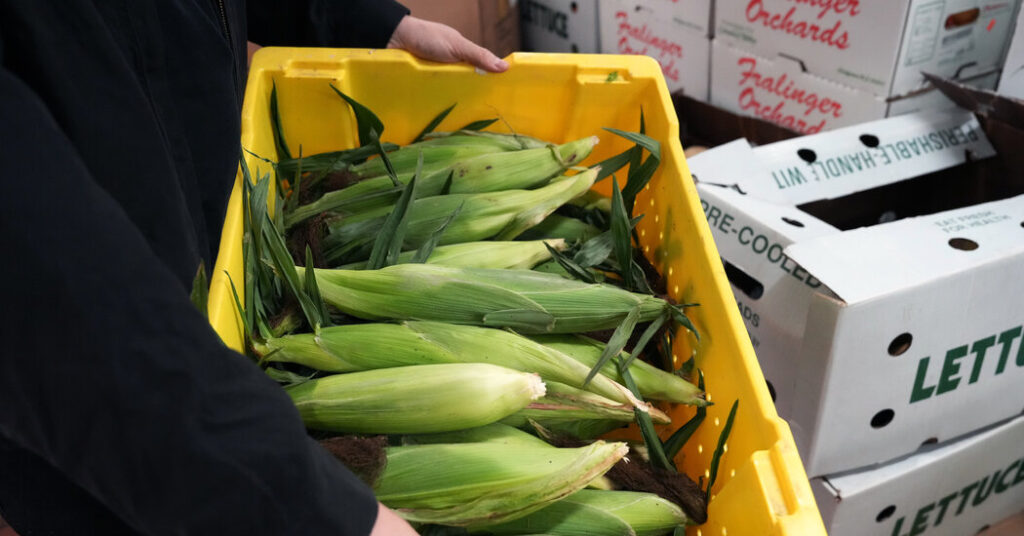
Getting farm-fresh groceries directly to consumers isn’t a unique concept. Shoppers have farmers’ markets, community-supported agriculture (C.S.A.) boxes and services like Misfits Market and Hungryroot to choose from, which offer similar benefits to Farm to People. But at a time when the number of U.S. farms is declining, Farm to People says it is trying to create a new economy for small farms to succeed. The company says it returns about half of every retail dollar to its producers, roughly three times the conventional grocery average, according to data from the Department of Agriculture.
“We don’t want to just come across as a different grocery-delivery company,” said Michael Robinov, 33. “It’s really about the makers, the customers and building infrastructure for a more direct food system.”
When Ms. von Haeften and Michael Robinov joined the company in 2013, they gradually changed the business by creating a warehouse model. They planned to funnel food from farms through a facility for distribution, instead of shipping food directly from farms to customers. Michael Robinov’s parents’ studio apartment on the Upper West Side of Manhattan was Farm to People’s first makeshift holding facility, and in 2014 the operation moved into a real warehouse. It made the full transition from shipping to delivery in 2020.
During the Covid-19 pandemic, when people were opting for delivery to help protect themselves from the virus, Farm to People saw its business boom. It moved warehouse locations three times and scaled from eight employees to 50 in less than a year.
“I do think people are waking up more and more and thinking critically about where their food is coming from,” said Ms. von Haeften, 33, who runs brand marketing operations.
While Farm to People provides convenience and curation, those come at a cost not everyone can afford.
Seasonal Produce Boxes start at $25; the Cook’s Box, which includes meat, dairy and grains, starts at $49.90. While some of the à la carte items are priced similarly to what customers may find in a regular store — $3.99 for a head of organic lettuce, $2.99 for two sweet potatoes — there are also lots of expensive organic and specialty items. One pint of seasonal strawberries currently costs $9.99.
Farm to People does not currently accept food stamps, a benefit from the Supplemental Nutrition Assistance Program, but said it was actively working to change that.
“Our goal is to be radically transparent with our pricing and our costs and to leverage programs like SNAP/E.B.T. to enable New Yorkers, no matter their economic standing, to be able to eat this food,” Michael Robinov said. “There is more than enough food. No one should go hungry.”
The recent investment came from New Fare Partners, a venture capital fund for food businesses, as well as other food industry and technology entrepreneurs, including founders of Stonyfield Organic and Blue Hill Farm, a former executive at Whole Foods Market and a founder of Union Square Ventures.
With the money, Farm to People also plans to improve the technology it uses to help small farmers plan crops. “We can help farmers even further up the supply chain grow what we know will be popular and what we know will have a market,” Ms. von Haeften said.
For Sun Sprout Farm in Chester, N.Y., Farm to People has helped expand its customer base.
“It’s actually great to have that anchor in the city to be able to explore those markets so we don’t have to do that research,” said Simon Ziegler, 33, a co-owner of Sun Sprout. Five years ago, Farm to People was buying two pallets of produce a week from the farm. Now, it is buying an average of 24 pallets per peak season delivery from Sun Sprout. Twenty percent of the farm’s annual revenue comes from Farm to People orders.
“Our hope is,” Michael Robinov said, “by working directly with the farmers and putting more money back into the farmers’ pot, we can actually make this a viable living for them.”
The post Farm to People Wants to Create a New Economy for Small Farms to Succeed appeared first on New York Times.