Send questions about the office, money, careers and work-life balance to [email protected]. Include your name and location, or a request to remain anonymous. Letters may be edited.
A Worker Who Uses A.I. Too Much …
Dear Work Friend,
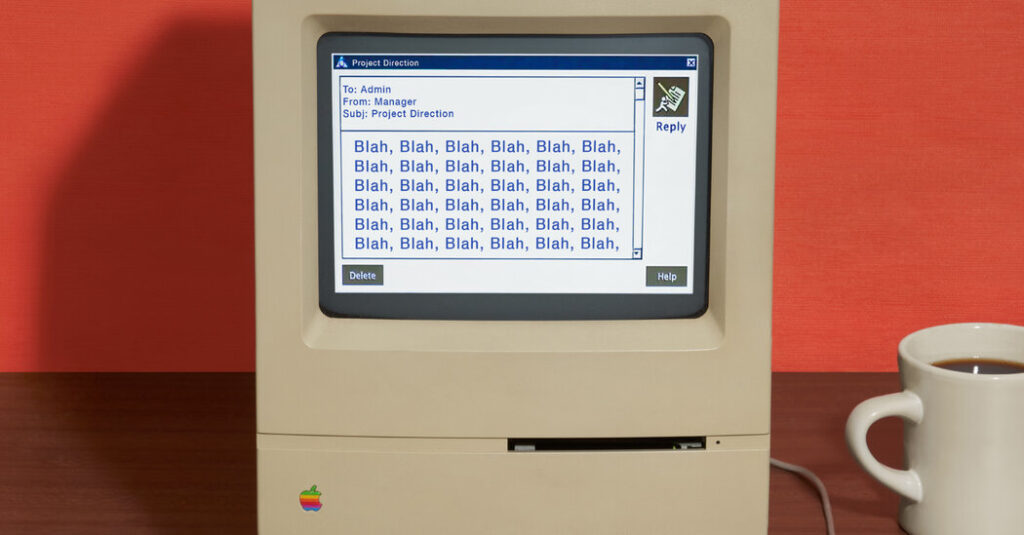
I’m a supervisor at a small nonprofit. I regularly receive communications from a subordinate that are clearly written by artificial intelligence. Basically, anything longer than a sentence — Teams message, email — has the hallmarks of A.I. writing. This person is a capable employee and I value his work. I’m also aware that English is not his first language, though he is quite competent in English. But being sent A.I. messages, particularly about occasionally sensitive matters, leaves me feeling odd.
My question is if I should raise this with the employee and encourage him to find a different way to communicate with me — in person (which is not always possible) or by drafting his own messages.
— Anonymous
For nonnative speakers obligated by their jobs to communicate in second or third languages, A.I. has been a godsend: A program that can check, correct and polish your email prose instantaneously so that you never feel embarrassed or underprepared. But as you note, the people receiving those emails (or Slacks, or whatever) can find them unnerving. It can be hard to tell where your correspondent’s ideas end and the A.I.’s begin. And at some point, the homogenizing, inescapable voice of today’s large language models can be so slick as to feel less professional than a stilted and ungrammatical — but unquestionably human and unique — message might.
Still, I’m torn about whether or not you should raise this with your employee directly. Perhaps he’s honest and amenable to criticism. But in my experience, many people who use A.I. for functions like checking grammar or lightly polishing prose don’t see what they’re doing as “using A.I.,” and will deny that their writing is “A.I. assisted” even when it clearly is. (There’s even a vanishingly small chance that he truly isn’t using A.I., and composes emails like that only because he learned to write in English from LinkedIn posts.)
And anyway, we’re still in novel territory when it comes to A.I. in the workplace. There’s probably no official policy for your team about using A.I. to write, edit or punch up emails, so why would he know not to — and on what grounds would you be asking him to stop besides a vague sense of unease?
Or at least, there may be no policy yet. You’re a supervisor — create and enforce one. A blanket ban on using LLMs, with an emphasis on the matter of sensitive material, would communicate clearly to this employee that he needs to stop, without singling him out. (When you communicate the policy, you might include some language assuring insecure writers and nonnative speakers that they are not being judged on the quality or correctness of their prose.) It would also set a precedent for other parts of your organization that might be feeling the same pressures. As Claude might say, that wouldn’t just be good management — it’d be the load-bearing foundation of a new workplace compact.
… and One Who Doesn’t Use A.I. Enough
Dear Work Friend,
I have a colleague who is not a clear or direct communicator. In person, this isn’t a huge problem because I can ask clarifying questions pretty quickly. By email, however, it creates a lot of confusion. I know he spends a lot of time crafting his messages, but the intent of them is often obscure.
Sometimes it seems that a question or request is implied but remains unstated while other times the question that is posed directly is secondary or marginal, and the real issue needs to be unearthed. This wastes a lot of time and creates a great deal of confusion.
I am a very straightforward communicator, so this situation might be particularly problematic for me, but I want to help my colleague and reduce the noise for myself and everybody else. I have asked him to be more explicit, to state his question or request as plainly as possible, many times, but it is hard for him to break his pattern. I’m not his boss, so maybe he’s uninterested in my exhortations, though he holds a relatively senior position and seems to have aspirations for higher-level work. Fixing this would clearly benefit him in the long run.
How can I make communication easier without being much more blunt? I don’t want to be rude!
— Anonymous
Well, here’s another side of the issue: A native English speaker who might benefit from running his workplace messages through A.I., which would presumably make his writing more direct.
I don’t necessarily think that’s a good idea. If you’ve already asked him to be more explicit and he hasn’t fixed the problems, there are two possibilities: Either he doesn’t really know what “being explicit” means or he doesn’t care. These seem equally likely to me. Maybe, as a lifelong indirect communicator, he’s never developed the ability to communicate clearly even when asked to do so. Or maybe he’s resentful of a peer who keeps exhorting him to abandon the communication style he prefers.
The good news is that it doesn’t really matter. The solution is the same either way: Rewrite his emails in the format you prefer. Obviously you can’t do this before he sends them, but you can do it afterward, in the form of a reply that reflects the content of his email back to him in a more direct and structured way.
For example, if he sends you three vague paragraphs with implied but never-articulated questions, send back three punchy points: “Here’s what I’m understanding you’re asking. (1) … (2) … (3) … Is that right?” If he sends you a long email with no action items attached, reply: “Do you need me to (a) approve this; (b) edit this; or (c) just read it?”
Don’t spend too much time on these replies. Their purpose is to take the work you do playing guessing games about your co-worker’s meaning and redirect it back onto him. At this point, quickly asking specific follow-ups about individual emails is likely to save you more time and energy than maintaining a broad pressure campaign to change his entire communication style.
But these emails have another purpose as well: to model for this colleague what it actually means to be direct. If the problem is that he really doesn’t understand, the experience of receiving his own words back to him in an explicit and structured format might help him grasp the practice and advantages of direct communication. And if the problem is that he feels annoyed by your urgings, he’s likely to be even more annoyed at the constant clarifying replies you send — and will change his behavior in response.
Worst-case scenario, I suppose, you could just paste his emails into A.I. yourself, and ask it what he’s trying to say.
Dreading the Cancer Talks
Dear Work Friend,
I recently had surgery for cancer and am undergoing chemotherapy. Since I was diagnosed, I have learned that everyone knows someone who has or had cancer. That seems to be top of mind for them when they talk to me — they want to share these stories.
When I return to work after my leave of absence, is there a polite but firm way to let my colleagues know that I prefer not to hear stories about someone they know who has or had cancer (some of whom didn’t make it through), or their unsolicited cancer advice? I know they are well meaning, but like any other cancer patient, I have been through the wringer and just want to get on with my life with some sense of normalcy. I also will still be receiving treatment with unpleasant side effects for some time. I don’t want constant reminders of my experience through someone else’s experience. And I don’t have the patience or empathy right now to listen to a story of someone I don’t even know.
— Anonymous
If you make such a minor and understandable request, I can’t imagine anyone begrudging it — no matter the form in which it’s made. OK, to be fair, there are probably ways to phrase your preference that would rise to the level of rude, even given the circumstances. (I wouldn’t interrupt your co-workers’ stories to say something like “I don’t care about your uncle,” for example.) But your options for a firm request are pretty wide before they start to feel impolite.
The best option is to make a clear, blanket request before or upon your return to the office, so that everyone is on the same page from the beginning. The exact format will depend a bit on the culture of your workplace. In a small office where you know everyone well, an email directly from you is probably best; at other offices, it may be better to ask your supervisor or H.R. to send a short notice. The main message should be simple and straightforward: You truly appreciate the support and well wishes of your colleagues, but you’re looking forward to the normalcy of your job and would rather not talk about cancer in the office.
Making such a request pre-emptively might feel presumptuous, but you’re doing your co-workers a favor by letting them know precisely how you’d like to be treated amid a major crisis. I’m sure that people often bring up friends and relatives who’ve had cancer because they don’t really know what else to say that might rise to the occasion. If you tell them you don’t need them to say anything at all, you’re removing both a potential irritation to you and a source of anxiety for your colleagues.
And consider that in one small and useless sense, you are lucky. There are many people across the country who would like to ask their co-workers to stop talking to them about a particular topic. You now have the moral and practical standing to actually do something about it.
The post Every Word My Employee Writes Reeks of A.I. appeared first on New York Times.