“What do you think about Roy Lichtenstein?”
In early 2020 a curator at the Whitney Museum of American Art posed that question to the artist Alex Da Corte, whose vibrant work spans video, performance, painting and installations.
The question was hardly a casual one: The Whitney was exploring who might curate a retrospective of Lichtenstein, who died in 1997. Though his hand-painted reproductions of 1950s and ‘60s comic books and advertisements are seen everywhere — T-shirts and postage stamps as often as museum walls — Lichtenstein’s last New York retrospective was some 33 years ago. Would audiences today get how topical and funny and new he was back then — and how much of his thinking endures in contemporary culture?
“Of course I was aware of Roy’s work, it was everywhere in the world,” Da Corte, 46, said in an interview from his north Philadelphia studio. “But I had never thought about it in a close way.”
“I thought, how curious that an artist’s work could be so ubiquitous, and yet I don’t see it,” he said. “So, for me, it felt urgent to ask, as an artist, how would I want my work to be considered and reconsidered when everyone thinks they know everything about it?”
In 2018, the Roy Lichtenstein Foundation had gifted 400 works by the artist — about half its holdings — to the Whitney, and in 2022, Dorothy Lichtenstein, the artist’s widow, donated their former Greenwich Village house and studio, which will become the new home of the Whitney Independent Study Program. A major show, drawing upon this largess, seemed logical.
The result is “Lichtenstein: Like New.” Opening on Oct. 11, it brings together a vast swath of work by this key figure of Pop Art, including painting, drawing, collage, prints, photographs, sculpture and even a three-channel film, all made between the early 1940s and mid-1990s.
From the start, the challenge for the Whitney was how to mount a show of such a familiar — perhaps too familiar — artist that would resonate today.
“I remember Dorothy saying, ‘You don’t need to make this a traditional retrospective. In fact, it would probably be better if it wasn’t,’” said David Breslin, who initiated the conversation with Da Corte before moving to the Metropolitan Museum of Art as curator of modern and contemporary art.
Da Corte’s own post-Pop sculptural installations and videos draw upon 20th-century American art history and sometimes involve playing the roles of the artists he engages, whether Marcel Duchamp or Eminem. He embarked on a deep dive into everything Lichtenstein, teaming up with a Whitney curator, Meg Onli, 42, an organizer of the 2024 Whitney Biennial whose past exhibitions have focused largely on the Black experience, with a special interest in new media.
“What? I’m not the first person you think of when you think of Roy Lichtenstein?” Onli joked during the joint interview.
Beyond Pop
But they hope their perspectives will offer up new readings of Lichtenstein’s oeuvre. While including some of Lichtenstein’s most recognizable paintings, such as “Girl With Ball” (1961) and “Drowning Girl” (1963), the show moves away from a narrow view of his status as a Pop artist best known for recontextualizing mass media imagery and translating cheap, industrial printing processes (all those Ben-Day dots!) into high-art canvases.
Instead, Da Corte and Onli offer up a picture of how he was equally inspired by more conceptual approaches, including Fluxus, a Sixties anti-art movement that favored D.I.Y. techniques, using cheap and reusable materials to create spontaneous art.
In his research, Da Corte was particularly fascinated by Lichtenstein’s interviews with other artists and curators. “Seeing Roy’s words, and the ways in which he described his work, it was so conceptual,” he said.
Lichtenstein, it turned out, was a peer of Allan Kaprow, who coined the term “happenings,” and he himself was a participant in one of them in 1963. “They taught at Rutgers together, and Roy hung out with the Fluxus crowd,” Da Corte said. “I thought, what if the framework of Pop has actually been a limiting device when it comes to understanding his work?”
The curators also trace a complicated back-and-forth between Lichtenstein and a number of postmodern appropriation artists (the so-called Pictures Generation of the 1970s and 80s) who regularly represented existing artworks as their own in order to challenge ideas of originality, copying and authorship.
Lichtenstein was appropriating imagery and being appropriated right from the earliest moments of his career, said Onli, citing artists whose works hang side by side with his own paintings. Elaine Sturtevant, for example, “was copying Lichtenstein’s work as soon as he was making it, and Lichtenstein was giving her stencils to work with. And Lichtenstein ends up copying his own work, too.”
The exhibition will include a reconstruction of Lichtenstein’s 1962 debut exhibition at Castelli Gallery — the first time that landmark show has been rehung in its entirety, right down to the parquet floor and lighting that mimics the original fixtures. “It was quite hard to track down all the paintings, including one of my favorites, ‘Laughing Cat,’ originally owned by Andy Warhol,” Onli said.
An introductory room in the show will highlight Flash Lab, an experimental studio set up by Hoyt Sherman, a professor at Ohio State University where Lichtenstein was a student in the 1940s. At the Flash Lab, students would stand in a darkened room; a burst of light would appear, illuminating a still life arrangement for moments. The students would then be asked to render the image from memory — turning themselves into human cameras, in a way.
Lichtenstein, in interviews throughout his life, attributed his ideas about visual perception and his conceptual bent to Sherman.
Curator as Performer
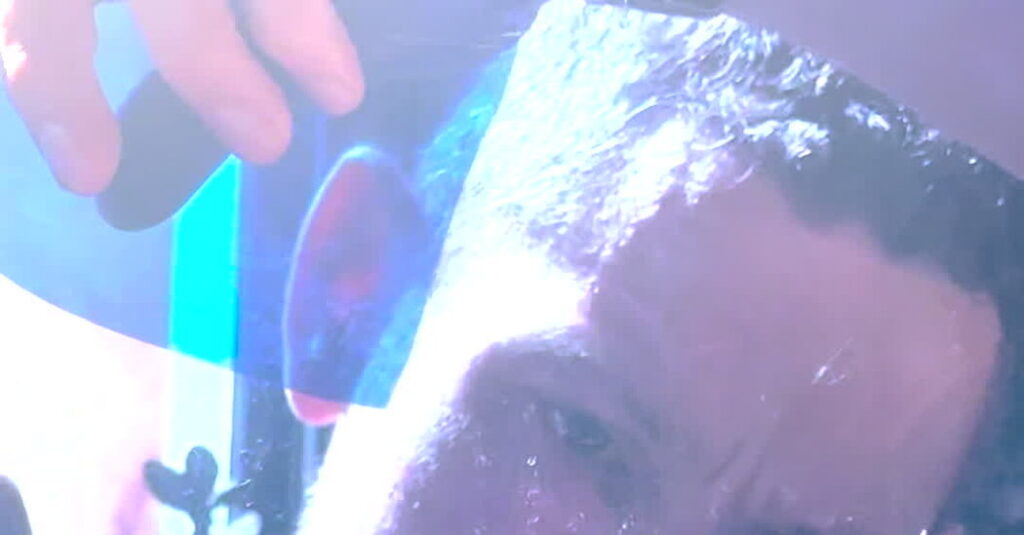
Some of Lichtenstein’s most celebrated war-themed paintings in the show, borrowing from the DC Comics series “All-American Men of War” — “Varoom!” (1963) and “As I Opened Fire” (1964) — recall Flash Lab’s explosions of light, which Sherman developed not only to train artists but to condition fighter pilots. One gallery will incorporate a new video by Da Corte in which he plays Hoyt Sherman (his two-hour transformation process involved prosthetic makeup).
“We felt it would be a generous way to start the show, to get into Lichtenstein’s sort of psychedelic mind space before you go through his whole life of pictures,” Da Corte said.
It was Onli who urged Da Corte to make the video. “There’s an interesting position that Alex gets to take as an artist-curator,” she said. “Why not take advantage of that?”
Da Corte’s artistic perspective comes into play in other parts of the show as well — including the recreation of important, temporary murals that Lichtenstein created at different points in his career. Da Corte pointed out the replica he and his studio assistants were making of Lichtenstein’s “Girl in Window” (1963), originally installed at the New York World’s Fair. The process of remaking the piece — consisting of acrylic on 10 plywood panels that together measure 20 feet by 16 feet — allowed Da Corte to understand Lichtenstein at a deeper level, he said. “I had to work in ways that were out of step with the stylistic choices that I would typically make, with the colors that I would typically use,” said Da Corte. “It put me in the space of historian or the archivist.”
It also underscored the handmade nature of Lichtenstein’s work, no matter the scale at which he was working. “The way that he painted the dots, they’re raised like Braille,” said Da Corte. “You begin to understand that this is a person who’s deeply engaged with touch, and with making things by hand, even as he lives in a space full of icons and symbols.”
Onli points out that Lichtenstein’s embrace of ephemerality as an aesthetic value is an important counterpoint to his current status as a blue-chip artist. (In a time of declining values, Lichtenstein’s auction prices have soared in the past two years.) “Lichtenstein was interested in impermanence. He was totally open to this work being destroyed.”
The first thing visitors to the show will see is a replica of the nearly 96-foot-long “Greene Street Mural,” displayed at a six-week-long show in 1983 at Castelli Gallery, after which it was covered in drywall and painted over. It has been remade by Colossal Media under the guidance of the Roy Lichtenstein Foundation, and will likewise be destroyed at the end of the Whitney show’s run.
When the gallerist Leo Castelli first proposed Lichtenstein make the site-specific work, he was daunted. “I don’t know, Leo,” he is quoted as saying. “It’s so big. I’d have to use every image I’ve ever painted to fill this.” And indeed, the composition is filled with motifs that had already or would in the future appear in his work — brushstrokes, composition books, Swiss cheese, a Brancusi sculpture and a Picasso painting, and banal household objects.
“It is a retrospective in its own right — a summary of his visual practice through icons,” said Da Corte, who hopes visitors will see a comparison with texting a string of emojis today.
The Whitney’s director, Scott Rothkopf, believes that the choice to put an artist in charge of “such a well-known and significant figure at such great expense and with such great insurance values” is rare, he said.
But the move, Rothkopf said, was made with the recognition that the museum needed to meet the moment. “The Whitney’s audience, by virtue of our free admissions programs, has transformed radically over the last three years. It’s now much younger. It’s much more diverse,” Rothkopf said. “I can’t take for granted that the people who come through our doors today necessarily share the view that Roy Lichtenstein or Jasper Johns or Andy Warhol are among the greatest artists who ever lived.”
Da Corte added of himself and Onli, “Here we are, people of color who are queer, who have a different view onto the world. Even though it doesn’t seem to be about me, I bet I can learn something from this.”
Onli is betting that the Whitney’s younger, digital-native audience will “inherently understand what Lichtenstein was doing,” she said. “He was always thinking about what we do with the images we receive, and how do we internalize them and then put them back out into the world.”
The post Don’t Call Him Pop: A New, Improved Roy Lichtenstein Is at the Whitney appeared first on New York Times.