Which Celine Dion would turn up at her Paris comeback show? The powerhouse belter? The sensitive balladeer? The unpredictable ad-libber?
But the real question in the back of some many people’s minds at Plenitude Arena on Saturday was whether she would turn up at all.
As the minutes ticked by past the scheduled start time of 8 p.m., it was hard not to think about the wrenching vulnerability the singer exposed in the documentary “I Am: Celine Dion,” in which she detailed the impact of her battle with a rare neurological condition known as stiff person syndrome. Sure, she had performed at the Paris Olympics opening ceremony two years ago, but that was just one song. Saturday’s would be her first full concert in six years, kicking off a string of 26 shows in a venue holding 35,000 people.
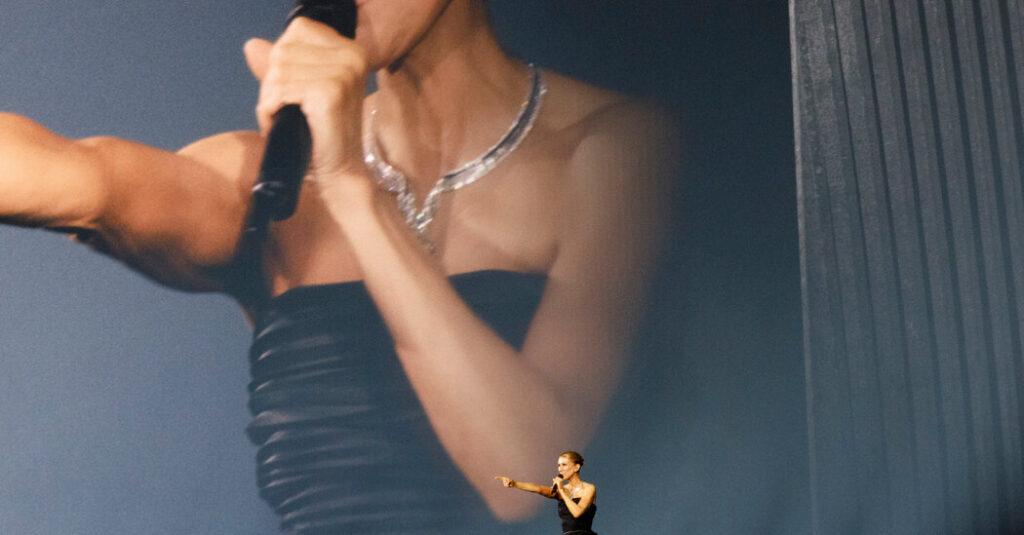
Then the lights went down at 8:48 p.m. Dion slowly walked onto the gigantic stage in a black gown and opened with “On Ne Change Pas” (“We Do Not Change”).
While fans in France and Quebec tend to know Dion’s repertoire in both French and English, most American listeners are unaware of her French songs. She is bilingual and bicultural, as if she were two stars in one, with distinct careers that complement each other.
On Saturday night, it was obvious from which side the emotion was flowing. Dion did most of her stage banter in French, which she grew up speaking in Charlemagne, a small town near Montreal, and she sang in French for roughly two thirds of the set list.
Dion, 58, looked defiant yet fragile. Her familiar voice had a burnished patina that seemed to reveal a touch of nerves and a whole lot of roiling feelings. She lost her composure during that first number and had to briefly stop singing. “I had promised myself not to cry,” she told the audience at the end of the song. “I don’t keep my promises.”
That Dion was making her return to evening-length live performance in Paris instead of Las Vegas, where she lives and has held two successful, lucrative yearslong residencies, may have partly been a logistical choice — Paris, after all, is a transportation hub easily accessible from around the world.
But France is a huge deal to Dion and was the first country to embrace her outside Canada. Conversely, she is a huge deal to France: A weekend front page of the Libération newspaper asked whether she would “save the 2027 budget” and an article inside cited a study estimating that her concert run could generate up to “1 billion euros in economic benefits for France.”
The show did include some of Dion’s biggest English-language hits, like “My Heart Will Go On,” “Beauty and the Beast” and “I’m Alive” — the last one inserted into a medley that also included Donna Summer’s “I Feel Love” and Eurythmics’ “Sweet Dreams (Are Made of This).”
“I was pleasantly surprised when she did ‘All by Myself,’” said Pauline Martin, an audience member from the greater Paris area, who confessed she had spent half of the show crying. “It proved she hasn’t lost her voice. It was a symbol, as if she was telling us ‘I’m back.’”
But the biggest responses were reserved for the French-language material, including the wildly popular “Pour Que Tu m’Aimes Encore” (which audience members reprised in unison later on as they walked to the subway) and the rollicking duet “J’Irai Où Tu Iras,” a classic at French weddings that Dion performed with Jordan Lévesque, a new backup singer.
In contrast to her English-language style, which is more extroverted and flamboyant, the French tunes draw from styles like chanson and the soft-pop genre known as variété, with an emphasis on storytelling that pulls listeners close rather than stunning them into awe with vocal pyrotechnics.
Scott Price, Dion’s musical director, said in an interview last week that it was when they started poking around the singer’s French repertoire that Dion got back in the saddle last year.
“That really lit a spark in her, and a lot of the song selection came from that,” Price said, explaining that singing in French and in English required different techniques. “To me, it’s more where the voice emanates from in French. It’s a little lower, deeper in the back of the throat, less up front,” he said. “That seemed to be something that helped her out along her path.”
After front-loading the set with slower warm-up numbers, Dion seemed to gain in confidence on Saturday, building up to one of her epic live staples (even if it was decidedly less over-the-top than usual, marking a return of sorts to her early-career, more conservative singing style.)
A gospel choir came onstage for a segment, adding sonic majesty and oomph to tracks like “Love Can Move Mountains.” The set incorporated enormous concrete-looking slabs and stout columns that moved around to alternately expose and hide the band, and looked like something an avant-garde sculptor might have cooked up for a Brutalist version of “Dune.” Interstitial videos of Dion traipsing across a sandy desert furthered that impression.
“There is kind of like this opera diva art to her, this kind of grande dame,” said the show’s creative director, Willo Perron, who has worked on Beyoncé’s Cowboy Carter tour and Rihanna’s halftime extravaganza at Super Bowl LVII. “And I wanted her to go all the way to that, go completely into that role.” The opera reference was driven home in one of the evening’s most jaw-dropping moments: a performance of “Ebben? Ne andrò lontana” from Catalani’s “La Wally,” an aria forever associated with Maria Callas.
But the singer’s trick is how she can balance outsize emotions with simplicity. “At the same time,” Perron also said of Dion, “there is this endearing — and this is very much a French Canadian attribute — very down-home thing.”
That latter side is a huge part of Dion’s appeal, making her closer to Dolly Parton than to, say, Beyoncé or Mariah Carey in terms of her relationship with her audience. Notably, both she and Parton grew up in families of modest means and despite their wealth (and, in Dion’s case, love for experimental high-end couture), they project an earthy spontaneity that feels genuine rather than hatched by social media teams.
You could experience that relatability in the couple of weeks leading up to the first Paris show, when Dion would hang out with the fans waiting outside her hotel late at night. She would turn up well past midnight and chat for a while, looking overcome as her admirers serenaded her with her own songs, or dancing like everybody’s favorite kooky relative. You got the feeling that though she is light years away from her hardscrabble upbringing, she has retained a fundamental structural integrity.
“She has a relationship with the stage and her audience that is authentic,” said Thomas Jolly, who directed the Olympics opening ceremony. “You might assume that artists are always performing, creating characters. But with Celine, it’s as if there’s only herself. And she herself is enough.”
That self is capacious enough to juxtapose “La Wally” and rambunctious boogie, “Titanic” and classic disco. And it is strong enough to give a message of endurance and hope to the singer’s fans.
“I had lost faith we’d ever see her again,” said Sophie Lesaffre, who had come to the show from Toulouse in southern France. Julien Grand, her friend from Compiègne, knew better. “I always knew she’d be back,” he said. “I always knew that no matter what, Celine will be there.”
The post Celine Dion Is Back Onstage. Naturally, She Chose Paris. appeared first on New York Times.