He has no neck.
That’s what stopped the internet in its tracks: a raccoon whose head sits directly on his shoulders. A raccoon who runs without appearing to travel, loping in the manner of a man crossing a hot parking lot in flip-flops.
His name, if you’re one of the few who haven’t heard, is Jimothy. He lives in my part of Seattle, and that’s as precise as I’ll get. Nobody around here wants the world clogging our street corners, hoping for a glimpse. Which hasn’t, however, stopped me.
On the evening of July 13, Kiana Hall saw something moving under a parked car near her home. A cat, she thought. Then it stepped into the light. She got a few seconds of video and uttered what remains the best single line spoken on this subject.
“What am I looking at?”
She posted it to her friends, saying that she and her husband had been blessed by a Jimothy. Why Jimothy? To her, he just looked like one. Nobody has come up with anything better.
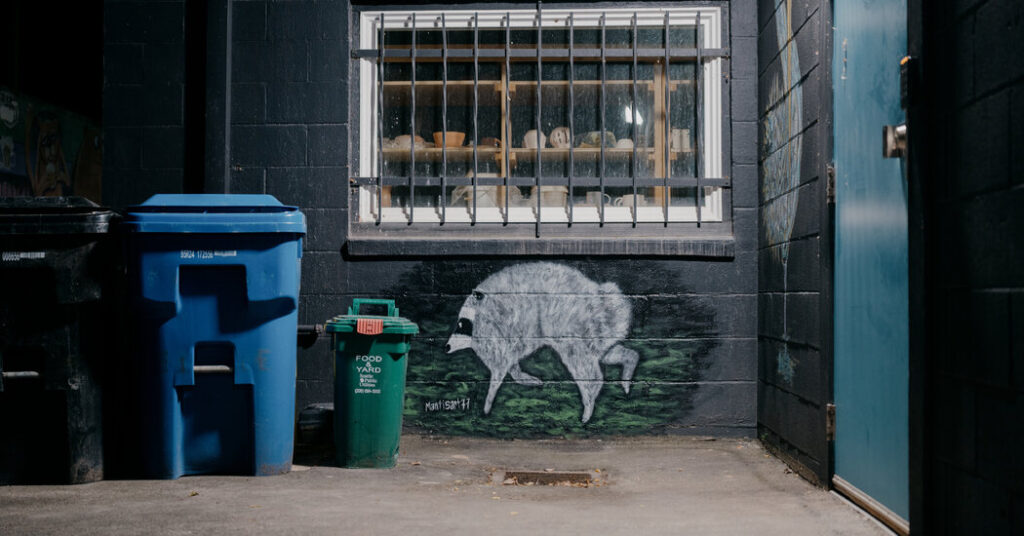
By morning, her video was ricocheting worldwide. Within a week, it had racked up 10 million views and media from Germany to the Philippines to New Zealand were calling Ms. Hall. Soon, Jimothy was the subject of a mural, tattoos at a shop up the street, a cryptocurrency, a charity auction that raised $271,975 for a food bank and an honorary degree from the University of Washington.
Seattle City Council members declared this Jimothy Summer. The Seattle Mariners held Jimothy Night, doling out baseball cards of the raccoon, including a single gold-bordered edition that a 13-year-old fan sold on eBay for over $20,000.
Jimothy received no royalties. He was up a tree.
Jimothy isn’t the first. Every so often, a town reaches into its animal population, pulls one out, endows it with a name, personality and opinions and takes it in like an orphan. Then social media churns, and out comes a bona fide world celebrity.
Professionals have thoughts about the phenomenon. Aimee Frazier is a licensed counselor who practices ecotherapy, which means her clients get the woods, not the couch. She explains the pattern as a reaction to the way people live their lives now. Every building, every street was built by humans for humans, Ms. Frazier said, adding: “We’re so humancentric.”
A hobbled raccoon under a Prius is a reminder that the arrangement is recent. “He pulls us out of ourselves,” Ms. Frazier said, and back into something people have lost touch with.
Some of these animals we take in out of pity. Consider Pedals, the New Jersey bear who couldn’t use his front paws and walked upright past the trash like a neighbor getting the paper. For the many humans who fear their flaws could subject them to scorn, here was an animal whose disability was the narrative — and he became a hero.
Then there are wayward ones: Flaco, the eagle-owl loose on Manhattan’s Upper West Side, or P-22, the cougar who zigzagged across Los Angeles freeways to live under the Hollywood sign. They refused the rules, thumbed a paw or a claw at the system, proving the metropolis, its permits and codes and bumper-to-bumper grind are escapable.
What’s Jimothy? A bit of everything. He’s damaged, unbothered, in the wrong place and pulling it all off without noticing.
If Jimothy came when called, he would be a pet, and a pet is of no special use to a city. The whole lore runs on the animal’s indifference. In a world where everyone seems to be working an angle, people fall in love with something that won’t look up when asked.
Sometimes my neighborhood seems like a zoo. Bald eagles land in the tall trees, scanning for rabbits. Coyotes come in packs, famished and ready to pounce. Raccoons? They’re hardly strangers — though they usually don’t get fan clubs and bumper stickers.
Oscar Velasco-Schmitz, a friend down a few blocks, recently saw two gangs of raccoons duking it out in a late-night brawl. They battled across his trees and the neighbor’s roof. The sound is seared in his mind. “A cacophony WrestleMania throwdown!” is how he described it.
There was a small one getting worked over while another hung on for dear life, Mr. Velasco-Schmitz recalled. Was it Jimothy? Maybe, he said, but he sure hoped not.
None of these animals consent to being the objects of our fascination, and they’re often the ones who pay. Norway shot the walrus Freya because people wouldn’t stop crowding her for selfies. New Yorkers fought to keep Flaco free, and then he died after striking a building with a gut full of rat poison.
A short time ago, somebody spotted Jimothy in the neighborhood again. Another video flew across the digital ether. There he goes, prancing down a street strewn with browned Seattle leaves. “Jimothy is alive and well,” read the post, which was met with 75,000 likes. That’s where this is now — a terrible dread takes over if Jimothy isn’t seen for a few weeks.
These days, I drive slower down my street. Not only for his sake. In this era of social media malice, imagine the harrowing fate of the driver unfortunate enough to run over Jimothy.
One evening I spotted four or five raccoons in the cypress tree a few feet from my front door. They stared at me with the blunt disinterest of people waiting for a city bus.
My only thought: Get the dang dog inside!
My dog Chana is the reason I’m out on these blocks at night. Against Jimothy, Chana might have a puncher’s chance. Cornered by Jimothy’s mother — full-sized, full-necked, unnamed and unproclaimed — he’d be raccoon appetizer.
So when Chana gets up at 3 a.m. to relieve himself in the backyard, unleashed, we watch or listen for the bark. Lately I’ve been listening for coyotes, too, on behalf of a raccoon I’ve never seen. He has no neck.
The post Why Finding Jimothy Is Really About Finding Ourselves appeared first on New York Times.