While this year’s enormous El Niño is spawning a parade of hurricanes in the Pacific Ocean, the Atlantic is quiet — record quiet — as the weather pattern crushes storms before they get going.
No Atlantic hurricanes have formed yet this year and none are likely to form for at least another week, even though this would normally be the peak of the season, according to the National Hurricane Center. Only five relatively weak and brief tropical storms have spun up this season.
On Saturday, 2026 set a record for the longest a season has begun without a storm that has reached winds of 74 mph to qualify as a hurricane — at least in the satellite era, said Nick Novella, a meteorologist at the government’s Weather Prediction Center. Before the 1950s there were a few years where no hurricanes were recorded this late in the season, but meteorologists don’t trust those records because ocean monitoring wasn’t complete.
Overall hurricane activity using a measurement that factors in the number of storms, their strength and how long they last is also at a post-1950 record low, according to Colorado State University hurricane expert Phil Klotzbach. Storm activity in the Atlantic is only 7% of normal for this time of year.
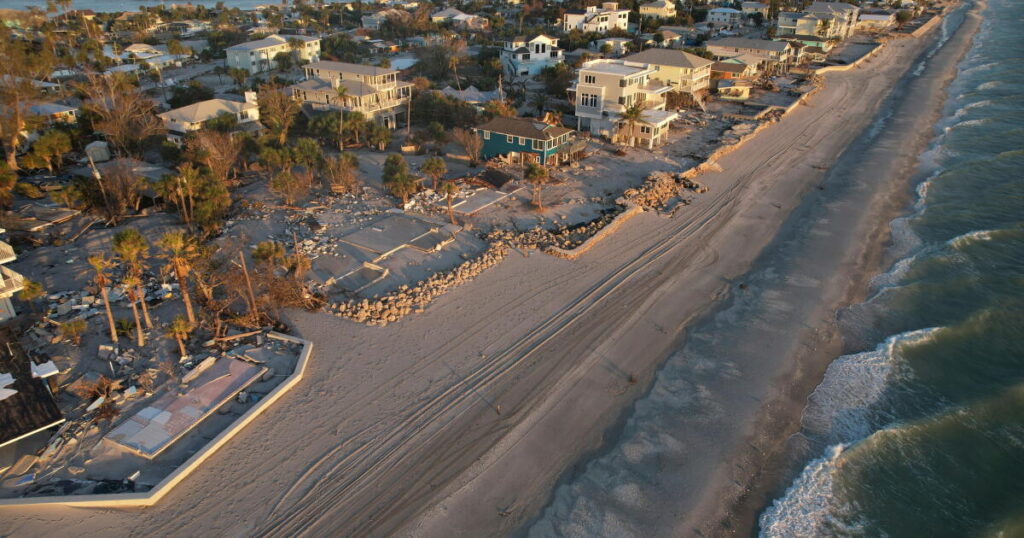
People shouldn’t let down their guard because it just takes one storm, even during an El Niño, to be catastrophic. Several experts pointed to 1992, which kicked off late but nastily with devastating Hurricane Andrew.
El Niños spawn storm-stunting conditions
“It’s really staggering, just how inhospitable the Atlantic is to anything that could form a tropical cyclone right now,” said Kristen Corbosiero, a University at Albany atmospheric science professor. “Anything that tries to form is just getting this triple whammy” of winds that decapitate a storm, dry air that starves it, and downward pushing winds that basically stomp it.
Those three forces are classic impacts of El Niño, the natural and temporary warming of parts of the equatorial Pacific that warps and warms weather worldwide, five experts told the Associated Press.
“It’s just hammering the Atlantic. It’s just impressive,” Klotzbach said. “We haven’t even had anything really even close to a hurricane.”
The biggest El Niño effect in the Atlantic is record strong wind shear, which is when strong easterly winds hit a storm system at low levels while strong westerly winds push it the other way at upper altitudes. The result is that they “tear apart” the storm, Corbosiero said.
In the area between Africa and the Caribbean where the strongest storms normally form and head west, that wind shear is about 45 mph more than what a tropical cyclone can withstand, Corbosiero said. That’s an unheard of level, she said.
“Their heads are cut off before they even have a chance,” said University of Miami hurricane expert Brian McNoldy.
Watching the Gulf of Mexico
The one area where wind shear hasn’t been high has been the Gulf of Mexico, and those storms tend to really get going later in the season, so there could still be some strong ones coming to that region, Corbosiero and others warned.
Along with the dry air that starves the storm, African dust is choking it and there are fewer “seeds” of stormy weather that could develop, all classic El Niño signs, the experts said. And in the Atlantic, high pressure is pushing the air downward, which also hinders storms from forming, they said.
This is all despite warm waters — the world’s oceans have been record hot for 100 days — that normally feed storms. It shows the power of El Niño to overcome that, Klotzbach said.
The trouble is that the Atlantic waters, while warm, haven’t warmed up nearly as quickly as the atmosphere above, which got hotter quickly as part of El Niño, said Massachusetts Institute of Technology meteorology professor Kerry Emanuel. His research found that what matters more than just the water temperature is the difference in temperature between the air and the water; because hurricanes are powered by the flow of heat from the ocean to the air, the higher that is, the less storm activity there will be.
The waters of the Atlantic are a few months behind the atmosphere in feeling the El Niño effect. But next year, as this El Niño winds down and cools closer to normal, the warm water will persist, which will increase the odds for next season to be extra busy, Emanuel said.
The opposite issue in the Pacific
Just as El Niño traditionally dampens Atlantic hurricane season, it tends to rev up tropical cyclone activity in the Pacific, with moist air and little wind shear. And so far this year, storm activity in the eastern Pacific is nearly double normal, with hurricanes lasting much longer than usual. In the central Pacific, activity is about 40% more than normal.
“It’s just a party out there, one right after the other in the eastern Pacific,” Klotzbach said.
While the Atlantic has had only five small tropical storms, there have been 16 named storms in the eastern Pacific and 20 in the central Pacific.
Hawaii has been hit twice. Hurricane Marie off the Southern California coast brought rain, high tides and heavy surfto the region last weekend. El Niño tends to push storms farther west than other years, Corbosiero said.
Because scientists have long known about El Niño’s effects on storm activity in both oceans, forecasters months ago predicted a slow Atlantic hurricane season.
“I don’t think anyone really foresaw it being this quiet,” McNoldy said. “This is quite remarkable.”
Borenstein writes for the Associated Press.
The post Where have all the Atlantic hurricanes gone? El Niño’s might brings record slow storm season appeared first on Los Angeles Times.