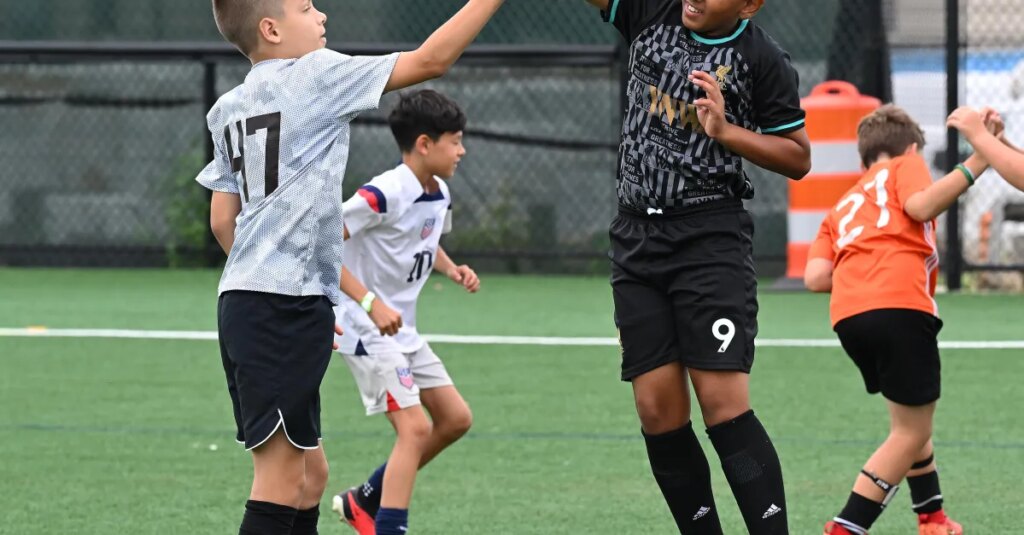
In the last decade, the cost of youth sports has skyrocketed. Cheaper, more local rec leagues have lost out premium travel leagues funded by private equity. The Covid-19 pandemic made things worse. As a result, some families are now paying thousands of dollars to keep their kid in a sport that they love.
Caitlin Moscatello wrote about the phenomenon last month for New York magazine. She says the shift started during the pandemic when park and rec budgets were slashed and the premium leagues became the only game in town. Private money saw the opportunity and seized it. Now, participating in youth sports means you’re caught in a pay-to-play model.
In return, elementary-aged children are being railroaded into a professionalized environment before they’re ready. More children are suffering from overuse injuries and are getting locked into a sport before they even have time to decide if they love it.
Moscatello joined Today, Explained co-host Noel King to break down what happened to youth sports, the impact on children, and whether it’s possible to reverse this trend.
Below is an excerpt of their conversation, edited for length and clarity. There’s much more in the full podcast, so listen to Today, Explained wherever you get your podcasts, including Apple Podcasts, Pandora, and Spotify.
Private money in youth sports doesn’t seem to make a ton of sense. Who’s going to make money off of an 8-year-old playing soccer? And yet what you found is there’s a lot going on here. Give me a broad sense of what’s been happening.
It was a little over a decade ago that you really started to see this influx of big money coming into the youth sports sector. And what you see right before and then certainly after Covid is investors using what’s called a roll-up strategy — where they own, or have a financial stake in, different touch points that families would have in the sport that their child’s playing.
For instance, they might have a stake in the league itself, but also the apparel company where families are required to buy the uniforms, and the software or the app that families need to go on to look at the team’s schedule, and in some cases look at updated stats and standings. There can be a hotel partner, so even though there’s a less expensive hotel down the street, they’re required to stay at this specific hotel.
There’s also money to be made on what’s being called the media side of all this. Parents described to me not being able to record video at their child’s game, but then being sold a package of photos and videos, which, again, is just another financial touchpoint.
How much are parents spending on sports?
But ultimately, in their quest to do something good for their kids, the way that the sports ecosystem has changed and is continuing to change can potentially set them up for long-term harm.
The average spend is a little over $1,000 a year, but many of the families that I spoke with, especially in this travel private club sector, can spend anywhere from $3,000 a season. It can be $5,000 or $10,000 a season depending on the sport, where you are, the level of play. I spoke with numerous families who were spending $25,000 a year.
There was one mother that I spoke with. She’s a single mom. She was pet-sitting on the side in addition to her full-time job to help offset the cost of her son’s $25,000-a-year hockey program. I also came across a lot of GoFundMes for families who are trying to get their 6-year-old or their 7-year-old or their 8-year-old who made the travel fill-in-the-blank soccer, baseball team. And they’re fundraising to try to make that happen.
And for your $25,000 or more a year, what are you getting?
It’s a loaded question. Part of what’s drawing families to this in some areas is that they really feel like they have no other choice. Rec programs are sparse. They also don’t extend as long as they used to.
I’m an elder millennial, I guess I would say, and back in the ’90s, it was still very much that you could play a rec sport through eighth grade and then if you chose to, go on and play in high school. What’s happening is that rec programs now are ending much earlier. In some places it can be difficult to find a rec program after maybe third or fourth grade. And these programs are also getting diluted because the private leagues are incentivized to attract families earlier and earlier.
Now you start to see travel teams and even tryouts for kindergartners, first-graders, second-graders. And what I was hearing from parents over and over again was that there was this fear of missing out: “This isn’t something I would necessarily choose for my kid, but if we don’t get in on the ground floor, the elevator’s going to go up without us and we’re never going to catch up and my kid won’t be able to play and everyone around me seems to be doing this now, so we’re going to do it too.”
What this does to the rec programs is that it dilutes them really early in a couple of ways. One, it just brings the level of play down when kids start leaving in the first and second grade, by third grade. Also, there just aren’t as many kids.
And then the other factor is that kids and parents both notice that these other leagues exist. And so another thing that I kept hearing was, “Well, the rec programs sort of felt second-rate and we’re looking across the field.” There was this one father, he’s a lacrosse coach and he has two children who now play travel lacrosse. And he’s like, “It’s kind of hard when you look across the field and you see the kids with their shiny helmets and their fancy uniforms and their professional coach.”
What did you find all of this money in youth sports is doing to the youths playing the sports?
The benefits of sports have been really well established. Kids who play sports have everything from higher levels of academic achievement to higher self-esteem, better long-term health outcomes.
But ultimately, in their quest to do something good for their kids, the way that the sports ecosystem has changed and is continuing to change can potentially set them up for long-term harm. It can be psychological. So they’re seeing stress and anxiety, burnout, but also physical [harm].
There’s a surge of overuse injuries now in young athletes, especially because the private programs are incentivized again to get kids playing as much as possible. And so what’s happening now is that you have young children playing in this hyper-competitive year-round environment.
Medical advice has said that kids should play all different sports, use different muscles, learn different skills. And that’s what’s appropriate for young developing bodies, not playing one sport 10 to 12 months a year, tournaments on the weekends, six games, practices three or four times a week where then you see these overuse injuries, because kids are just doing that same motion over and over again.
Is there any movement among parents to stop this, to say, “This has gone too far, let’s not do it anymore.”
This is a collective action problem. If more parents stayed in the rec programs, then we would have a more robust rec system: more kids play, it’s more accessible, it’s more affordable. It’s also local and fun.
I don’t want to be so naive and think, “Oh, things could go back to the way they were in the ’90s.” I think you can’t put the toothpaste back in the tube entirely. But the good news is that we do have a model for a pathway forward.
Minnesota Ice Hockey is a nonprofit youth sports program, the core of which is 250 public rinks. The cost to play is about $200 to $400. Coaches are volunteers, but they are trained through USA Hockey. And these kids play more in that rec model where they play with other kids from their community.
This is showing real results. You look at this program and there’s 60,000 kids who play Minnesota ice hockey and Minnesota produces more D1 men’s and women’s ice hockey players than any other state in the country.
And really what this comes down to is it’s accessible to everyone. And so it’s more of a meritocracy, right? Everyone gets to play, and everyone gets to have fun. And then the kids who really do eventually show a high level of ability, they still get to play at that really competitive level because it’s not diluted. That has shown that it can produce really amazing hockey players while giving all these kids a good experience.
The post The cost of youth sports is out of control appeared first on Vox.