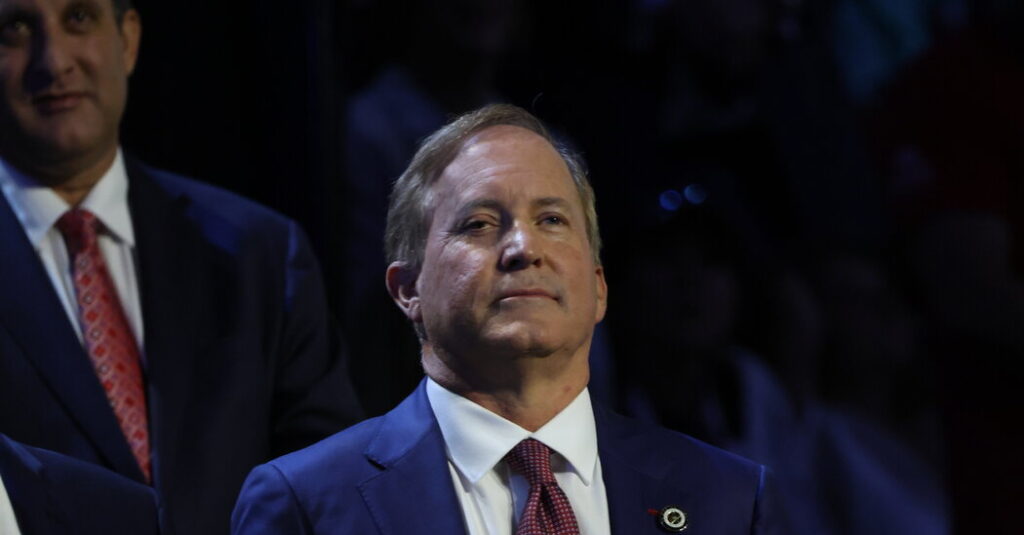
A major Republican group booked more than $51 million worth of advertising in the Texas Senate race on Friday to help Ken Paxton, the G.O.P. nominee whose tight race has become a growing concern in the party as it seeks to keep control of the upper chamber of Congress.
For months, top Republican outside groups stayed away from Mr. Paxton’s contest, where polls show a close competition between him and a well-funded Democratic opponent, James Talarico. But a flood of outside money suddenly arrived over the last two weeks to help Mr. Paxton amid Mr. Talarico’s rising prospects of winning.
The new $51 million investment from Texas PAC, a group affiliated with the Senate Leadership Fund, the main super PAC allied with Senate Republican leaders, adds to the more than $23 million that has already been booked by a half dozen other G.O.P. groups on advertising for Mr. Paxton from Sept. 1 through Election Day. That gives Mr. Paxton and Republican allies a 5-to-1 spending advantage over Mr. Talarico and Democratic allies, according to AdImpact, a media tracking firm. For months, the Democratic side had possessed a clear spending advantage.
The approximate total of $75 million doesn’t include all of a $10 million Texas ad buy disclosed by President Trump’s super PAC last week or the $2 million-plus investment in voter contact work from Elon Musk’s super PAC.
That Mr. Paxton is abruptly in this position is a twist in the Texas race. After defeating Senator John Cornyn in the primary, with Mr. Trump’s help, Mr. Paxton spent months as a heavy financial underdog, with various Republican groups hoping that at least one would step up to spend in an expensive state that can drain an organization’s coffers. Now, the Republican financial establishment appears to have decided to jump in together to boost Mr. Paxton.
When the Senate Leadership Fund outlined its spending plans in April, an investment in Texas was notably omitted. Pressure to spend mounted from fellow Republicans for months. Alex Latcham, the head of the Senate Leadership Fund, said on Friday that its ad buy “affirms our commitment to maintaining the Republican majority.”
When Mr. Paxton defeated Mr. Cornyn, who some Republicans argued was the stronger general election option, many in the party braced for a more difficult and expensive general election. Allies of Mr. Cornyn, who is close with many donors and served in Senate leadership, were embittered by the outcome, complicating Mr. Paxton’s path to consolidating support. Some wondered why they should have to rescue a candidate they saw as flawed and didn’t want to nominate in the first place.
Buying ads is a fluid process, and campaigns and outside groups often adjust their spending as Election Day nears.
Mr. Talarico, a state representative, is one of his party’s strongest fund-raisers this election cycle and may be able to keep up financial parity without outside help. He outraised Mr. Paxton by a huge margin through the middle of this year, bringing in more than $54 million in 2026 compared with his Republican rival’s nearly $4 million.
From June through August, Mr. Talarico and his allies outspent Mr. Paxton and his by a 7-to-1 margin, according to AdImpact data. During that period, neither candidate had much outside help.
But now pressure will most likely mount on the main super PAC backing Senate Democrats, the Senate Majority PAC, to invest in the state as Republicans now have. The New York Times reported in July that the Senate Majority PAC had given other Democrats the impression that it planned to spend there, even though it, like Republicans until now, has conspicuously avoided Texas.
On Friday, Lauren French, a spokeswoman for the PAC, said, “We’ll continue to watch the race closely, but if you ever needed a sign Paxton was in trouble, this is it.”
The post Republican Groups Rush to Paxton’s Aid in Texas After Staying on Sidelines appeared first on New York Times.