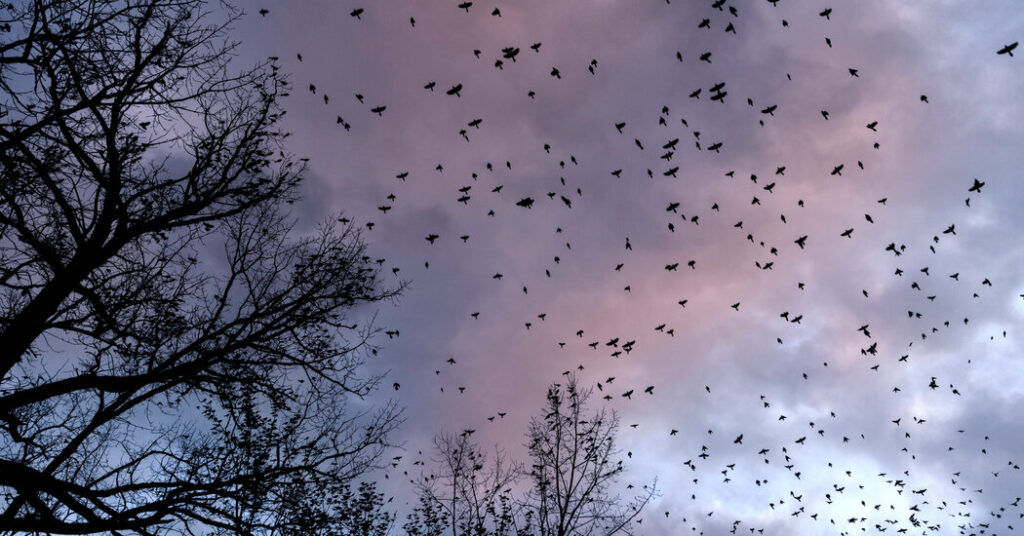
More than 300 million birds are expected to soar across the United States on Saturday during their annual fall migration, prompting requests for residents to turn off or dim lights to help ensure their safe flight.
Hundreds of species of birds, such as blackpoll warblers, chimney swifts and scissor-tailed flycatchers, will fly from the Northern Hemisphere to South America for a warmer climate filled with more food, said Dylan Osterhaus, a postdoctoral research assistant at Purdue University who studies migratory birds.
“It’s always like Christmas morning, going out each morning and seeing what new presents arrived from the north,” he said.
But the trek can be dangerous.
At least one billion birds die each year after crashing into skyscrapers and other lighted buildings, said Adriaan Dokter, a research associate who leads Cornell University’s BirdCast, an online resource that tracks the birds in real time.
The birds, which typically travel after darkness falls, will be most heavily concentrated in eastern Minnesota and Michigan on Saturday.
The birds could fly through Illinois and Indiana and then cluster in the Southern states before soaring out of the country, according to projections from the Aeroecology Lab at Purdue University.
Some cities, such as Minneapolis and Chicago, ask residents to turn off or dim lights so the birds do not mistakenly fly toward lit structures.
Building owners or managers could switch off exterior decorative lighting and floodlights and install automatic motion sensors, the Audubon Society said. The lighting should be turned off or reduced from 11 p.m. to 6 a.m.
The leading cause of death for wild birds is crashing into buildings, said Jessica Wilson, the executive director of the NYC Bird Alliance.
Some birds become disoriented during bad weather and can fly into tall buildings. Some migrators also are drawn into well-lit areas and cannot see glass, Dr. Dokter said.
The fall migration, which began in mid-August, could peak over next two weeks, with more than 500 million birds dotting the Northern Hemisphere, Dr. Osterhaus said. The migration period typically ends in mid-November.
The birds rely on weather patterns to determine when to fly, Dr. Dokter said. They can halt their migration if storms settle over a region.
The bird projections studied by researchers at Purdue and Cornell rely on weather radar data, Dr. Osterhaus said.
Certain weather conditions, such as favorable wind shifts, have correlated to instances in which large flocks of birds take off, he said.
Scientists have combined decades of this weather data and built a predictive model to project how many birds will be flying based on how the weather shifts, he said.
Each species has its own migration pattern.
Some species, such as the dark-eyed junco, nest in Canada and then fly in the winter to the United States, Dr. Osterhaus said.
“These birds are really trying to maximize their survival and fitness,” he said.
Generally, the fall migration contains more birds because the summer’s breeding season has concluded, said Catherine Quayle, the communications director for the Wild Bird Fund, a nonprofit that rehabilitates injured or sickened birds and other animals.
From Sept. 5 until Friday, the Wild Bird Fund admitted 453 birds, of which 124 had crashed into windows, she said. The birds cannot tell the difference between a real tree and the reflection of a tree.
In New York City, more than 250,000 birds die each year after crashing into buildings, Ms. Wilson said.
Residents can help by sticking films with patterns on windows to make the glass less clear, Dr. Dokter said.
Alexandra E. Petri contributed reporting.
The post As Millions of Birds Migrate, Residents Are Asked to Turn Off the Lights appeared first on New York Times.