A diplomatic rift is hindering cooperation between the United States and Brazil on jointly fighting organized crime, according to U.S. and Brazilian officials, an issue the Trump administration has placed at the center of its agenda in the Western Hemisphere.
The State Department is withholding visas for two Brazilian federal police agents assigned to posts in the United States, where they would be working with U.S. Homeland Security Investigations and other federal agencies to combat transnational crimes, according to one American and three senior Brazilian officials who spoke on the condition of anonymity because they were not authorized to speak publicly.
In response, Brazil is now also blocking the visa of a U.S. law enforcement official meant to be stationed in the country, according to the American and Brazilian officials.
The U.S. government, citing a busy agenda, also declined a request for a visit by Brazilian customs and revenue agents investigating money laundering and arms smuggling by international drug gangs, according to two other Brazilian officials.
Brazil and the United States have a long history of jointly investigating international crimes, like fraud and trafficking, and sending law enforcement officials to each other’s countries. U.S. Immigration and Customs Enforcement has had an attaché in Brazil for over two decades.
In the past, joint action by Brazil and the United States has helped the authorities dismantle international corruption schemes, piracy networks and human trafficking rings.
That type of close cooperation, experts say, is becoming crucial for fighting Latin America’s drug gangs, which have more resources and greater geographic reach than ever before.
“Today, criminal factions know no borders,” said Edvandir Felix de Paiva, the president of Brazil’s association of federal police commissioners. “So we need to be working together.”
The recent disruptions in cooperation, which have not been previously reported, come against a backdrop of strained relations over the past year, stemming from President Trump’s attempts to meddle in Brazil’s internal affairs. This rift has only deepened in recent months with the administration’s apparent readiness to help Flávio Bolsonaro, the right-wing candidate challenging President Luiz Inácio Lula da Silva, a leftist, in Brazil’s elections in October.
Fighting transnational gangs has become a top priority for the Trump administration, and, in that fight, it has joined forces with Latin American countries led by conservative leaders. But fraying diplomatic ties may be derailing cooperation between the United States and Brazil, the Western Hemisphere’s most populous nations.
“The perception is that U.S. security policy toward Brazil has become entangled in politics,” said Robert Muggah, a security expert and research director of the Igarapé Institute, a Brazil-based research institution. “It hasn’t led to a fundamental rupture,” he added, “but it has introduced new complexities into the relationship and shaded it with levels of mistrust.”
The State Department declined to comment on the specifics of the visas, but said in a statement that the Trump administration was protecting “the nation and its citizens by upholding the highest standards of national security and public safety through our visa process.” The department added that it would continue working with Brazil to advance “longstanding shared interests.”
The U.S. Customs and Border Protection said in a statement it was committed to engaging with Brazilian authorities to advance “security goals and disrupt transnational crime.”
Brazil’s federal police and Foreign Ministry declined to comment. The Finance Ministry, which oversees the nation’s customs, revenue and border control agency, said the two nations maintain a dialogue aimed at exchanging best practices and combating transnational crime.
The two Brazilian federal police agents who have not been granted visas were scheduled to take their posts in Miami and New York last month, according to the Brazilian officials. They had already been selected and vetted by U.S. and Brazilian authorities early this year as part of a routine personnel change, one of the officials said.
One of the federal police attachés was to replace Marcelo Ivo de Carvalho, who was expelled from the United States in April and accused by the Trump administration of a “political witch hunt” over his role in the arrest of a former Brazilian intelligence chief. The chief had fled to the United States after he was convicted of plotting a coup in his home country with the former President Jair Bolsonaro.
The elder Mr. Bolsonaro, an ally of Mr. Trump’s, is serving a 27-year sentence over his attempt to cling to power. In response to Mr. Carvalho’s expulsion, Brazil revoked the credentials of a U.S. law enforcement agent working in Brasília, the capital.
In another reciprocal move, Brazil is now withholding a visa for the U.S. law enforcement agent’s successor until its own police attachés are allowed to take up their U.S. posts, according to two senior Brazilian officials. The authorities in both countries are still in negotiations over the visas, American and Brazilian officials said.
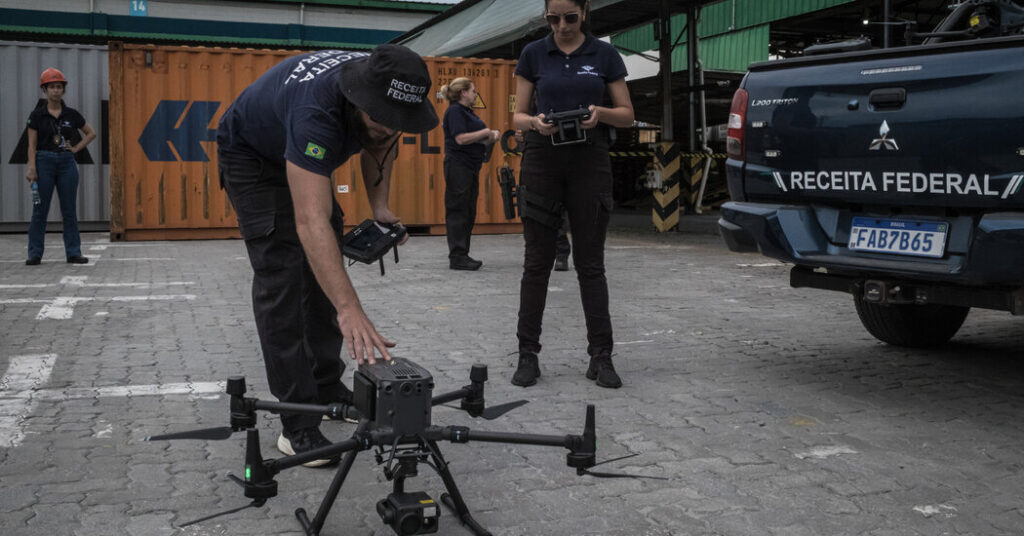
A team of nearly a dozen agents from Brazil’s customs and revenue agency also asked to visit their U.S. counterparts in Washington in June, as part of a recent push to increase cooperation in countering transnational money laundering and smuggling operations. But U.S. authorities declined their request, citing a crowded agenda through November, the two Brazilian officials said.
Under a new intelligence-sharing system introduced this year, customs agents in each country were alerting each other about suspicious container shipments, helping U.S. and Brazilian authorities to intercept illicit cargo, such as weapons, according to one of the officials.
While police and intelligence experts say this kind of technical cooperation between Brazil and the United States continues, a lack of high-level coordination may thwart more ambitious plans.
While Brazil does not export significant quantities of drugs to the United States, it is a major transit route for cocaine heading to Europe, Africa and elsewhere. Brazilian gangs are also increasingly forging alliances with Mexican and Colombian gangs and finding new ways to smuggle drugs out of Latin America.
Experts say Brazilian organized criminal groups use the U.S. banking system to launder profits from illicit activities. The United States is also a key source for these groups of illegal arms, smuggled from U.S. states with permissive gun laws. Last month, Brazilian police arrested two men in connection with weapons parts mailed from Florida.
During multiple meetings and phone calls over the past year, including as recently as Aug. 21, Mr. Lula has pitched Mr. Trump on closer cooperation on combating organized crime.
At a White House meeting in May, Mr. Lula delivered a proposal on how the two countries could fight drug gangs together by targeting their weapons and finances, according to a Brazilian official. The Trump administration never responded to the proposal, the official said.
That same month, the United States moved to designate the country’s two largest drug gangs as terrorist organizations after aggressive lobbying by Mr. Bolsonaro and his allies, who have accused Mr. Lula of being weak on crime. Public security is a major concern for many Brazilians and a key issue in October’s presidential election.
The full effect of the U.S. designation is not yet clear, but it has already led to at least one policing stumble. The United States used the designation to apply sanctions to people who had secretly been under investigation by Brazilian police, revealing their links to gangs and tipping them off to the probe. As a result, Brazilian police had to rush to arrest the targets.
At the same time, Washington has sought to strengthen cooperation with conservative leaders in the Western Hemisphere through the Shield of the Americas, a new security alliance against drug traffickers that does not include Brazil. Some members, including Ecuador and Colombia, have agreed to joint military operations with the United States in their countries.
Last month, Brazil was also not invited to a U.S.-led gathering of security officials from Latin America and the Caribbean at the United Nations.
The diplomatic scuffle between Brazil and the United States escalated in recent months, with a series of other visa rejections and cancellations. But while the Trump administration has sought to use visas as part of its effort to assert its dominance in Latin America, this approach may only further alienate Brazil.
“We want to have Brazil closer to the United States — not further away,” said Jimmy Story, a former U.S. ambassador and a founding partner of Global Frontier Advisors, a consulting firm. “And this kind of diplomacy has the opposite effect.”
Alice Maciel and Thayz Guimarães contributed reporting from Brasília.
The post A Visa Dispute Is Threatening a U.S.-Brazil Effort to Fight Crime appeared first on New York Times.