This is an edition of Time-Travel Thursdays, a journey through The Atlantic’s archives to contextualize the present. Sign up here.
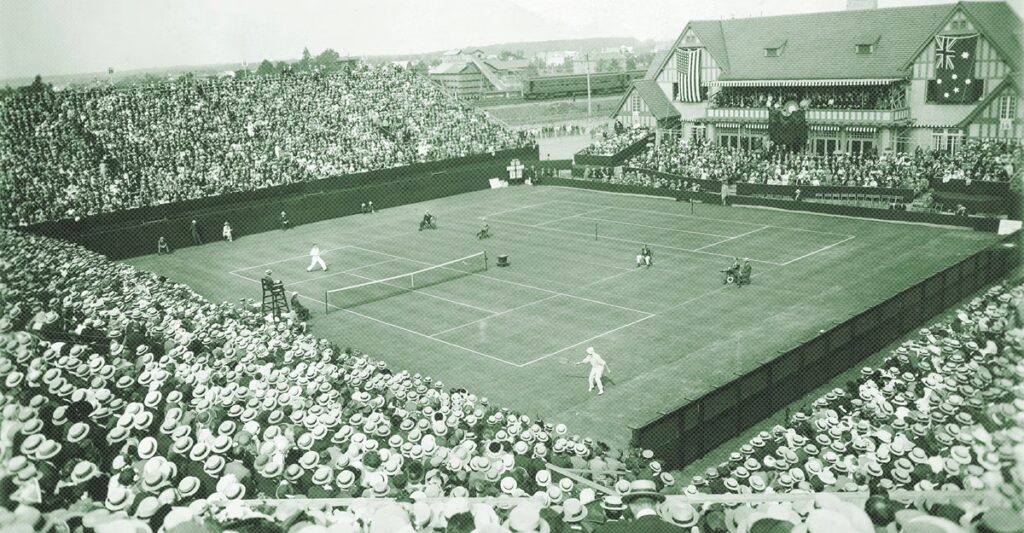
The American tennis player Ben Shelton blasted a 146-mile-an-hour ace past the Spaniard Carlos Alcaraz at 3:33 a.m. yesterday. It was the final shot of a U.S. Open quarterfinal match that had begun 4 hours and 28 minutes before, during which the two men contested five sets, two tiebreakers, and many points so long and improbable that they made the television announcers giggle with delight. When it was done, Shelton and Alcaraz embraced warmly at the net, as if in mutual appreciation for having shared something so grand. The contest, which Shelton afterward described as a “war,” was an emphatic affirmation of a claim made by Arthur Stanwood Pier in The Atlantic 123 years ago: that tennis “is entitled to the place of supremacy among games.”
If the case for this assertion is clear today, it was perhaps less obvious in 1903, when the question of which sport should hold such a title was no small matter among men—particularly elite white men—who spent a good deal of time discussing the import of athletics and manliness. Tennis, no matter how much Pier insisted, usually did not rate a mention at all.
Far from being only amusements or diversions then, sports were considered serious undertakings that had the job of making men men and rescuing the nation from softness and degeneracy. These contests, the thinking went, offered a way—short of participating in actual warfare—to develop martial virtues, cultivate strength, and channel aggression. The value of a sport, Pier noted in his essay, was not measured so much “by the physical exercise it necessitates, as by the satisfaction and outlet it gives to the spirit of combat that troubles us.”
By this measure, football—dangerous and deliberately martial in character—seemed to have been the most valuable game. Already firmly established at the turn of the century as a popular spectacle and staple of American collegiate life, the sport appeared to offer an ideal arena for masculinity, with its inherent risks and demand for coordinated action. “Every manly man must have a certain amount of courage, physical and mental,” the famed University of Michigan coach Fielding H. Yost wrote in 1905, “and no football player can long be without it.” The sport’s most sanguine supporters embraced the game’s violence as a precondition to cultivating manly men, even at the cost of serious injury or death. Two years after the 1894 Harvard-Yale game—the so-called Springfield Massacre that left four men seriously hurt and led to a temporary suspension of the rivalry—Senator Henry Cabot Lodge defended such contests in a speech at Harvard’s commencement. He minced no words, using the imperialist and anti-immigrant language underlying much athletic talk of the moment: “The time given to athletic contests and the injuries incurred on the playing field are part of the price which the English-speaking race has paid for being world conquerors.”
Tennis—genteel, clubby, and historically played by women as well as men—seemed unlikely to do such work. As Robert D. Osborn, an early authority on the game, wrote in 1881, it was a game of “exceeding delight,” particularly when played in what he described as its ideal conditions. “The scene should be laid in a well-kept garden lawn. There should be a bright warm sun overhead, and just sufficient breeze whispering through the trees and stirring the petals of the flowers to prevent the day from being sultry,” Osborn wrote. “Near at hand, under the cool shadow of a tree, there should be strawberries and cream.” This seemed a decidedly peaceful game—one for people who were taking a rest after conquering the world, as opposed to getting ready to do so.
In making his case for tennis in The Atlantic, Pier confessed that the risks of the game were nothing like those of football. The inherent dangers were fewer, the injuries less “heroic.” But perhaps the calm of tennis was a good thing. Pier, a student at Harvard in the 1890s, was possibly in attendance for the speech in which Lodge justified the injuries that had occurred during football games. Without calling out the senator directly, Pier wondered whether such perils were necessary: What if the “injuries and deaths that sometimes take place in our rougher sports should not be viewed as glorifying these forms of contest” but instead as “deplorable calamities”?
Tennis offered another way to make men of strength and vigor while allowing them to remain gentlemen with their bodies fully intact. Its ample physical demands—the game is “ardent, not phlegmatic,” Pier assured—were matched by an intellectual and psychological challenge. Pier tried to convey this complexity by way of lengthy descriptions of match play. Hemingway on bullfighting it was not, but something deeper emerged from the depiction. The purpose of the sport was to develop attributes of peace rather than war: A “steadfastness of aim and purpose, a better temper, and a kinder heart; here, through striving with your fellow man, you may learn to love him,” Pier wrote. This was a different kind of strength and vigor, one that included physical prowess but ultimately went beyond it.
Dancing around the court the other night, Shelton and Alcaraz were playing a game that would’ve been barely recognizable to Pier in its speed and power. (Their attire would surely have made him blush.) But the subtle graces of the “lawn tennis” Pier wished to promote were still there, in the complex calculations and fluid coordination that clinched each point. Watch Shelton’s slide into a shot at the baseline, or the elegant arc of Coco Gauff’s swing as she defeated Mirra Andreeva in three sets during yesterday’s women’s quarterfinal. For all of the grand claims made about the purpose of sports, perhaps Pier’s tribute to tennis landed on the simplest point of all: “Is not this one of life’s priceless pleasures?”
The post What Makes Tennis One of the Greatest Games appeared first on The Atlantic.