The Trump administration is seeking to revise a federal climate report published three years ago to recast worst-case climate scenarios as implausible and limit their use in federal decision-making.
The White House has proposed an “amendment and clarification” to the findings of the National Climate Assessment 5, published in 2023. National Climate Assessments are Congressionally mandated reports composed by hundreds of scientists and researchers and have been published every four years since 1990.
Now, the White House wants to go back and change how the highest-emission scenarios — those representing the worst possible outcomes of climate change, known technically as RCP8.5 — can be interpreted and used by the federal government.
The proposal comes from the U.S. Global Change Research Program within the White House’s Office of Science and Technology Policy and was published in the federal register.
RCP.8 or other equivalent pathways “are not policy relevant, and should not be used in authoritative federal work products,” officials wrote in the proposed amendment.
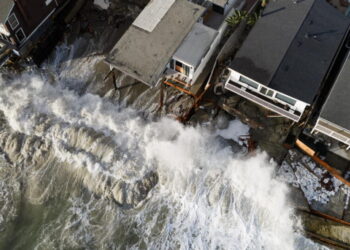
National climate assessments are important because their projections can inform federal infrastructure planning, risk assessments, regulations, disaster preparedness and cost-benefit analyses, including from hazards such as wildfires, floods, drought and sea-level rise.
The worst-case scenario paints an extremely unlikely but theoretically possible picture of what the climate would look like if the world continued to develop with a heavy reliance on coal, oil and natural gas, and if greenhouse-gas emissions kept rising with little effective climate policy.
Scientists have already acknowledged that this scenario has become implausible based on recent trends in renewable energy, climate policies and actual greenhouse gas emissions, and planned to retire RCP8.5 from the next international climate report. While the world is now nearing the dangerous threshold of 1.5 degrees Celsius of global warming, the scenario represents at least 4 degrees Celsius, or 7.2 degrees Fahrenheit, of warming above pre-industrial levels.
But revising a finalized report, which was based on the best available science at the time, is unheard of, said Carlos Martinez, a senior climate scientist at the nonprofit Union of Concerned Scientists — particularly because the authors were not consulted.
“It’s unprecedented. It’s also not surprising,” he said. “This is one of a series of ridiculous tactics by the administration to manufacture uncertainty on climate science, but also uncertainty with respect to the robust nature of the National Climate Assessment.”
He noted that the assessment was developed by 14 federal agencies in collaboration with hundreds of scientists, and it underwent a rigorous public comment process and review that included the National Academies of Sciences.
What’s more, the emissions scenarios it includes are not forecasts but rather pathways to understand how human activity, industry and policy could interact between now and the end of the century. To remove or alter them in an existing document is a “complete violation of scientific integrity,” he said.
The proposal comes after the Trump administration dismissed more than 400 scientists working on the upcoming National Climate Assessment report, citing a reevaluation of its scope. It also took down the website that housed current and past National Climate Assessments.
Last year, Trump disbanded and defunded the U.S. Global Change Research Program that produces the reports, but later reinstated it and appointed Matthew Wielicki, a known critic of climate science, as its director.
In their proposal, officials said the amendment is necessary to align the climate report with Trump’s May 2025 executive order, Restoring Gold Standard Science, which directs federal agencies to avoid reliance on “highly unlikely or overly precautionary assumptions in decision making.”
“A federal assessment that presents impacts derived primarily from implausible high emissions pathways as ordinary planning futures is inconsistent with these principles,” it says.
The administration has heavily favored oil and gas development as part of its “American energy dominance” agenda, and worked to slow the development of renewables such as offshore wind. Oil and gas are two of the main causes of climate change.
The proposal received about 100 public comments through a midnight deadline Wednesday night, although the comments were not available for viewing as of Thursday.
But at least one group, the nonprofit CO2 Coalition that touts the controversial opinion that carbon dioxide emissions are beneficial for the Earth, has come out in support of the plan. “This correction is long overdue,” wrote chief executive Angela Wheeler.
Another comment came from a multistate coalition of attorneys general, including California Atty. Gen. Rob Bonta, who opposed the plan.
“The science doesn’t lie. Climate change is harming public health and causing devastating and ever-worsening disasters,” Bonta said in a statement. “To restrict federal agencies from acknowledging or planning for these impacts is playing politics with people’s lives, and that’s exactly what President Trump is doing.”
It is not immediately clear when the administration will make a decision on its proposal.
The post The Trump administration wants to revise the latest National Climate Assessment—three years after publication appeared first on Los Angeles Times.