Glen E. Howard is president and chairman of the Saratoga Foundation.
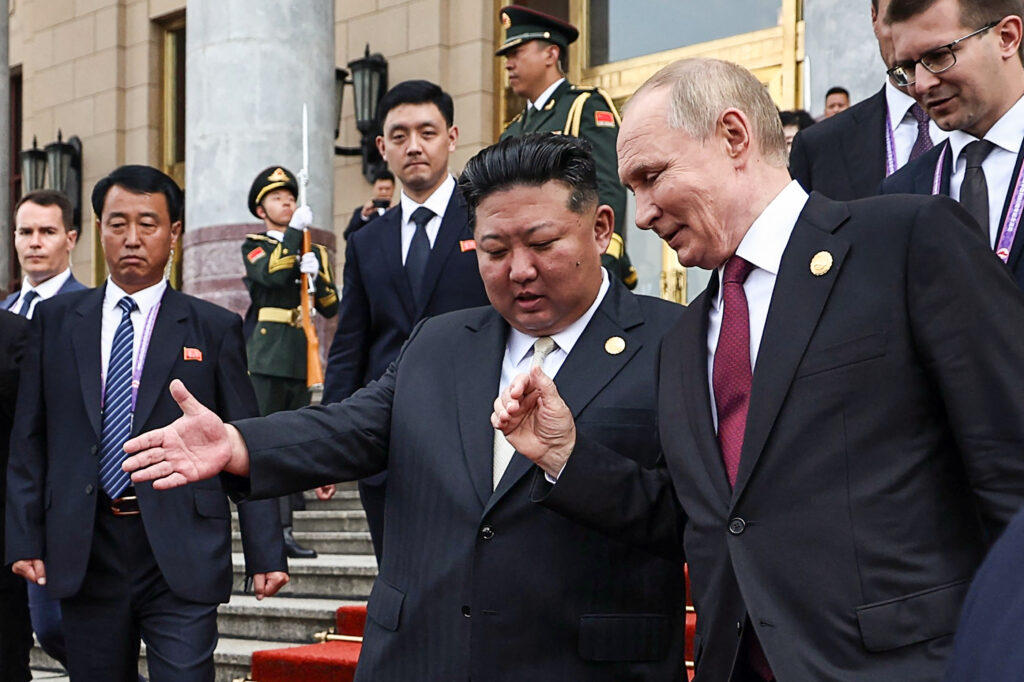
As Russian President Vladimir Putin’s war in Ukraine enters its fifth year, North Korea’s involvement has reached an unprecedented scale — marking Pyongyang’s largest foreign military deployment in its 78-year history.
Under a 2024 mutual defense pact, North Korea sent over 10,000 troops from its elite 11th “Storm” Corps to Russia’s Kursk province to help repel a Ukrainian offensive in the fall of that year. They have been there ever since. According to President Volodymyr Zelensky, Kim Jong Un plans to significantly deepen this commitment by dispatching as many as 40,000 additional troops to the Ukrainian theater in time for Putin’s rumored mobilization drive.
Ukrainian intelligence estimates that more than 25,000 North Korean soldiers have rotated through Kursk since 2024, turning the conflict into a high-tech battle lab that offers Pyongyang invaluable exposure to modern combined-arms warfare. The former head of Ukrainian military intelligence, Kyrylo Budanov, highlighted the gravity of this development, noting that “there are currently only three countries in the world with the experience of waging a modern war on a very long front line using virtually all available conventional means — Ukraine, Russia and North Korea”
North Korean units are deployed primarily to secure rear echelons and free up frontline Russian units for offensive operations elsewhere in Ukraine. A recent BBC analysis, estimating the size of a freshly erected public monument in Pyongyang, found that North Korea may have lost as many as 2,300 soldiers. South Korean intelligence estimates the number of wounded and dead to be as high as 6,000.
Meanwhile, Russian technology transfers are modernizing Pyongyang’s defense industrial base, improving the targeting accuracy of its KN-23 and KN-24 ballistic missiles while advancing its air defense systems, nuclear submarines and satellite launch capabilities. And earlier this year, North Korean units also started to become operationally integrated into Russian formations, firing tube artillery, coordinating multiple launch rocket systems and conducting aerial reconnaissance.
North Korea is leveraging battlefield lessons to mass-produce short- and medium-range attack drones. Specialized forces, including 400 drone operators and a 90 missile operators, have been deployed to rear staging grounds in Voronezh and Kursk to execute strikes against the Ukrainian cities of Sumy and Kharkiv. Pyongyang can apply this tactical experience to the Korean Peninsula. The Seoul-Kharkiv analogy is glaringly obvious: Sitting roughly 30 miles from the DMZ, the South Korean capital shares Kharkiv’s exact geographic vulnerability to cross-border strikes.
North Korea is contributing its industrial capacity to Putin’s war effort. It has supplied, by some recent estimates, as many as 15 million artillery shells. According to Ukraine’s National Security and Defense Council, North Korea’s contribution accounts for up to 50 to 70 percent of all ammunition fired by Russian forces in key frontline sectors of the Ukraine war. Moscow plans to bring 12,000 North Korean drone assemblers to the Alabuga drone plant in Tatarstan to mass-produce the next generation of Iranian-designed Shahed strike drones at a rate of 3,000 a month. In total, the Ukrainian military estimates 20,000 North Korean laborers are deployed across Russian industrial sites to sustain Moscow’s war effort. In exchange, Moscow provides critical energy supplies and delivers 600,000 to 700,000 tons of rice annually, single-handedly offsetting more than half of North Korea’s chronic food deficit.
Moscow and Pyongyang are also expanding border infrastructure, completing a two-lane road bridge over the Tumen River capable of transiting 300 heavy vehicles daily. They are also modernizing the neighboring Korea-Russia Friendship Bridge rail link. These improvements connect to Russia’s own vast transcontinental railway system, providing a logistical corridor largely impervious to Western sea power.
The Russia-North Korea alliance is evolving into a permanent operational axis, and Pyongyang likely expects direct Russian assistance in any future conflict on the Korean Peninsula. This emerging reality exposes the failures of the Asia First doctrine, championed by a faction of Republican foreign policy experts and government officials who urged the United States to deprioritize Europe and focus exclusively on countering China. While these proponents sought to compartmentalize the two theaters, Kim Jong Un had other plans and executed his own pivot toward Europe.
At this summer’s NATO summit in Ankara, leaders from Japan, South Korea, Australia and New Zealand urged the creation of a “Korea-NATO Defense Industry Partnership 2.0,” which could anchor a new Eurasian security framework to counter the Moscow-Pyongyang axis. The U.S. should embrace such initiatives. And it should stop undermining its existing alliances in the region. Recommitting to exercises with South Korea would be a good first step.
As then-U.S. Defense Secretary Lloyd Austin warned when North Korean troops first arrived in Kursk, co-belligerency in Europe “will also impact things in the Indo-Pacific.” Indeed, the front lines of both theaters are now one and the same: For both Kim and Putin, the Indo-Pacific begins in Ukraine.
The post The Indo-Pacific begins in Ukraine appeared first on Washington Post.