America’s “forever war” in Afghanistan began only weeks after the Sept. 11 attacks and lasted just short of 20 years, ending in the chaos of Aug. 15, 2021, when the capital, Kabul, fell once again to the Taliban.
Journalists for The New York Times covered the war from beginning to end and have continued capturing the lives of Afghanistan’s people as they navigate a scarred landscape and an uncertain future.
2001-2002
The War Begins
Operation Enduring Freedom began on Oct. 7, 2001, with an American bombing campaign against Al Qaeda and the Taliban. American Special Operations forces teams linked up with Afghan militias opposed to the Taliban, mainly the Northern Alliance, to drive the Taliban from power. Kabul fell in mid-November, along with the Taliban stronghold of Kandahar.
In December, Osama bin Laden, Al Qaeda’s leader, escaped to Pakistan through the mountains around Tora Bora. That same month, an interim Afghan government led by Hamid Karzai was installed.
2003-2007
Drift to Iraq
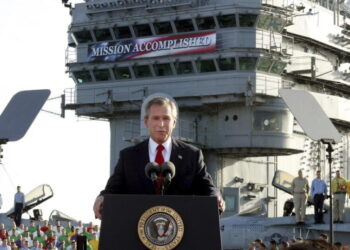
Defense Secretary Donald Rumsfeld announced an end to major combat operations in Afghanistan in May 2003. Even with a major reconstruction effort underway there, and about 8,000 American troops in place, President George W. Bush’s administration began shifting combat resources to the war in Iraq.
[Read a Times historical photo essay on past Afghan wars, The Empire Stopper.]
The Taliban-led insurgency grew stronger in 2006, carrying out more ambushes and suicide bombings. Despite training and equipment supplied by the United States and allied forces, Afghan security forces could not contain the Taliban resurgence, which was aided by militants across the border in Pakistan.
By 2007, the number of American troops in Afghanistan had climbed to 25,000.
2008-2010
Recommitment and Surge
In February 2009, the new American president, Barack Obama, declared a recommitment to the war and deployed 17,000 more troops to Afghanistan, adding to the 36,000 already there.
In December, Mr. Obama announced a “surge” meant to build and train an Afghan security force that would be strong enough to assume responsibility for fighting the Taliban insurgency. His plan included sending 30,000 more American troops, bringing the total number to nearly 100,000 by mid-2010.
2011-2013
A Troop Drawdown
In May 2011, a U.S. Navy SEAL team killed Osama bin Laden in a compound in Abbottabad, Pakistan, where he had been living for years. In June, Mr. Obama announced that he would pull 33,000 troops from Afghanistan by mid-2012.
In 2012, Afghanistan’s president, Hamid Karzai, began blaming United States and coalition troops for rising civilian casualties. His relationship with American leaders deteriorated.
Afghans took over most security responsibilities in 2013, with the U.S.-led coalition’s forces shifting to training and counterterrorism operations.
2014-2018
A Taliban Resurgence
On Dec. 31, 2014, the combat mission in Afghanistan formally ended, but the American military presence in the country did not. Mr. Obama announced a timetable for the withdrawal of most troops by the end of 2016.
After a 2014 election marred by fraud, Ashraf Ghani became president, but signed a power-sharing agreement with his top opponent, Abdullah Abdullah.
On the battlefield, the Afghan security forces increasingly struggled against the Taliban, taking heavy casualties and losing territory.
In August 2017, President Trump, early in his first term in office, said he would continue to prosecute the war.
2018-2020
A Deal With the Taliban
In late 2018, American and Taliban negotiators began holding peace talks in Doha, Qatar. The Afghan government was excluded from the talks; the Taliban refused to meet with its officials.
On Feb. 29, 2020, the United States signed a peace deal with the Taliban, opening the door to a gradual, final troop withdrawal from Afghanistan and the beginning of direct talks between the Afghan government and the Taliban to determine the country’s future.
About 12,000 American troops were still in the country.
2021-2026
The Taliban’s Return
On April 14, 2021, the recently sworn-in U.S. president, Joseph R. Biden Jr., called for a complete withdrawal of all American forces from Afghanistan by Sept. 11, 2021.
The United States had spent about $2 trillion on the war effort. About 2,400 American troops and nearly 700 troops from other nations in the coalition died. More than 40,000 civilians were killed, as well as an estimated 60,000 Afghan security forces.
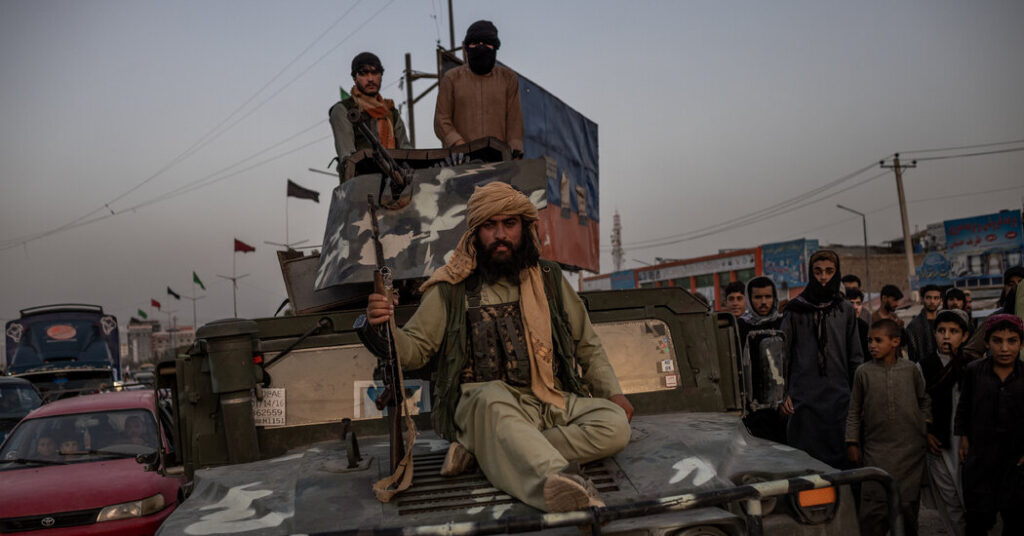
After the rushed withdrawal of U.S. forces, the Afghan government did not mount a significant resistance, and Taliban forces quickly regained control. Many Afghans feared a return to civil war between the Taliban and the remaining anti-Taliban fighters, but the violence affecting civilians dropped sharply with the end of the U.S. war.
In 2022, the Taliban government imposed a series of edicts governing every aspect of daily life, which remain in place. The rules are particularly strict for women and girls, who are no longer allowed to work at most jobs or seek formal education beyond sixth grade.
Military conflict has not disappeared. In late 2025, Pakistan began a campaign against the armed groups operating on its border with Afghanistan, while the Taliban tighten their grip on Afghan society and defend their rule against the few remaining forces of resistance.
The post The ‘Forever War’ in Afghanistan: 25 Years in Pictures appeared first on New York Times.