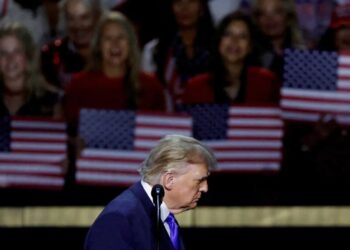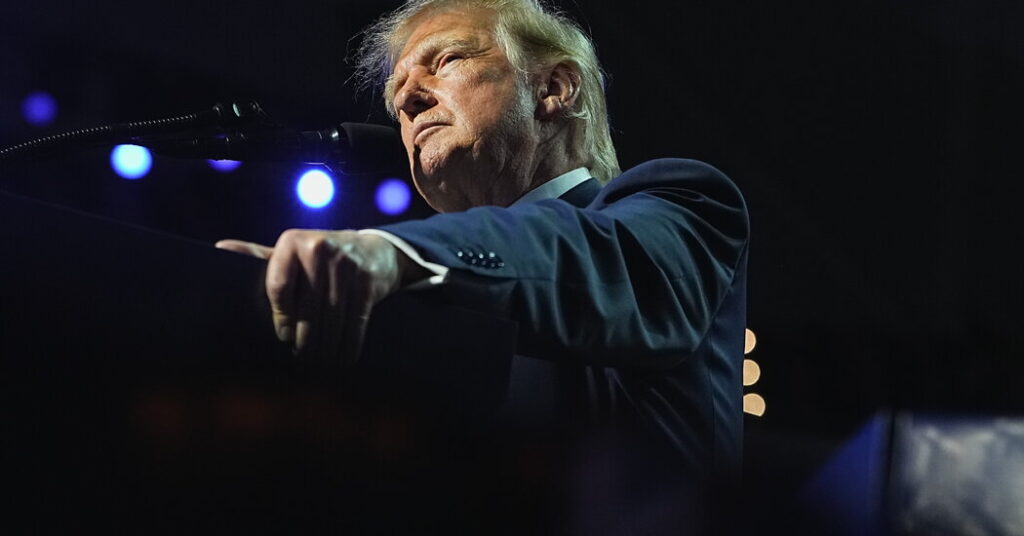
President Trump took the stage at his convention on Wednesday and spoke for nearly two hours about the need for midterm voters to imagine that it was him, not other Republicans, up for election this fall.
“Pretend I’m on the ballot,” he urged. “I’m on the ballot. Just one more time.”
Facing dwindling weeks until the midterms, deepening unpopularity and darkening political prospects for his party, Mr. Trump interrupted his usual fare by tossing out a new idea: a $5,000 check for every American adult if Republicans keep control of Congress in November.
“If the Republicans win the House of Representatives and the United States Senate, both of them,” Mr. Trump said, “I will issue a dividend to every adult citizen in the United States of America for $5,000.”
It is not unheard-of for politicians to tie the possibility of an economic stimulus to an election’s outcome. In 2020, Democrats in Georgia pointed to $2,000 coronavirus relief checks if their party took control of the Senate.
But few have been as brazen as Mr. Trump, who often dangles the possibility of free money if it means achieving his political goals, even as he seeks to undermine public trust in elections. In the same speech, Mr. Trump insisted that he won the presidential election three times (he didn’t) and accused Democrats of trying to cheat in elections.
In several cases, the money Mr. Trump has promised in the past has not materialized. He has proposed $2,000 checks based on tariff revenues (in an interview with The New York Times in January, he said that money could arrive by the end of this year). He has also floated the idea of $5,000 payments from money saved by eliminating thousands of federal jobs, and assorted payments to Americans from government health care subsidies.
Republicans did send Americans larger, direct payments this year in the form of heftier tax refunds. Mr. Trump and Republicans designed last year’s tax cut so that it would deliver bigger refunds, rather than slightly lower their payments over time. The hope was that one larger lump sum could help Republicans win the midterms.
But Mr. Trump’s latest notion would be exorbitantly expensive.
It would cost more than $1.3 trillion to send $5,000 checks to each of the roughly 270 million adults in the U.S., making such a plan almost prohibitively costly for a country with a $40 trillion national debt.
Mr. Trump said that the money would come with just one caveat: It must be spent in the United States.
“We don’t want you going to Canada to spend the money,” he told the crowd. “We don’t want you going to China, to Germany. You got to spend the money in the United States of America.”
Outside the cost and the complications of carrying out a plan that would track voter spending, Mr. Trump’s latest pledge could raise legal questions. Federal laws prohibit expenditures to influence voting, but he has framed his proposal as a promise that will be delivered upon later, as an economic incentive.
Jessica Levinson, who teaches election law at Loyola Law School at Loyola Marymount University in Los Angeles, said that Mr. Trump’s statement did not seem too far afield from a promise to lower taxes.
And Richard Hasen, an election law expert at the University of California, Los Angeles, said Mr. Trump’s promise was protected speech under the First Amendment, pointing to Brown v. Hartlage, a unanimous Supreme Court decision from 1982 that struck down the application of a Kentucky law preventing candidates from making monetary promises in return for votes. Justice William J. Brennan Jr. wrote in the court’s opinion that “so long as the hoped-for personal benefit is to be achieved through the normal processes of government, and not through some private arrangement, it has always been, and remains, a reputable basis upon which to cast one’s ballot.”
David Becker, the executive director of the Center for Election Innovation and Research, a nonpartisan group that advises election officials, said that Mr. Trump’s proposal appeared to be part of a broader effort by the president to sow doubt about the country’s election systems.
“Whether it’s legal or not, it seems — just like with a lot of his election disinformation — it seems rather desperate,” Mr. Becker said in an interview. “Ultimately, it’s going to be up to the voters whether or not they trust this man to deliver on his promises.”
He added: “If I were a voter, I would be asking myself, why are you promising to do this in 2027? You control both houses now. Why not deliver on this promise now?”
The president did not seem particularly concerned about the details of the plan, but he was sure about what he would call it: The $5,000 payments would be known as Trump Dividends.
Andrew Duehren, Bayliss Wagner and Tim Balk contributed reporting.
The post Pleading for Votes, Trump Tries a New Spin on an Old Promise: Free Money appeared first on New York Times.