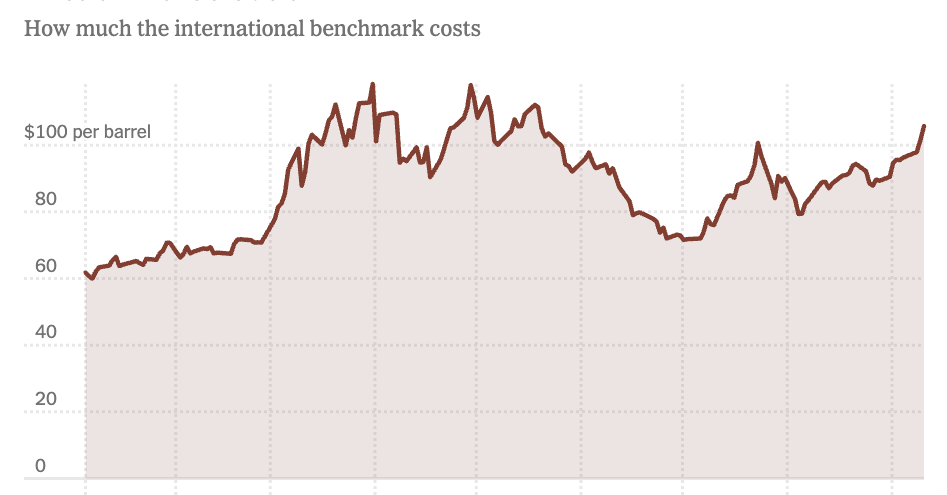
The price of oil rose above $105 a barrel on Thursday, the highest level in months, and stocks and bonds slumped as geopolitical uncertainty and inflation fears weighed on investor sentiment.
The rise in energy costs threatens to raise prices more broadly, further squeezing consumers and businesses already struggling. Investors are waiting for a crucial report on U.S. inflation, set for release on Friday, that could frame expectations for the Federal Reserve’s decision on interest rates at its meeting next week. Traders believe that a Fed rate increase is more likely than not, according to futures markets.
Rising government bond yields, which move inversely to prices, have spilled over into the market for consumer loans, which are heavily influenced by the 10-year Treasury note.
The average 30-year fixed-rate mortgage, the most common home loan in the United States, has steadily risen in recent weeks, hitting 6.71 percent last week, according to the mortgage financing giant Freddie Mac. Higher rates are putting a damper on the housing market: Sales of existing homes fell 2 percent in August from the month before, the National Association of Realtors said Thursday.
“It’s not a good time to sell your home,” Heather Long, chief economist at the Navy Federal Credit Union, said in a statement. “Americans are hitting the pause button on home buying.”
Investors are also grappling with the escalation of fighting in the Middle East, which has increased their concerns about the supply of energy.
Yemeni officials said Thursday that the Iranian-backed Houthi militia had captured a port city, giving it greater control over passage through the Bab al-Mandab Strait at the southern end of the Red Sea. Saudi Arabia had been using this route to export its oil and bypass the Strait of Hormuz, the narrow waterway between the Persian Gulf and the Gulf of Oman.
The turmoil in the Middle East, which started when United States and Israeli attacked Iran on Feb. 28, has no apparent end in sight. President Trump on Wednesday night said that it would continue through the November midterm elections in the United States. Oil prices have jumped 41 percent since the war began.
Oil exports from Saudi Arabia, long the world’s biggest oil exporter, fell last month to their lowest levels in at least 13 years, according to data from Kpler, a maritime information company.
With Iran targeting tankers in the Persian Gulf and the Houthis targeting Saudi tankers in the Red Sea, Saudi Arabia is now exporting more oil north through the Red Sea via the Suez Canal. This route is longer and costlier, but Saudi Arabia has few good options.
“The threat is real, and that’s why they keep shying away,” Peter Sand, a shipping analyst at Xeneta, said of shipowners operating in the southern Red Sea near Yemen.
Oil prices leap.
-
The price of Brent crude, the global benchmark for oil, jumped more than 4 percent above $105 a barrel on Thursday, a level not seen since May.
-
West Texas Intermediate crude, the U.S. benchmark, climbed to around $100 a barrel.
-
The continued disruption to shipping in the Strait of Hormuz and the Bab al-Mandab Strait has crimped the global supply, raising concerns among investors and analysts.
-
The market is still pricing in persistent geopolitical risk, “with Persian Gulf tensions showing no credible path to de‑escalation,” analysts at ING wrote in a research note. “If anything, current signals point to further escalation, keeping upside pressure firmly in place.”
-
Adding to the stress are signs of increased oil purchases from China, which had lowered its crude imports though much of the war, helping to rebalance the market. “While imports remain well below year-ago levels, they’ve started to recover from the lows seen in June,” the ING analysts wrote.
Shipping in the region is scrambled.
-
Shipping traffic through the Strait of Hormuz, which carried a fifth of the world’s oil supply and a significant amount of natural gas before the start of the war, is still running at a fraction of what it was before February.
-
Twelve ships passed through the strait on Wednesday, compared with more than 130 per day before the war began, though it is difficult to have a complete picture of traffic because some ships are transiting with their location transponders off to obscure their positions.
-
Suez Canal traffic was up 28 percent in July and August compared with last year, according to Lloyd’s List Intelligence data, driven largely by an increase in tankers that were rerouted because of Iran’s blockade on the Strait of Hormuz.
-
Fawaz A. Gerges, a professor at the London School of Economics, said the Houthis viewed the war in Iran as their best opportunity to both consolidate power and completely cut off the route that Saudi Arabia just months ago considered a lifeline for its oil exports. “If this descends into all-out war, this could have catastrophic implications,” he said.
Stocks are down.
-
The S&P 500 fell about a half-percent when stocks began trading in the United States on Thursday.
-
Stocks in Asia, where countries import vast quantities of oil and gas, were mixed. The KOSPI in South Korea and the Hang Seng in Hong Kong slipped, while the Nikkei in Japan was up.
-
In Europe, the Stoxx 600, a broad index that tracks the region’s largest companies, and the FTSE 100 in Britain fell about half a percent.
Bond yields climb.
-
The yield on the 10-year Treasury note, an influential measure of borrowing costs that influences mortgages, business loans and other types of debt, jumped above 4.9 percent on Thursday, the highest in years.
-
On Wednesday, the Treasury Department said that it would repurchase up to $6 billion of its own long-dated debt, an attempt to lower borrowing costs for consumers and businesses.
Gasoline prices tick higher.
-
Gas prices rose on Thursday to a national average of about $4.28 a gallon, according to the AAA motor club. Drivers, on average, are paying 44 percent more for gas than when the war began.
-
Gas prices don’t move in lock step with crude, usually trailing increases or drops by a few days.
-
The average price of diesel also climbed, to $5.98 a gallon, on Thursday. Costs are up 59 percent since the start of the war.
Lisa Friedman contributed reporting from London.
The post Oil Prices Surge as Stocks and Bonds Wobble appeared first on New York Times.