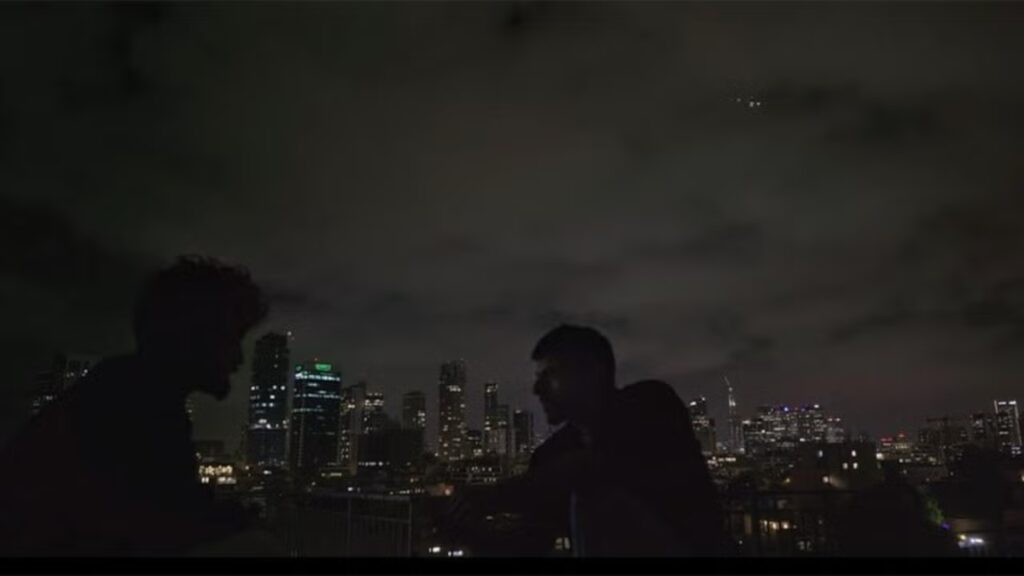
Perched on a Tel Aviv rooftop, his face eclipsed by city lights, an unnamed military systems operator gives “NAZA” its mission statement: “We have to describe things as they really are.” That he speaks under a shroud of darkness, his identity concealed for fear of legal reprisal, reflects both the danger of doing so in the current climate and the grim solemnity directors Yuval Abraham and Rachel Szor bring to the task.
That task doesn’t take the shape of an investigative doc or an exposé. Much of the film’s chilling information has already surfaced, among other outlets, in newspapers like The Guardian, which serves as a producer here. Instead, Abraham and Szor, two of the four-person team behind the Oscar-winning “No Other Land,” heed their interviewee’s call, laying things out with the same abject candor as their subject. Having delivered the film’s mission statement, the man continues in cool dispassion, describing, in almost recreational terms, how his time behind a high-tech command console has resulted in, oh, at least several thousand deaths.
Framed in silhouette, he’s neither whistleblower nor sociopath, but just another office grunt whose thoroughly unexceptional job makes him unworthy of an extra key light. He’s one of 24 technicians and intelligence officers interviewed here, all of them obscured, all telling variations on the same story in the same language. That last detail matters for a film made by two Jewish-Israeli directors, conducted entirely in Hebrew, that will still inevitably face spurious charges of antisemitism for daring to criticize the machinery of the Israeli state.
The filmmakers clearly anticipate as much. They did, after all, just navigate a similar media cycle with their last outing. So they’ve built “NAZA” to defuse such attacks. The figures onscreen barely amount to individuals, let alone some grander ethno-religious symbol. They’re just highly paid hired hands implementing policy. “My role is technical,” says one. “I’m not allowed to express any moral positions.” Once more, the filmmakers turn those words to their advantage, sidestepping the whole tough-but-necessary debate to trade questions of “why” for “how.”
The film works backward from Gaza’s current state, asking how the death toll, now estimated above 70,000, got so high. The very title gives the answer. “NAZA” is a portmanteau of the Hebrew words for “collateral damage” (a direct English translation would be “CODA,” if that title weren’t already taken). The math couldn’t be simpler. The IDF treats, say, 20 NAZA, or 20 civilian casualties, as an acceptable price for eliminating one military target. Extrapolate that formula across a narrow strip of land with thousands of “active-duty” targets, and the numbers add up fast.
Split into three chapters, and told mostly through interviews, “NAZA” opens with its most apocalyptic implications, detailing how the intelligence service selects those targets. In short, they outsource the task to an AI program called Lavender that, at best, offers predictive guesses based on phone-usage patterns. The operators know the margin for error runs as high as 15%, yet remain sanguine about the resulting bloodshed. “Having AI decide who lives or dies is better than leaving it to human hands,” says one. Premiering in Venice days after an Anthropic employee made headlines with a resignation letter doubling as whistleblower testimony, “NAZA” confirms the worst: an AI regime of judge, jury and executioner is already here.
Chapter two is no less grim. Here the film turns to implementation, or more accurately, execution, of those campaigns. Once a target is set, operatives track him down, and the household, it turns out, is the most reliable place. Through audio surveillance, personnel wait for two heart-shattering words, “Daddy’s home,” before the order is given. That these operations are coordinated from a high-tech command center in Tel Aviv, and that the whole process reportedly feels like playing a video game, can almost dull the human toll. Describing the aftermath, one interviewee’s voice breaks, but he quickly recovers, noting, “We’re just completing the mission.”
Chapter three asks “who benefits?” and answers unambiguously. The chapter title gives it away: “Bibi’s Department.” Netanyahu looms over the film, in news broadcasts, on billboards and, in the one moment that drew an acrid laugh at the Venice press screening, in a 1980s interview clip where he defines terrorism in terms that contradict his own reelection campaign. But the Shoah looms larger still, informing everything about a country built post-Holocaust.
This goes beyond Israeli identity. Abraham and Szor are both Jewish millennials, born into a world where Elie Wiesel was already a Nobel Peace Prize laureate and “Never Again” was already a moral credo burned into their souls (that description fits this reviewer too). The film taps into a dissonance common to their generation: the failure to believe that Wiesel’s charge, “one has no right to turn away, not to see,” should be expected to include one major exception.
Produced by Jonathan Glazer, “NAZA” shares the ethos of “The Zone of Interest,” turning to the home front and keeping the “bad stuff” out of sight, if never out of mind. Set across countless Tel Aviv rooftops, the film peers into hundreds of high-rises as locals go about their evening routines, only here with far greater moral ambiguity. Its quiet appraisal of city life could be read as an admonishment, implicating a society that would rather not see things “as they really are.”
Yet the stark, reflective images of steel and glass feel born less of quiet fury than of genuine concern. Under the governing policy, any structure housing military targets is fair game, and in nearly every shot, here they are: active-duty personnel perched atop densely populated buildings. In “Naza,” everything on screen is collateral damage.
The post ‘NAZA’ Review: ‘No Other Land’ Directors Return With an Even Bleaker Indictment of the IDF appeared first on TheWrap.