In today’s edition … One congressman’s worries about Christian nationalism … We ask you about Republicans’ midterm convention … but first …
The big news
And down goes a sitting governor.
CVS executive Helena Foulkes defeated Rhode Island Gov. Dan McKee in the state’s Democratic primary last night. And it wasn’t even close — the race was called around 20 minutes after polls closed in the state.
McKee was one of the least popular governors in the country going into the race against Foulkes, who he defeated in the 2022 gubernatorial primary. Voters’ disdain was partially driven by delayed repairs of Providence’s Washington Bridge, a reminder that all politics are local.
Our colleague Ben Binday has more on how McKee fell.
Why Rep. Jared Huffman is concerned about religious freedom
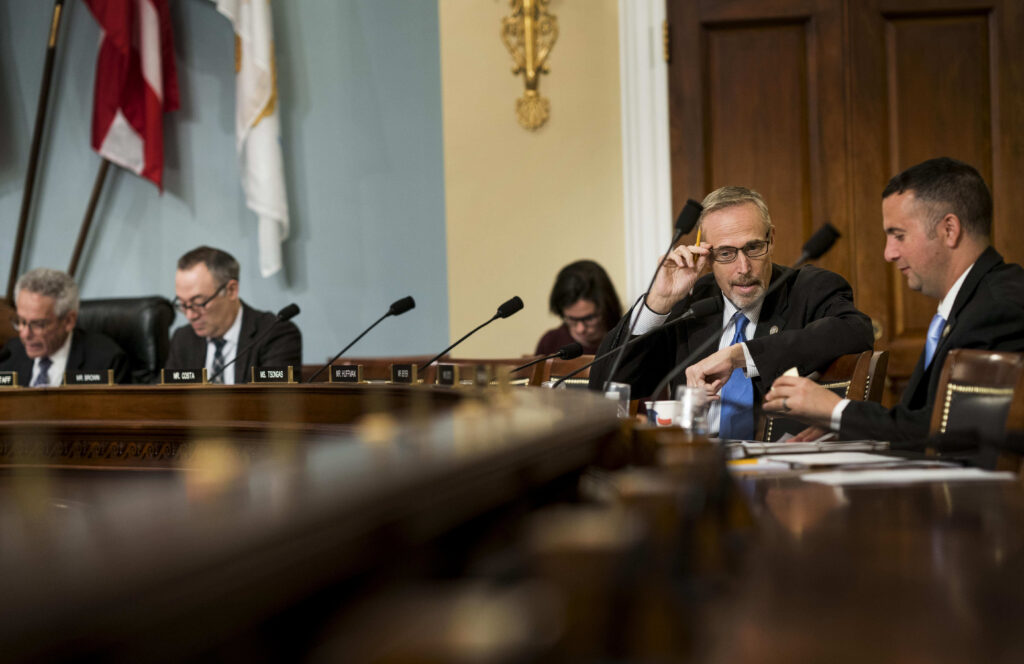
Four questions for … Rep. Jared Huffman, a California Democrat who has served in Congress since 2013 and made history in 2017 when he became the second known member of Congress to publicly identify as nonreligious.
Huffman grew up practicing an offshoot of Mormonism and says his early experiences with religion made him concerned about religious extremism, particularly about what he sees as the rising threat of Christian nationalism. It is a conservative view of Christianity that holds the government should promote right-wing Christian views in its policies, while excluding or minimizing the influence of other religious traditions — even while acknowledging that conservative Christians represent a minority in the nation.
Many Christian nationalists see President Donald Trump as divinely appointed. And their merging of politics and religion has led to violent rhetoric, threats and acts of violence from right-wing religious extremists in recent years. Christian nationalists were present at the Jan. 6, 2021 storming of the Capitol, where some rioters prayed in the Senate chamber after breaking in and others engaged in what they called a “Jericho March” around the Capitol, praying for the election results to be overturned. (In the Bible, God brought down the walls of the city of Jericho after having the Israelites march around the city and blow horns.)
Figures like former Georgia Rep. Marjorie Taylor Greene (R) and Sen. Josh Hawley (R-Missouri) have embraced the Christian nationalist label, while others — like Trump himself — have appropriated their rhetoric without using the term. This summer, the Trump administration sponsored a prayer festival to rededicate the United States as “One Nation under God” — a nod to the phrase added to the Pledge of Allegiance in 1954 and Christian nationalists’ Christian-centric view of the role of government.
As Christian nationalism is having something of a renaissance, I spoke with Huffman — who has a new book on Christian nationalism — about what the lawmaker thinks needs to be done to maintain religious freedom in America and why he’s wary of Democrats signing on to “theocracy light” in their pursuit of Christian voters in the midterms and beyond.
This interview has been edited and condensed for length and clarity.
Why did you decide to write this book now?
I really thought January 6th would be the reckoning. It would wake people up to this [Christian nationalist] movement, and it just wasn’t.
I’ve watched the movement get stronger and more militant since January 6th and I felt compelled to do something. … There have been a lot of books on Christian nationalism, but nobody has taken folks inside the highest level of government.
What do you think Americans broadly, and maybe politicians specifically, need to know about Christian nationalism?
I think really the first and most important action is understanding the threat.
This is not even the right-wing Christianity of a generation ago. There has been a sea change, and the 1990s were just this transformative time for right-wing Christianity: Everything changed. The religion changed, especially for Evangelicals. But the politics changed, too.
[Previously, right-wing Christians argued that] a majority of Americans [were] ready to support the right-wing Christian religious agenda if they were just mobilized through the democratic process. When they lost the culture war, [right-wing Christians] figured out, ‘For two decades we’ve been wrong. And it is time to embrace non-majoritarian strategies, anti-majoritarian strategies.’
You’ve spoken about the importance of the separation of church and state. What are some policies you would like to put in place to maintain that separation?
When it comes to the secular guardrails of our democracy, I’m not sure we need any new laws. I think between the First Amendment Establishment Clause and Article 6 [stating that the U.S. can’t have religious tests as a requirement for holding office], we have what we need. We have just allowed them to be undermined and compromised in so many ways for so long that it is going to be a challenge, I think, to reclaim them.
I would love to see a Supreme Court that is more serious about defending actual religious freedom, which includes the Establishment Clause. They’re well on their way to reading the Establishment Clause out of the Constitution.
There’s an idea floating around in the Democratic Party right now that there’s a need to try to attract Christian voters who may not feel like they have a home in the current Democratic Party. What are your thoughts on that as a humanist?
I’m rooting for them. I hope that the Matthew 25 version of Christianity prevails over the Rambo Christianity. But what we can’t do as Democrats is sign on to theocracy light, where we don’t draw the line that needs to be drawn between church and state. We really need to keep that faith debate in a different lane. … That’s really the key that my Democratic colleagues need to understand because they have wittingly or unwittingly kind of enabled the chipping away at church-state separation over many years.
Want this in your inbox?
Start your day with The Washington Post’s flagship political newsletter. Sign up here.
Our picks
- Trump makes case for Iran war, promises $5,000 payouts if GOP wins midterms, from Isaac Arnsdorf and Natalie Allison.
- Democrat’s ad about tragic pregnancy injects abortion into tight governor’s race, from Molly Hennessy-Fiske.
- Supreme Court is asked to settle Missouri dispute causing electoral chaos, from Justin Jouvenal and Gregory S. Schneider.
- Trump administration proposes changes to census that could exclude millions, from Amy B Wang.
- See how Canada is shifting its trade beyond the U.S., from Luis Melgar and Rachel Lerman.
- Political world erupts as AI researchers warn of ‘extinction’ threat, from Miriam Waldvogel and Ian Duncan.
What we’re watching
The goal of the Republican midterm convention in Dallas is to elevate the party’s candidates on the ballot this year.
In reality, the event seems more about elevating someone whose last election is behind him.
“Stand for the President Donald J. Trump!” Sen. Tim Scott (R-South Carolina) bellowed during his speech, just one of many moments that highlighted how the convention was largely about the president.
Our colleague Anna Liss-Roy captured this well in her piece about how, for many attendees, Trump — not the midterm candidates — is the draw.
Trump’s speech, his first of two in the two-day event, tried to turn his record into a positive for Republicans on the ballot, but in doing so, he highlighted the tension of these midterms.
“When I am on the ticket, Republicans always do very well,” Trump said before acknowledging that the “midterms are not supposed to be won by the sitting president.”
“We are going to change that,” he added, before imploring people to “pretend that I am on the ballot,” adding that he plans to travel repeatedly to battleground states. “I am going to go to every one of those states for congressmen and for senators,” he said.
The vast majority of Trump’s remarks, however, were about him. He bragged about how his vote totals in Texas, dabbled in election denialism by saying he won the presidency three times and shouted out the MAGA diehards that were in the audience.
There was other news. Sen. John Fetterman, a Democrat from Pennsylvania, introduced Sen. Dave McCormick, a Pennsylvania Republican, in a video shown to the audience. “Yes, he’s in a different party, but I’m proud to count him as my friend,” Fetterman said.
But hanging over the entire event is the question: Who is really watching this? Some of the speeches were pushed for social media consumption, and several television outlets went live from Dallas.
But both nights of the convention will go up against the first two National Football League games of the season, leading some Republicans to openly wonder whether the convention will really reach an already skeptical public.
In your local paper
The Almanac (California): $10 million for dirt is a remarkable phrase — but as this paper reports, “AI wealth and return-to-office mandates are reshaping the fall housing market” in extraordinary ways.
Portland Press Herald: It’s never good when your family won’t vote for you. In Maine’s gubernatorial contest, Republican Bobby Charles’s sister says she will vote for Democrat Hannah Pingree.
Minnesota Reformer: Operation Metro Surge — the sweeping federal immigration enforcement in Minnesota that roiled the community when it began last year — has altered the local business landscape, especially in the Midwest’s Latino communities.
From you
I received a ton of emails when I asked how you feel about using AI-generated images or video in political ads.
The vast majority — nearly all of you — said its use was unfair and should be outlawed.
“I believe ALL AI-generated content should be labeled and dated,” wrote Mary Roland. “Using AI-generated content as Paxton is allows for posting personal opinion or false information as though it were true. That is very dangerous to our democracy. Very dangerous.”
And Toni Carpenter added, “The use of AI to generate deepfake images of living persons should be prohibited in all cases, but especially in political ads. The only reason to do so would be to create a false narrative and present it as real. In the big picture, anyone who would ‘approve this ad’ is unethical.”
Not all agreed. “If it is based on facts and gives truthful info it’s ok,” wrote Richard Head.
Morgan Thompson suggested passing legislation “to essentially copyright everyone’s body and voice, making them unavailable to AI manipulation without their explicit consent and approval of the end product.”
And then there is Dan Silva, who effectively sent a shrugging emoji.
“So many Americans have little to no trust in politicians that I don’t think it matters,” concluded Silvia.
Send a reply
Nothing is more popular in the United States than the NFL, which kicked off last night, the same time as the first night of Republicans’ midterm convention. A simple question: Which did you watch? Either? Both? And why? Let me and your fellow Early Brief readers know at [email protected].
Thanks for reading. You can follow me on X at @merica.
The post Meet the lawmaker who’s worried about Christian nationalism appeared first on Washington Post.